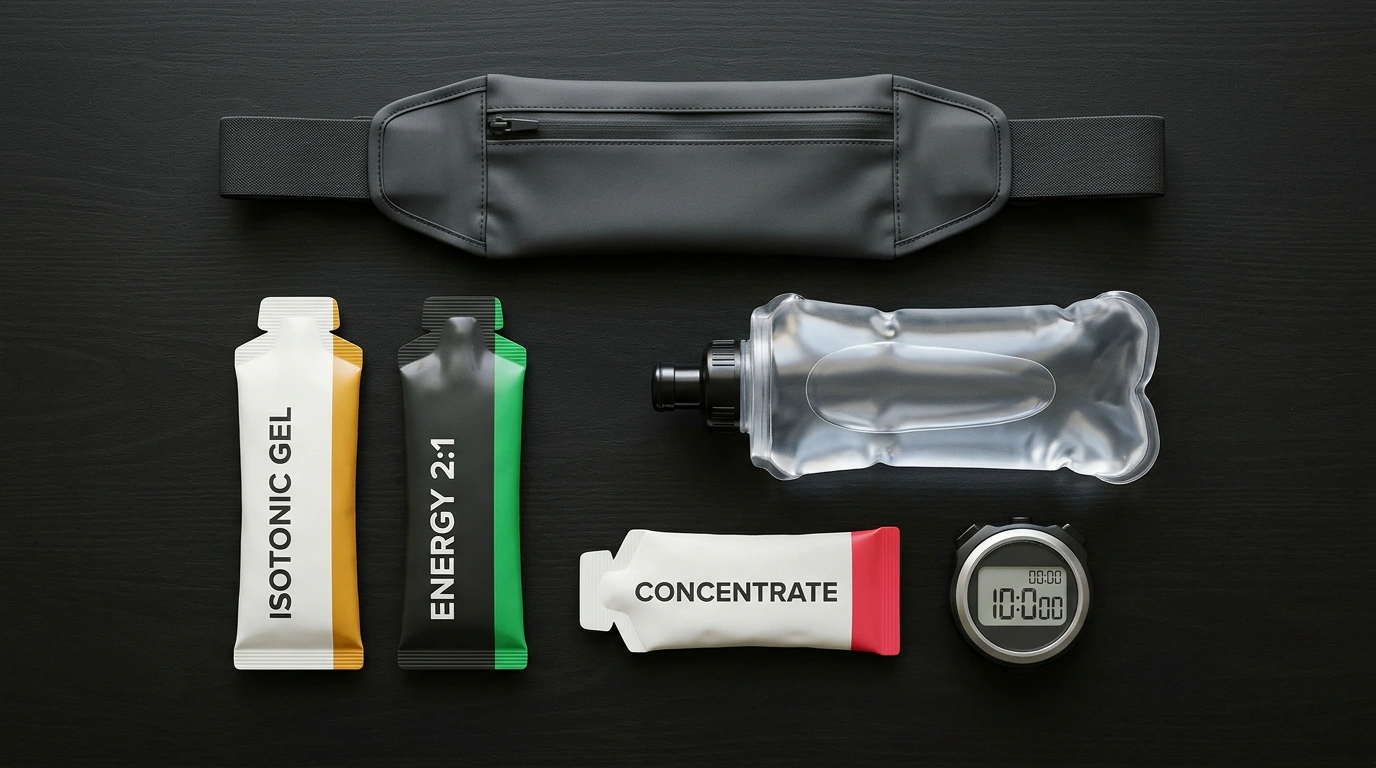
In races up to a half marathon, fueling almost runs on autopilot: tuck one trusted cola-flavored isotonic gel into your shorts pocket, knock it back on the move, and cruise through the finish arch without queuing at water tables.
Before a marathon or an ultra, though, a handful of bright packets from the race expo turns into a gamble: why does one tube put spring back in your legs while another knots your stomach ten minutes later? I looked at a five-gel field test from the Begat Prosto (Running Simply) channel ahead of the Comrades ultramarathon and cross-checked it with sports physiologist Asker Jeukendrup's research. Let's see how to match fuel to your pace without wrecking your gut.
Two Turnstiles for Energy: Why Gels Blend Maltodextrin and Fructose
Muscle and liver glycogen stores (around 400–500 g, or 2,000 kcal) last for 75–90 minutes of hard running—we covered how to ration that starting tank in Ingrid Kristiansen's marathon pacing story. Beyond that, carbs have to come from outside, and that's where the first trap waits: relying on gels made only with glucose or maltodextrin.
Picture the wall of your small intestine as a subway entrance. Glucose and maltodextrin share a single turnstile (the SGLT1 transporter) that maxes out at 60 g/h. Anything eaten past that cap backs up in a traffic jam and ferments in your gut. Professor Asker Jeukendrup described the workaround in Sports Medicine: adding fructose in a 2:1 or 1:0.8 ratio opens a second, independent lane (GLUT5).
Running both routes raises carb absorption to 90–120 g/h and speeds up water uptake too.
Pace-Tested in the Field: Liquid Isotonics vs. Thick Concentrates
The Begat Prosto author made a habit of spending 5 minutes after each run jotting down notes on every gel:
- Liquid isotonics (
GU Liquid Lemonade). The water-based formula needs no chaser and goes down easily at 3:30 min/km, though the bulky packets fill pockets fast. - Nootropic blends (
SiS Betafuel Nootropics). Taken 15–20 minutes before a 10K start (finishing in 34:14), it helped keep focus sharp through the final kick. - Thick and high-fructose formulas (
Nutrend Carbosnackand226ERS High Fructose). Coffee-flavoredNutrendheld up well on evening intervals and a 4:04 min/km half marathon, though its thick texture demands water. Meanwhile,226ERSin Speculoos cookie flavor felt cloyingly sweet and thirst-inducing even on an easy 10.5 km jog.
The sneakiest trap is trusting the label blindly: salty Sponser Liquid Energy Salty, despite the word Liquid on the packet, turned out to be a sharp concentrate that still has to be chased with water.
The print on a wrapper never replaces testing at your own heart rate.
The Osmolarity Trap: Why Unwashed Syrup Knots Your Stomach
Blood plasma and isotonic gels have a particle concentration (osmolarity) of 290–300 mOsm/kg, so they clear the stomach quickly. Thick syrups exceed 500–800 mOsm/kg. At high heart rates, blood flow to the gut drops by 50–70%, and an undiluted concentrate acts like salt on sliced cucumbers—by osmosis, it pulls fluid out of blood vessels into the intestine, triggering cramps and nausea. Every 25–30 g of carbs from a thick gel needs 150–200 mL of water.
A safe caffeine dose is 3–6 mg/kg of body weight: caffeinated gels from the opening miles risk jitters and GI distress, so save them for the final third. Also, 15–20% of people have lower fructose-transporter activity, making pre-race testing essential.
Race-Day Strategy: Spacing Your Gels and Training Your Gut
Your gut adapts in 6–8 weeks: if you regularly practice taking carbs on long runs, the number of active transporters increases and cramps fade (for the rest of your pre-race checklist, see our protocol for handling pre-start nerves).
Before your next run lasting over an hour, pack two different gels—a liquid isotonic and a thick concentrate—test one on the move while chasing the dense gel with water, and jot down taste, thirst, and stomach notes on your phone right after your cooldown.