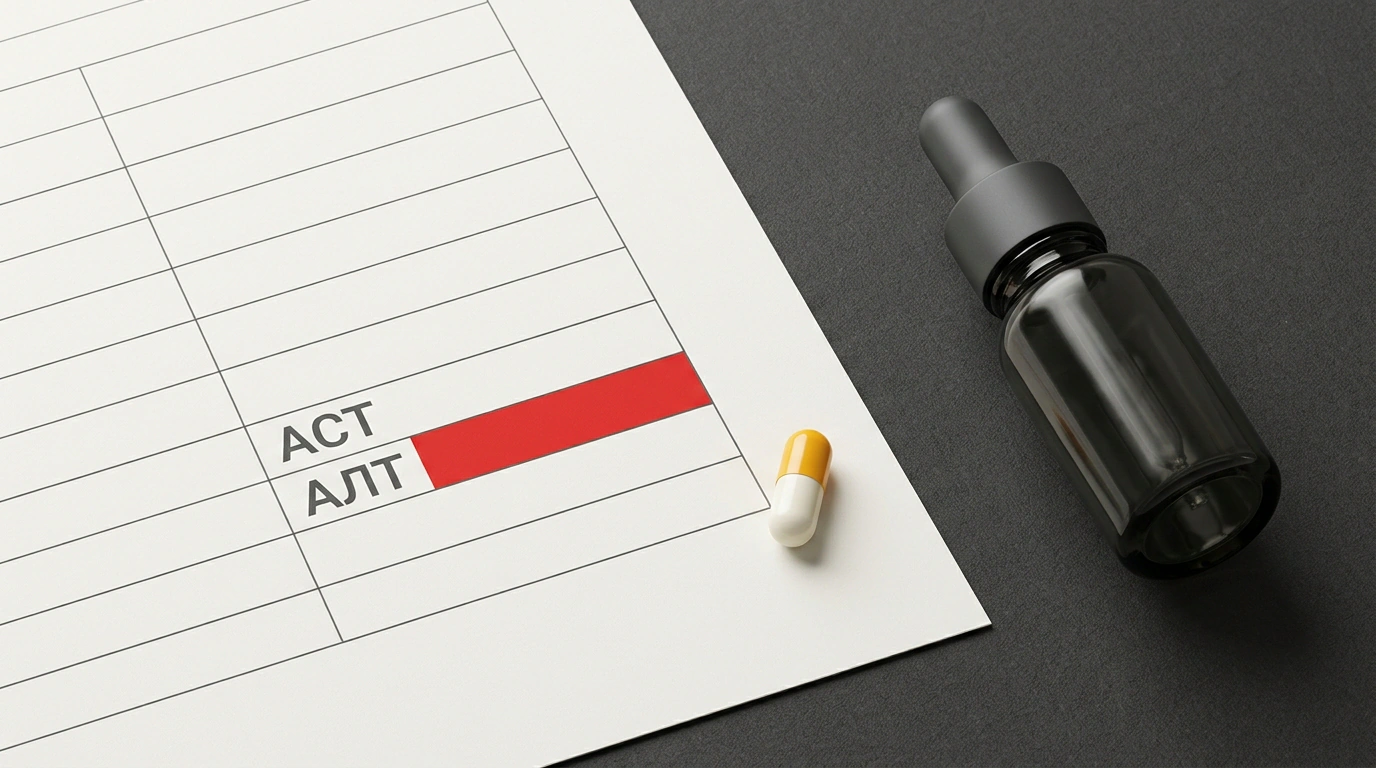
"Doctor, will my liver survive a statin?" That's how cardiologist Alexey Utin titled his breakdown on patients who start cholesterol therapy and nervously open their first blood panel. You see a red flag next to ALT or AST, and your first instinct is to shove the pills to the back of the drawer. Sometimes even doctors pull the drug in that spot. Meanwhile, hepatologists are actively testing whether statins help people who already have liver cirrhosis.
Where red ALT and AST numbers come from early in treatment
Let's look inside a liver cell. ALT and AST, which doctors call transaminases, are working enzymes inside liver cells, or hepatocytes. When those cells are calm, only a tiny trace enters your bloodstream.
A rise in transaminases is indeed one of the rare real side effects of statins. Out of 65 reactions listed on the package insert, only about five actually trace back to the drug in practice. During the first weeks of treatment, hepatocyte membranes temporarily become slightly more permeable, letting some enzymes slip into the blood. The cells themselves aren't dying; the organ is simply adapting to a new medication.
In clinical trials, a symptom-free bump in ALT or AST above three times the normal limit shows up in 1–3% of participants, mostly at maximum doses. In a joint interview with Utin, hepatologist and Rassvet Clinic chief physician Tatyana Rozina points out a telling detail: when statins are compared against a placebo, that rise happens at roughly the same rate—about 1% in both groups.
Serious drug-induced liver injury is extraordinarily rare. According to estimates from the American College of Cardiology and the American Heart Association cited by Utin and backed by the 2019 AHA scientific statement, a severe reaction occurs in roughly 1 in 100,000 people. Acute liver failure shows up at about 1 case per million person-years, matching the background rate in the general population. The fear that your liver will "quietly fall apart without pain" is also unfounded. Rozina notes that real liver damage always shows up on blood biochemistry, which doctors can check in the first 1–3 months if needed.
The main trap: why skipping a 'before' test always blames the statin
Here's how the trap springs in real life. You take a statin for a month, get blood drawn, and see elevated ALT and AST. If you don't have a lab sheet from before your very first pill, the medication automatically becomes suspect number one. Yet those enzymes could have been high long before you ever visited a cardiologist.
Doctors constantly see three causes for that spike that have nothing to do with statins. The first and most common is excess weight and metabolic dysfunction-associated steatotic liver disease (MASLD, formerly known as NAFLD). When fat droplets build up in liver cells, transaminases can stay elevated for years without any pills.
The second cause is straightforward: alcohol a day or two before your lab visit, which forces the liver to divert its resources to processing it.
The third trap fools even people who never drink: a tough gym session or deep-tissue massage the day before blood work. Tatyana Rozina specifically warns patients to skip heavy muscle strain and massage right before testing. After intense effort, both AST and the muscle enzyme CK (creatine kinase) spill into the bloodstream. In that case, the AST comes from tired muscles, and adding a CK test lets a doctor tell a muscle trace from a liver signal right away.
Before your first statin pill, get a baseline biochemistry panel: ALT, AST, bilirubin, and alkaline phosphatase. If a red number pops up later, bring both reports—the baseline and the latest one—to your visit. Stopping a statin on your own is dangerous because you lose protection against heart attack and stroke, whereas two lab sheets immediately show whether anything actually changed after you started.
The three-limit rule: how doctors separate a harmless bump from real trouble
One ALT line on its own isn't enough for a doctor, so they evaluate two other lab markers alongside how you feel. The upper limit of normal (ULN) is the cutoff your lab prints next to your result. Bilirubin is a bile pigment that turns skin and the whites of your eyes yellow when the liver can't clear it fast enough. Alkaline phosphatase rises when bile flow through the ducts is blocked.
Under ACC and AHA rules, a bump in ALT or AST below three times the upper limit of normal is considered benign as long as bilirubin and alkaline phosphatase stay calm and you have no symptoms. You keep taking the statin and recheck enzymes in 4–6 weeks, by which time they usually drift back to baseline.
Testing blood biochemistry every month without symptoms isn't necessary either. The AHA statement clarifies that frequent routine checks in people who feel fine don't catch rare acute reactions early. A baseline test before starting and a repeat test if symptoms appear or earlier abnormalities need follow-up are enough.
Doctors change course when ALT or AST stay above three times the normal limit on two consecutive tests, or when bilirubin and alkaline phosphatase climb. At that point, your doctor looks for other causes, may lower the dose, switch to a different statin, or pause therapy temporarily.
Contact your doctor without waiting for a scheduled visit if you develop signs of liver trouble while taking a statin:
- yellowing of your skin or the whites of your eyes;
- noticeably dark urine or unusually pale stools;
- severe unexplained weakness, nausea, or heaviness and pain under your right ribs.
This article is for information only: your treating physician makes decisions about prescribing, switching, or stopping a statin.
Fatty liver, cirrhosis, and the SACRED trial: where the safety line sits
Hepatologist Tatyana Rozina calls the belief that statins are strictly forbidden in liver disease one of the most stubborn myths in medicine. According to the 2024 EASL–EASD–EASO European guidelines, a modest baseline rise in liver enzymes from fatty liver disease doesn't rule out statins. On the contrary, people with MASLD face higher cardiovascular risk, so controlling cholesterol gives them a double win.
In large observational cohorts of chronic liver disease, statin use has been linked to a 33% lower risk of liver cancer and a 22% lower risk of liver failure. Still, observational data only shows a statistical link and can't prove the pill itself caused the drop.
To test the idea in a strict experiment, researchers ran the randomized SACRED trial led by David Kaplan, presented at the AASLD congress in November 2026. The study enrolled 142 patients with high-risk compensated cirrhosis, meaning part of the liver had turned into scar tissue, but the organ still handled its daily workload without major failure. Participants were randomly assigned to 40 mg of simvastatin a day or a placebo for up to two years.
Cirrhosis complications—including abdominal fluid buildup, encephalopathy, and bleeding from esophageal varices—plus liver cancer developed in 7 of 78 people on simvastatin (8.97%, or about 9%). On placebo, those events occurred in 12 of 64 patients (18.75%, or nearly 19%). Liver cancer alone appeared in 2.6% versus 7.8%. The hazard ratio came out to 0.41 with p = 0.064, just missing the classic 0.05 significance threshold due to the small number of events, and overall survival didn't differ between groups.
Proving that statins prevent cirrhosis complications will require larger trials like the ongoing RESCU study with rosuvastatin. What SACRED did confirm is simvastatin's safety: serious adverse events were actually slightly lower on the active drug than on placebo. That's why doctors prescribe statins in compensated cirrhosis when cardiovascular risk calls for heart attack and stroke protection. In decompensated cirrhosis—when fluid has already built up in the abdomen, jaundice has appeared, and the liver struggles to process drugs—any therapy decision is made strictly case by case with a hepatologist.
