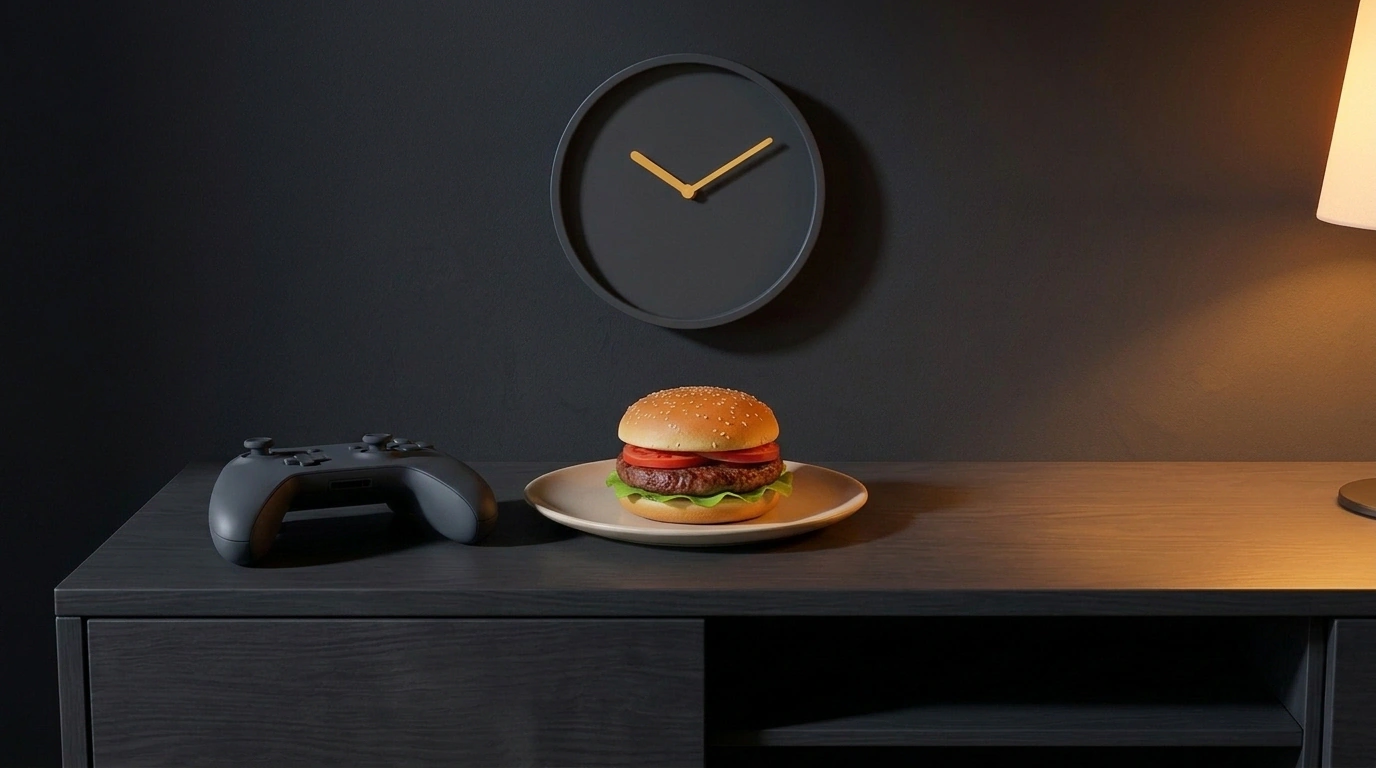
GTA 6 launches on November 19, bringing back character body-change mechanics. As dietitian Alexander Burlakov notes on his channel "Borodaty ne proboval...", Jason and Lucia will once again gain weight from food, bulk up at the gym, and look worn down from lack of sleep, much like CJ in San Andreas.
That contrast highlights just how far an on-screen status bar drifts from real human metabolism. Burlakov pulled together six studies to compare four classic game scenes with how a living body actually responds.
A burger for dinner and five minutes with a barbell
In San Andreas, you duck into Burger Shot, eat one burger, and your fat meter ticks up immediately. In real life, a single fast-food meal doesn't move the scale. Building one kilogram of body fat requires a sustained calorie surplus—eating more than you burn—of roughly 7,700 kcal above your daily maintenance. At 500 kcal a burger, you'd need around fifteen of them on top of your normal meals.
Even that number is only a rough ballpark. Kevin Hall tested the old "3,500 kcal per pound" rule using a mathematical model in the International Journal of Obesity and showed that the calorie cost of a kilogram depends on how much fat you already carry. In someone with 30 kg or more of fat mass, the classic formula holds fairly well. In leaner people, muscle tissue changes faster, so each kilogram costs fewer calories.
With the gym, the gap is even wider. In a game, a few barbell sets widen your shoulders on the spot, whereas real muscle hypertrophy—fiber growth—moves slowly. A review in IJERPH pooled 111 trials covering 1,927 healthy men and found that regular strength training added an average of about 1.53 kg of muscle over weeks and months. Numbers vary for women and athletes at different levels, yet the pace stays gradual. Doing too many sets in a single session even slowed growth in that review: your body needs a manageable schedule and recovery time.
Quiet traps: snacking at a screen and short nights
In reality, weight trouble hides where game logic goes silent. A character eats only when you press a button, while a person at a monitor easily loses track of snacks. In an experiment in the American Journal of Clinical Nutrition, young men played video games for an hour with chips and soda within reach and ate an average of 655 kcal more than they burned.
Gaming itself doesn't burn off that snack. In a companion study by the same team in Medicine & Science in Sports & Exercise, researchers measured energy burn in 100 volunteers aged 18 to 35 across genres. Seated controller shooters weren't statistically different from resting: energy expenditure rose 23% to 0.91 METs, nearly couch level. Fitness and dance games pushed burn to roughly 3 METs, though participants enjoyed them less.
A second leak opens after a short night. According to a meta-analysis of 11 randomized trials on 172 people in the European Journal of Clinical Nutrition, cutting sleep raised calorie intake by an average of 385 kcal per day without increasing resting metabolism or total energy burn. People made up those extra calories with fatty foods while eating a lower share of protein. A second meta-analysis in Sleep Medicine Reviews confirmed stronger hunger and lower insulin sensitivity. Burlakov's breakdown summarizes that shift as 250 to 385 extra calories a day.
Three boring rules with no cheat codes
One burger on launch day won't ruin your shape, so beating yourself up over an occasional dinner makes no sense. Over months, your body reflects the habits you repeat every week.
First, separate eating from screens: keep snacks and sugary soda away from your keyboard or controller so you eat at a table and notice when you're full. Second, protect your night's sleep, which curbs daytime cravings for fatty snacks better than any willpower rule. Finally, stick to a steady workout schedule and stand up to stretch now and then during long gaming or work evenings.