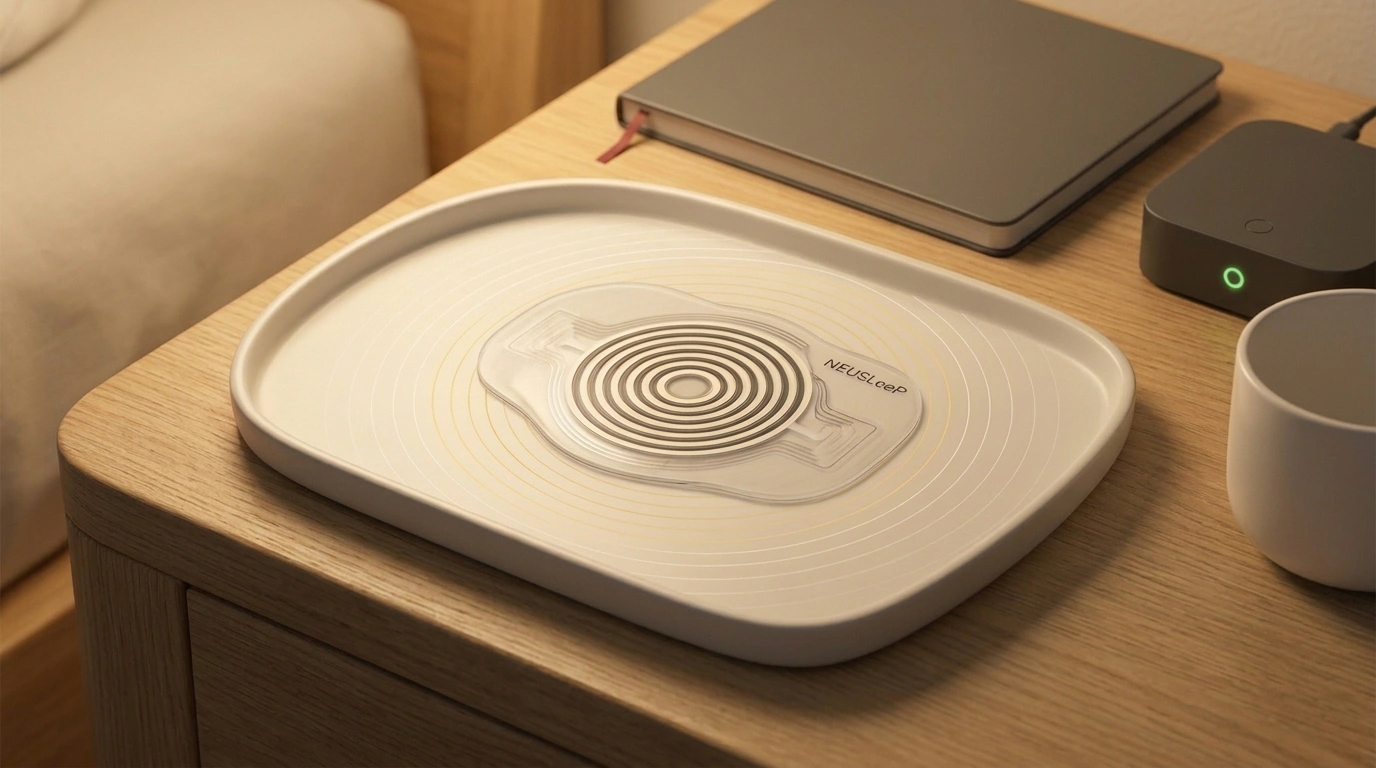
In June 2026, engineers and medical researchers at the University of Texas at Austin published a study in Nature Communications. They introduced NEUSLeeP, a soft silicone patch that sticks to your temple, tracks your sleep stages, and sends focused ultrasound pulses deep into your brain during the night. In a pilot trial with 28 volunteers, REM sleep arrived an average of 43 minutes earlier and lasted longer. All of this happened without pills, a bulky helmet, or surgery.
It sounds like a dream for anyone staring at the ceiling at 2 a.m., counting the hours left before the alarm goes off. Yet behind that eye-catching headline sits a much more interesting and nuanced story. Look closely at the study itself (registered on ClinicalTrials.gov as NCT07190287), and you'll see both a genuine engineering breakthrough and a clear limit: the nervous system of people with insomnia didn't respond the way researchers hoped.
Let's break this down without hype or heavy biochemistry. Why did scientists aim ultrasound seven centimeters inside the skull, how does the patch work, what happened over two nights in the lab, and why won't you find this gadget at a pharmacy anytime soon?
Why Boosting REM Sleep Without Surgery Was Almost Impossible Before
Sleep problems are far from rare. According to US Centers for Disease Control and Prevention (CDC) data cited by the authors, roughly 14.5% of adults struggle with them regularly. When poor sleep drags on for months, morning energy drops, memory and focus suffer, and chronic exhaustion makes anxiety and depression much harder to manage.
There are already plenty of ways to nudge sleep. The catch is that each option hits a hard ceiling.
Sleeping pills like zolpidem or benzodiazepines help you fall asleep faster, but they act like a blunt master switch. People often wake up groggy, feel sleepy during the day, lose focus, and face a risk of dependence with long-term use. Pills also can't target a single sleep stage without affecting the rest.
Drug-free attempts using surface brain stimulation ran into basic physics. Transcranial direct current stimulation (tDCS), transcranial magnetic stimulation (TMS), and acoustic pulses through headphones reach the outer layer of the brain, the cortex, fairly well. Scientists have used them to boost deep slow-wave sleep (NREM), when the body repairs tissue and clears metabolic waste. However, switching between sleep stages—and especially running the emotional phase of sleep—depends on structures buried deep beneath the cortex. Surface electrodes simply can't reach them because the signal scatters along the way.
For years, the only way to target those depths was deep brain stimulation (DBS). Neurosurgeons implant thin electrodes directly into specific brain nuclei, most often for patients with Parkinson's disease. Over a decade ago, doctors noticed an intriguing side effect: stimulating the tiny subthalamic nucleus (STN) noticeably improved REM sleep. Its share of the night rose by 1.3% to 6.2%, and it started about 15 minutes earlier.
You can see the obvious problem. Nobody in their right mind would drill into their skull just for better sleep. That left transcranial focused ultrasound (tFUS), a method that sends weak sound waves through the skull to a spot a few millimeters wide without heating or cutting tissue. The snag was hardware: standard brain ultrasound rigs look like heavy laboratory frames. They clamp the head completely still, making it about as easy to fall asleep as dozing off in a dentist's chair with your mouth wide open.
That is the engineering wall the Texas team set out to break. They wanted an ultrasound device soft, flat, and light enough for someone to lie on a pillow and sleep through an eight-hour night.
How the NEUSLeeP Patch Works and Where It Aims
Sleep isn't one uniform state. A normal night cycles between non-rapid eye movement sleep (NREM) and rapid eye movement sleep (REM). During NREM, the body repairs muscle, balances hormones, and tidies up metabolism. During REM, your eyes dart rapidly under your eyelids, your body muscles switch off so you don't act out dreams, and your brain runs vivid stories while processing daily emotions. REM sleep is what helps you digest stress and file away emotional memories.
A chain of deep subcortical hubs controls the switch into REM sleep. Right in the middle sits the subthalamic nucleus (STN), a small node in the basal ganglia tucked roughly seven centimeters inward from your temple. It connects to both emotional centers and the brainstem, which triggers transitions between sleep stages.
Location of the basal ganglia and subthalamic nucleus deep inside the brain (Source: Wikimedia Commons, CC BY-SA 3.0)
To track sleep stages and beam ultrasound straight into the left subthalamic nucleus at the same time, the Texas engineers built NEUSLeeP as a three-layer sandwich. Each layer solved an everyday problem that made earlier prototypes fall apart within hours.
The first layer is a sticky silicone base called Eco-PEIE-Gel. Regular soft silicone feels nice, but it peels right off skin the moment you roll onto your side. By adding 5% polyethyleneimine (PEIE) to the silicone, the team boosted skin adhesion twentyfold, matching medical tapes like 3M Tegaderm. The material stays soft, causes minimal skin irritation over an eight-hour night, survives reapplication, and barely blocks the ultrasound wave.
The second layer consists of transparent hydrogel electrodes (ASG). Anyone who has done an overnight polysomnography test remembers the hassle: a cap with thirty wires and sticky conductive gel smeared into your hair that takes two days to wash out. NEUSLeeP uses just six soft glycerol-hydrogel electrodes. Four record brain waves (EEG), one tracks eye movement (EOG), and one measures muscle tone (EMG). The gel is clear, doesn't stain hair, and doesn't dry out overnight. To prove six sensors could reliably score sleep, three volunteers slept wearing both NEUSLeeP and a standard 32-channel cap. A certified sleep specialist scored the records blind, and the agreement was nearly identical (Cohen's kappa of 0.88).
The third layer is the CRUTA ultrasound array. It packs eight thin piezoelectric rings nested inside one another like a bullseye. The array is just 3.5 millimeters thick (about 80% thinner than conventional probes), and the whole patch weighs around 103 grams. How do you steer the depth of a flat disk? Engineers adjust tiny timing delays between the rings. Waves from the outer and inner rings meet at the exact target depth—an average of 72 millimeters from the temple skin—passing through the thin temporal window of the skull straight to the left STN.
One delicate question remained: what pulse frequency to use. Preliminary MRI tests revealed a neat split. Slow pulses at 10 Hz excited the subthalamic nucleus. Raising the frequency to 100 Hz (similar to surgical DBS, which usually runs at 60–120 Hz) gently inhibited the nucleus and reshaped activity in neighboring basal ganglia hubs. The team chose this inhibitory 100 Hz mode for the overnight trial.
Two Nights in the Lab: What Changed for 28 Volunteers
Next came testing on real people. Researchers recruited 28 young volunteers aged 19 to 38, evenly split between men and women. Using the Pittsburgh Sleep Quality Index (PSQI), they divided them into two groups:
- 16 healthy sleepers with no sleep complaints (PSQI score below 5);
- 12 people with insomnia symptoms (PSQI score between 6 and 10; notably, these were questionnaire-based complaints rather than a clinical diagnosis of severe chronic insomnia).
Before sleeping, each participant had a standard brain MRI while wearing a 3D-printed dummy patch on their temple to measure the exact angle and depth to the left STN. Then they spent two consecutive eight-hour nights in the University of Texas sleep lab.
Night one was always a sham night: the patch was stuck on and wired up, but the ultrasound stayed off. Night two was the active night: every 90 minutes (matching a natural sleep cycle), the system ran a five-minute stimulation block—alternating 30 seconds of 100 Hz pulses with 30 seconds of pause, totaling five blocks overnight.
Here is a clever practical detail from the methods. At 100 Hz, the piezoelectric array makes a faint high-pitched chirping sound. To stop participants from guessing whether the device was on, a white-noise machine (kept under 60 decibels) played both nights with a matching 100 Hz background hum mixed in.
Out of 28 participants, 26 sleep recordings made it into the final polysomnography analysis (15 healthy sleepers and 11 with insomnia symptoms), as two nights had to be discarded due to severe electrode noise. Here is what the blinded sleep scorer found.
First, the share of REM sleep rose by an average of 4.6 percentage points, climbing from 16.3% to 20.9% of total sleep time. In real-world minutes, that is roughly 16 extra minutes of REM sleep per night. This gain was statistically reliable in both groups: healthy sleepers and people with insomnia complaints alike.
Second, REM sleep started earlier—an average of 43 minutes sooner across the whole group (24% faster than on the sham night). That is the headline figure that traveled everywhere. Yet when you split the numbers by group on a chart, a much more honest picture emerges.
Minutes from falling asleep to first REM episode (REM latency)
The contrast is striking. Healthy participants drove almost all of that headline 43-minute drop. Their first REM episode genuinely arrived much sooner, and the statistics backed it up. In the insomnia group, the delay shrank on paper, but individual results varied so widely that there was no statistically significant speedup.
On the bright side, ultrasound didn't disrupt the rest of the night. Awakenings didn't increase, overall sleep efficiency (the share of time in bed actually spent asleep) stayed around 80%, and deep NREM sleep didn't drop. The patch added REM sleep without stealing time from other stages.
The Morning Divide: Why Healthy and Insomniac Nervous Systems Reacted Differently
The experiment didn't end when volunteers woke up. Each morning, researchers recorded a five-minute ECG to measure heart rate variability (HRV), then placed participants in a functional MRI scanner for the Hariri emotional face-matching task. Volunteers saw angry, fearful, happy, or neutral faces alongside simple geometric shapes and had to match pairs quickly.
Why measure HRV? A calm, healthy heart doesn't beat like a Swiss metronome; the gaps between beats vary slightly from one beat to the next. Higher morning HRV means your parasympathetic nervous system—the body's brake pedal for rest and recovery—did its job well overnight. Lower HRV suggests your body is still stuck in fight-or-flight mode.
Here, the two groups went in completely opposite directions.
In healthy participants, morning HRV jumped by an average of 41.5% after the ultrasound night (compared with a slight 5.9% dip after the sham night). On the fMRI task, they recognized angry and fearful faces faster, and excessive emotional reactivity quieted down in deep midbrain nuclei on the stimulated side. For healthy sleepers, the textbook link held true: more REM sleep led to a calmer nervous system the next morning.
For people with insomnia symptoms, that magic broke down. Morning HRV didn't rise at all after ultrasound, and statistical analysis confirmed a clear divergence between the two groups. Speed on the emotional face task didn't improve either. Even more telling, fMRI scans showed that participants with insomnia already had hyperactive amygdalas (the brain's main alarm center for fear and threat) on both sides. After the ultrasound night, left amygdala reactivity to angry faces actually increased.
Infographic cross-section of the morning physiological contrast: calm heart rate variability in healthy sleep versus an overactive amygdala contour in insomnia.
Why did this happen? In their discussion, the researchers offer a grounded physiological explanation. Insomnia is rarely just a shortage of 15 minutes of REM sleep. In people with disrupted sleep, the nervous system often runs in a state of chronic hyperarousal: baseline sympathetic (stress) tone stays elevated, heart rate and body temperature drop less overnight, and hidden micro-awakenings fragment sleep even when you don't remember them in the morning.
Imagine a building where the fire alarm has been blaring for six months. Turning down a single sensor on the second floor for one night won't reset the whole alarm system. Something similar happened here: one night of local ultrasound to the subthalamic nucleus extended REM sleep, but it couldn't switch an overrevved autonomic nervous system back into rest mode.
Safety and Four Honest Caveats From the Authors
In this short test, safety looked clean. While the device ran, researchers continuously monitored heart rate, blood pressure, and blood oxygen saturation, and none of those metrics budged. Skin under the silicone patch showed barely any redness, and a follow-up check one week later turned up no delayed complaints like headaches or dizziness.
Still, there is a wide gap between 'safe in a pilot' and 'proven to treat insomnia.' Good science differs from marketing by listing its own weak spots. The Nature Communications authors highlighted four serious limitations that are worth reading closely.
First caveat: the 'first-night effect.' The researchers didn't randomize the order of nights: Night 1 was always sham, and Night 2 was always active ultrasound. They had a practical reason: nobody knows how many hours or days ultrasound aftereffects linger in the brain, so putting the active night first could have tainted the sham night. Still, that choice has a well-known cost. Sleep medicine has long documented the 'first-night effect': in an unfamiliar lab room with wires attached and an infrared camera overhead, almost everyone sleeps worse on Night 1 and deeper on Night 2 simply from getting used to the bed. With this setup, there is no way to separate how much of those 16 extra REM minutes came from ultrasound versus normal adaptation.
Second caveat: single-blind design. Volunteers didn't know whether the patch was active, but the lab staff did. In evidence-based medicine, the gold standard is a double-blind trial with a separate control group, where neither participants, staff, nor analysts know who got real stimulation. When staff know the condition, it can subtly influence how they talk to volunteers, set up sensors, or shape expectations.
Third caveat: a small, non-clinical sample. Only 26 people made it into the final sleep analysis, all of them young adults under 38. The 'insomnia' group consisted of volunteers with moderate questionnaire complaints (PSQI 6–10), not patients with diagnosed chronic insomnia who have struggled for years. Extrapolating from 11 people to millions with severe insomnia simply isn't valid.
Fourth caveat: this 'patch' is still tethered. The word 'patch' conjures up a futuristic gadget you pull out of a box before bed, stick on your temple, and forget. Lab reality looks very different. First, you need a 3-Tesla MRI scan with a 3D-printed marker to aim the beam at a millimeter-sized target deep in the brain—otherwise the ultrasound can easily miss the STN or hit neighboring areas. Overnight, eight coaxial cables run from the 103-gram temple sensor through a shielded wall into the next room, plugged into a stationary ultrasound rack and an EEG amplifier. It is a major leap for lab neuroscience, but turning it into a home gadget will take years of miniaturization, battery power, and large clinical trials.
What This Means Today and What Actually Helps Poor Sleep
Put all current sleep interventions side by side, and NEUSLeeP's place on today's medical map becomes crystal clear.
| Approach | How it works | What is proven | Main limitations |
|---|---|---|---|
| CBT-I (cognitive behavioral therapy for insomnia) | Rebuilds sleep schedule, 'bed = sleep' link, and anxious thoughts | First-line treatment per AASM guidelines; lasting results without drugs | Takes 4–8 weeks of steady effort and consistency |
| Sleeping pills | Chemically dampen nervous system arousal | Help you fall asleep quickly in acute situations | Daytime grogginess, risk of dependence, don't teach the brain to sleep on its own |
| Surface stimulation (tDCS, TMS) | Weak electrical or magnetic pulses through the skull to the cortex | Can boost slow-wave sleep in lab studies | Can't precisely reach deep brain structures |
| Deep brain stimulation (DBS) | Surgically implanted electrodes in the STN and nearby nuclei | Improves sleep in Parkinson's disease patients | Full neurosurgery with surgical risks |
| NEUSLeeP patch (tFUS) | Focused ultrasound through the temple + soft sleep sensors | Pilot in 26–28 people: more REM sleep, higher HRV in healthy sleepers | Needs MRI and stationary rack, no double-blind control, weak effect on insomnia stress |
For neuroscientists and clinical researchers, NEUSLeeP is genuinely groundbreaking. For the first time, there is a soft platform to study deep brain hubs during natural overnight sleep instead of an upright chair while awake. Once future trials use a double-blind design, randomize night order, and recruit larger groups, we'll learn much more about how the brain repairs mental health overnight.
If your sleep is broken right now, though, don't wait for future patches. Under current clinical guidelines from the American Academy of Sleep Medicine (AASM, Edinger et al., 2021), the main proven treatment for chronic adult insomnia remains multicomponent CBT-I (cognitive behavioral therapy for insomnia). It isn't vague talk therapy. It is a structured toolkit: temporarily restricting time in bed to rebuild strong sleep drive, stimulus control (not lying awake in bed for hours stewing in frustration), reframing catastrophic thoughts like 'if I don't fall asleep in five minutes, tomorrow is ruined,' and calm relaxation techniques.
A cool, airy bedroom, blackout curtains, skipping afternoon coffee, and putting your phone away before bed work great for prevention in healthy sleepers. Yet the same AASM guidelines explicitly note that once insomnia becomes chronic and lasts for months, sleep hygiene alone usually fails as a standalone cure. If you sleep poorly more than three nights a week for over a month and feel drained during the day, skip the random supplements and gadgets and talk to a doctor or sleep specialist. They can also rule out sleep apnea, iron deficiency, or thyroid issues that often masquerade as 'ordinary insomnia.'
NEUSLeeP's next trials will be fascinating to watch, especially once the team runs double-blind tests and cuts the cables to the lab rack. If you're struggling to sleep tonight, an appointment with a doctor and a course of CBT-I remain your fastest, most reliable path forward.