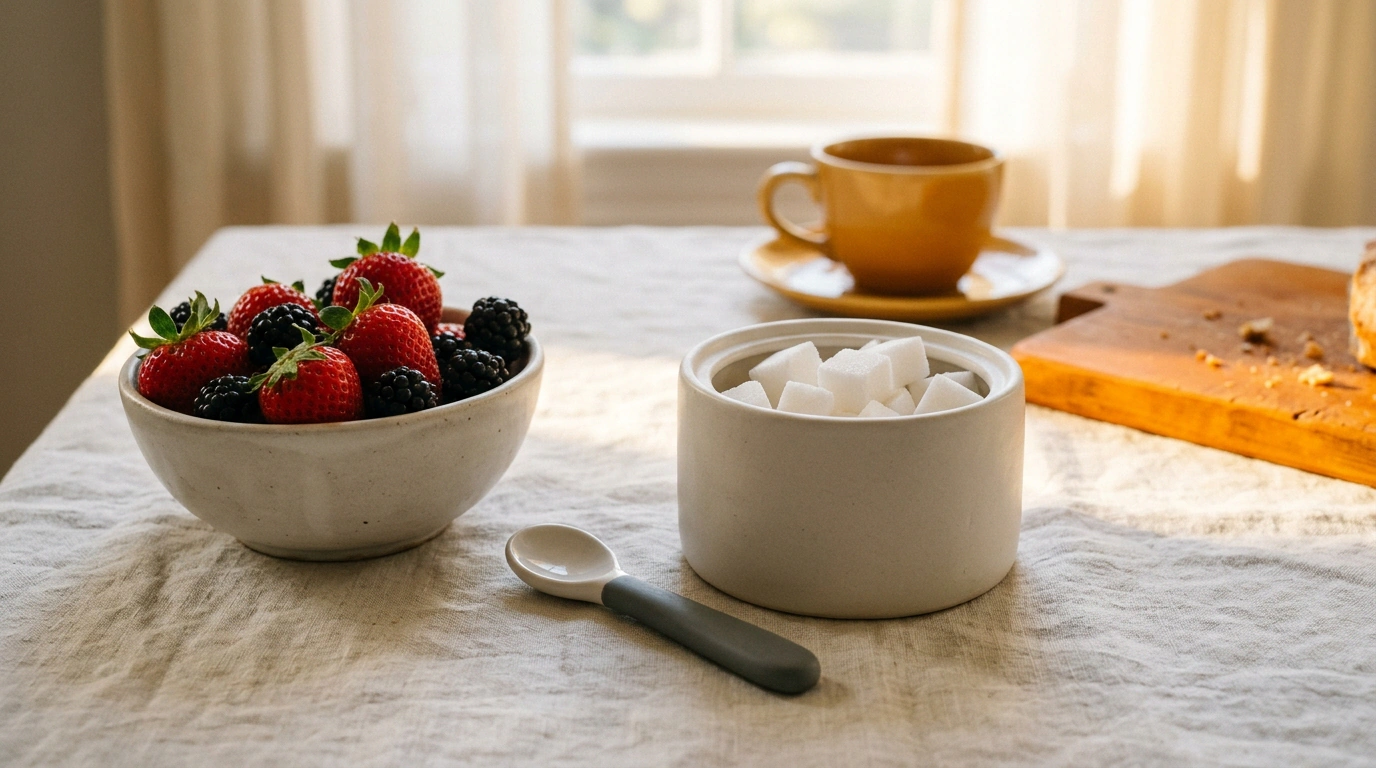
Let's test a popular scare story with an everyday observation. Walk into any café and look at the table: there is almost always a sugar bowl or free sugar packets for tea. If sugar truly acted like a hard drug, customers would be scooping those packets by the handful and eating white powder straight off a spoon. You don't see that happening in coffee shops.
People reach for cheesecake, flaky croissants, chocolate—or hot pizza and French fries, which barely contain sugar at all. Your brain loves the combo of sweetness, fat, salt, aroma, and crunch. Pure sucrose molecules on their own don't drive anyone wild.
Where 'Sugar Addiction' Came From and What Mice Had to Do With It
In everyday talk, people mix up 'addiction' and 'habit,' even though the difference matters. True chemical addiction builds physical tolerance, triggers withdrawal when stopped, and pushes people to extreme lengths for a specific substance. Food works through behavioral habit: a tasty dessert delivers quick pleasure and easily turns into a routine alongside tea or coffee.
A scientific review by Westwater and colleagues in the European Journal of Nutrition (2016) checked whether humans show signs of chemical sugar addiction. Compelling evidence isn't there: the classic pattern of withdrawal and substance-seeking for sugar itself doesn't show up in people.
Those famous lab experiments where rodents binged on sugar water came down to how the tests were designed. Animals drank sugar solution compulsively only under artificial intermittent access: researchers kept them hungry without sweets, then suddenly opened the tap. Remove those feast-or-famine swings, and the binges disappeared. The strict restriction schedule caused the backlash, not the sugar molecule.
Meanwhile, a meta-analysis by Mantantzis and colleagues (2019) debunked the related 'sugar rush' myth: carbs and sugar don't lift mood, and within the first hour after eating sweets, people more often experience lower alertness and higher fatigue.
Where the Real Harm of Too Many Sweets Hides
Finding no chemical addiction doesn't mean washing down cake with soda is harmless. Too much sweet food still carries three very real downsides.
First, extra calories. Sugary drinks and pastries slip down fast, barely fill you up, and push your daily intake into a surplus. You can gain weight without candy too—say, by overeating fatty foods—but sweet snacks speed that process up. Obesity is linked to a wide range of metabolic, cardiovascular, liver, and cancer complications, detailed in a 2023 review in Acta Pharmaceutica Sinica B.
Second, lower nutrient density—meaning fewer vitamins, minerals, protein, and fiber per hundred calories. When sweet ultra-processed foods take up a big slice of your menu, there is less room on your plate for whole, nourishing meals.
Third, tooth decay: the link between free sugars and cavities is directly proven. Free sugars include all added sugars plus natural sugars in honey, syrups, and fruit juices (sugars inside whole fruit and plain milk don't count). Under WHO guidelines, the baseline cap is under 10% of daily calories (around 50 g, or 12 teaspoons, on a 2,000 kcal diet). For extra dental protection, WHO recommends staying below 5%—about 25 g, or 6 teaspoons.
The Childhood Ban Trap and Calm Boundaries
In family nutrition, the sneakiest trap is trying to raise a child in total 'sugar-free' isolation, treating every piece of candy like poison.
Think back to those lab mice on intermittent access: a strict home ban triggers the exact same 'forbidden fruit' effect. As soon as kids get pocket money, go to friends' birthday parties, or move out on their own, years of restriction often snap back as compulsive overeating. That raises the risk of eating disorders—lasting, unhealthy patterns built around cycles of rigid control and binges.
The opposite extreme hurts health too: when a child fills up on cookies, juice, and candy instead of real meals, teeth suffer, excess calories pile up, and growing bodies miss key nutrients.
Keep the foundation of meals built on regular, filling food, and make dessert a predictable part of the day without drama. Don't use sweets as a reward for good behavior and don't take them away as punishment—that keeps candy as just tasty food, stripped of any forbidden-prize halo.