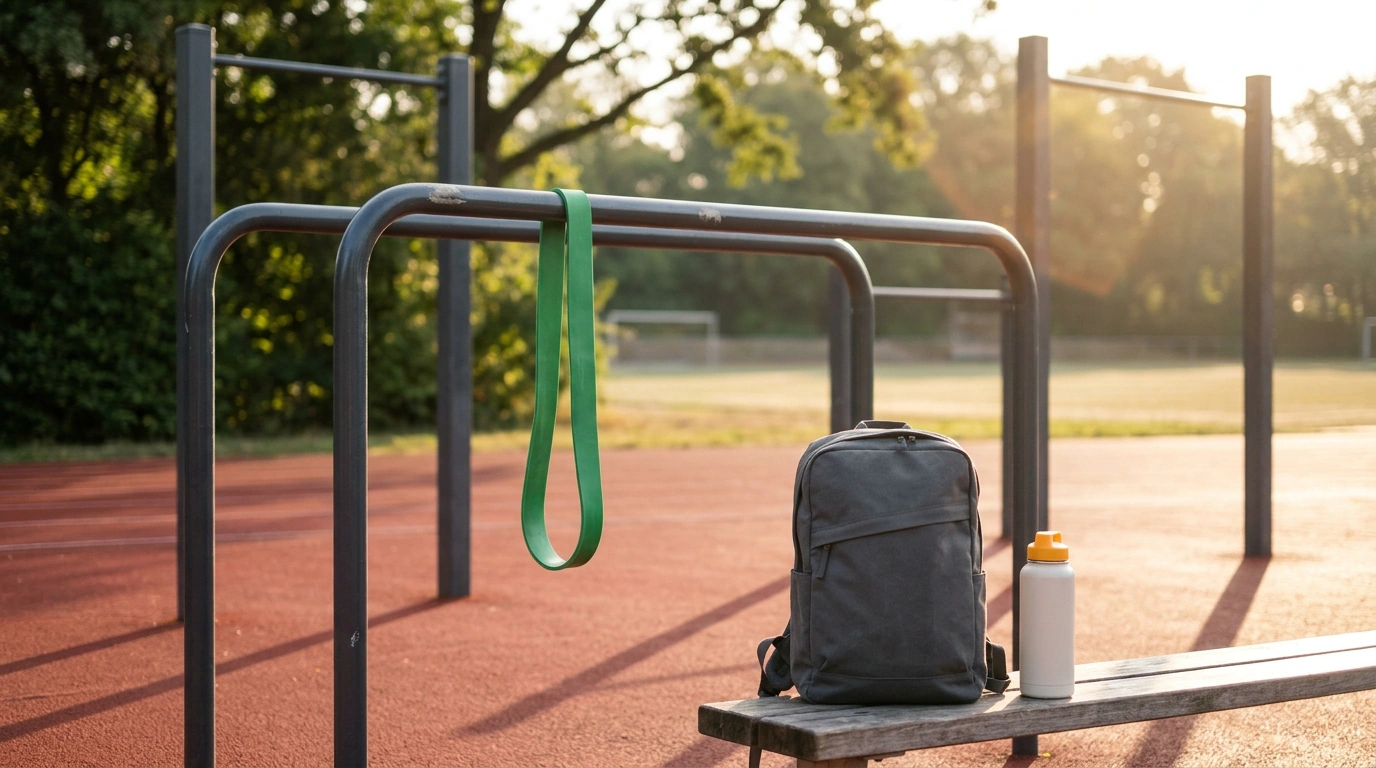
In one hour at a local park with a pull-up bar, parallel dip bars, and an inexpensive resistance band, you can train your entire body—back, chest, legs, arms, shoulders, and core. The plan works if you structure the load logically and leave old playground myths behind.
The Workout Framework: Big Muscles First, Small Muscles Last
The order is simple: tackle heavy compound moves for large muscle groups while you are fresh, then finish smaller muscles at the end. If you tire out your arms first, you won't be able to challenge your back or chest properly because your biceps and triceps will quit early. Before your working sets, warm up with 15 light, easy reps of each movement.
Next come 8 exercises for 3 working sets of 10–15 reps each, every one with an accessible starting version.
| # | Muscle group | Main exercise | Easier starting option |
|---|---|---|---|
| 1 | Back | Wide-grip pull-ups without swinging, elbows out, shoulder blades squeezed | Resistance band or foot support |
| 2 | Chest | Parallel bar dips leaning torso forward | Two sturdy home supports or low bars |
| 3 | Legs | Single-leg 'Spartan' squats (12–15 reps per leg) | Lightly hold a pole for balance |
| 4 | Biceps | Narrow underhand chin-ups, elbows tucked, torso upright | Feet on ground or resistance band |
| 5 | Triceps | Bodyweight 'skullcrushers' against a bar | Use a higher bar |
| 6 | Side delts | Lateral raises with a resistance band or weighted bag (elbow slightly above hand) | Lighter band or less weight |
| 7 | Abs | Hanging straight-leg raises curling the pelvis up without swinging | Raise bent knees |
| 8 | Lower back | Gentle straight-back hinges holding a band or light dumbbells | Floor 'superman' holds on a mat |
A common park mystery: after months on the dip bars, your shoulders feel stronger yet don't look wider. Presses and dips mostly hit the front deltoid, while shoulder width comes from the side (lateral) deltoid. A pull-up bar alone misses it, so tossing a resistance band in your backpack fills that gap neatly.
Progressive Overload, Rest Times, and Joint Safety
Muscles grow (hypertrophy) when mechanical tension pushes slightly beyond what they're used to. Without gradual progression, your body adapts and stops changing. As soon as you hit 12–15 clean reps on pull-ups or dips with ease, strap weight to a belt or pack a weighted backpack, and add ankle weights for leg raises. Grinding out 30–40 bodyweight reps builds endurance rather than strength and size.
Rest between sets matters just as much. Hopping back on the bar every 40 seconds turns strength work into cardio exhaustion. A 2–3 minute rest acts like a quick pit stop: muscles refill fast energy stores (ATP and creatine phosphate) so your form stays sharp. A 2016 study by Brad Schoenfeld and colleagues confirmed this: lifters resting 3 minutes gained more strength and muscle size than those resting 1 minute.
Don't drop all the way to the bottom on dips, especially with weight in a backpack. Going too deep when shoulder mobility is tight strains the front joint capsule; stopping around upper-arm parallel to the floor is much safer. Also skip the old advice to put a sandbag on your neck and do 30 good-mornings until your lower back cramps—hold a light band or dumbbells in your hands and move pain-free. If you have chronic back issues, clear exercises with a doctor first.
Three Old Myths Science Has Retired
Old workout routines often pass down three beliefs from the VHS era. All three have been tested in labs.
'Squats grow your biceps by spiking testosterone.' In 2012, Daniel West and Stuart Phillips at McMaster University showed that the brief spike in testosterone and growth hormone after leg training doesn't speed up arm growth. Trying to build biceps with squats is like turning up the kitchen stove to heat your bedroom: the stimulus stays where the work happens. Local mechanical tension inside the working muscle drives growth. Train legs for leg strength, healthy joints, and balanced proportions.
'Every set must go to total failure.' Muscular failure is the point where you physically can't complete another clean rep. Compare pushing to zero every set versus stopping 1–3 reps shy of failure (known as Reps in Reserve, or RIR). Modern meta-analyses show similar muscle growth either way, while leaving a rep or two in reserve spares your nervous system, protects technique, and speeds up recovery.
'After 60 minutes, your workout burns up.' Your body has no internal stopwatch that erases training gains at minute 61. What counts is weekly volume, set quality, and recovery. An hour is simply a handy time limit to keep you focused and moving.