The parameter race in large language models hit hard physical and economic limits in data centers long ago. Training a dense monolithic network with hundreds of billions of parameters is hugely expensive, and serving it in production costs even more. To generate a single short word, a server cluster must activate every transistor in sync and push matrices through terabytes of memory registers.
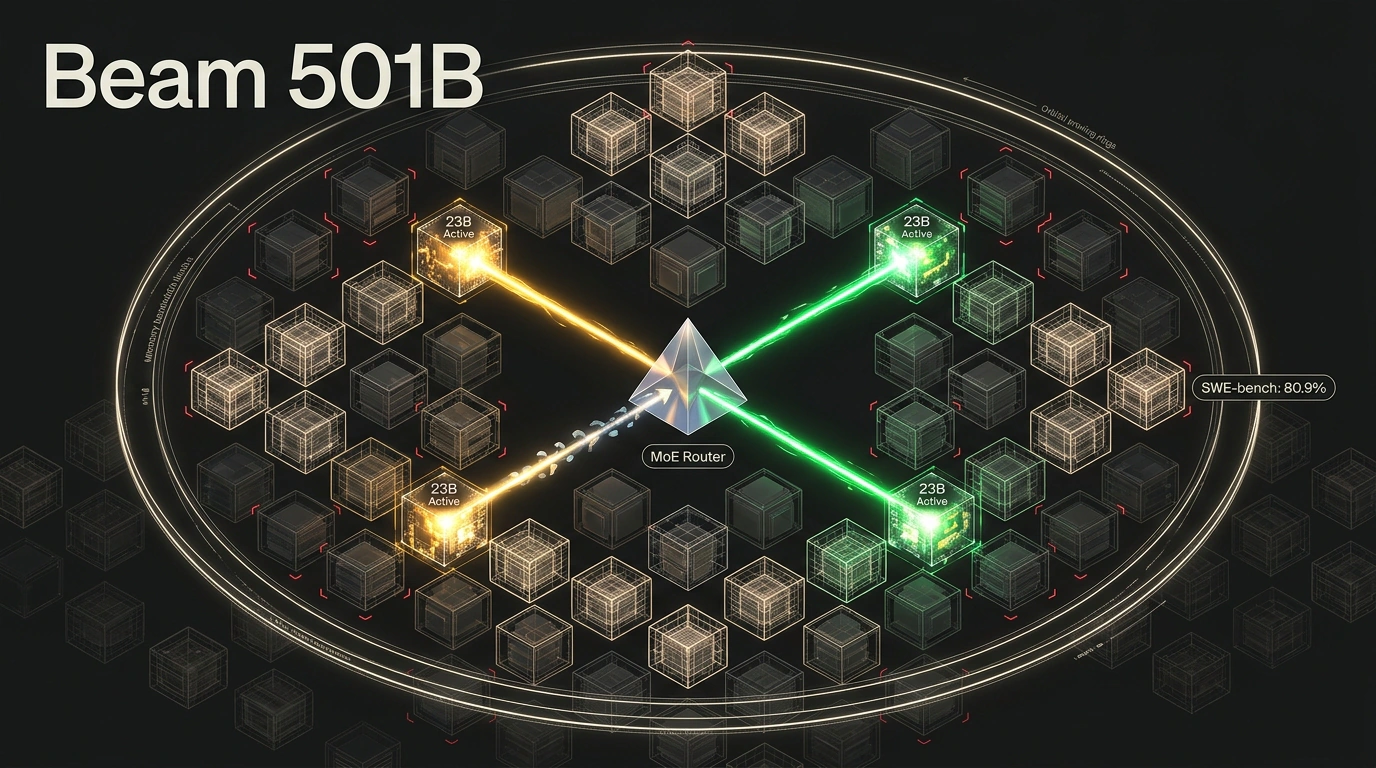
Brooklyn-based startup Reflection AI—founded by former Google DeepMind leads Misha Laskin and Ioannis Antonoglou (a key architect of AlphaGo and Gemini RL alignment)—offered a bold answer. The company announced Beam, its first open foundation model with 501 billion parameters (501B), built on a Sparse Mixture-of-Experts (MoE) design. While packing massive knowledge, the model activates just 23 billion parameters per generated token, transforming compute economics.
The Dense Giant Trap: Why the Industry Is Moving to Sparse Experts
In a classic dense architecture, a network acts like a lone polymath. Whether you ask it to write a Bash script or translate a Shakespeare sonnet, 100% of its neurons fire. That creates two major limits:
- Massive energy and time costs: Token generation hits the GPU memory bandwidth ceiling. Response time grows alongside total model size.
- Gradient conflicts during fine-tuning: When engineers train a dense network on advanced math, law, and coding at the same time, skills overwrite each other—a problem known as catastrophic forgetting.
Sparse MoE architecture breaks this deadlock by splitting network layers into dozens of independent specialist modules ("experts"). A dynamic router evaluates each incoming token and sends it to only the two or three best-suited experts, leaving the rest of the network idle.
Beam 501B Architecture: 4.6% Compute Without Losing Encyclopedic Depth
Beam 501B pushes this principle to engineering precision. Out of 501 billion total parameters, dynamic routing activates only 23 billion parameters per token—exactly 4.6% of the network's capacity.
In practice, Beam feels like a fast, compact 23B model in response speed and compute load, while keeping the breadth and reasoning depth of a half-trillion-parameter giant. On independent benchmarks, it posted standout scores:
- SWE-bench Verified: 80.9% on real GitHub repository tasks (compared to 77.6% for Inkling and 70.7% for Nemotron 3 Ultra);
- Terminal Bench 2.1E: 80.1% on autonomous OS administration via the command line;
- AIME 2026: 97.8% on olympiad-level math problems;
- GPQA Diamond: 90.5% on cross-disciplinary graduate-level science questions.
Training in 1.3 Billion Sandboxes: How Agent Reliability Was Taught
The model's strong coding and systems performance came from an unusual training pipeline. Pre-training ran on a 23.8-trillion-token corpus, followed by a massive Reinforcement Learning (RL) phase.
Reflection AI rented capacity at the Colossus data center for a four-week sprint on 10,500 NVIDIA GB300 accelerators. Instead of scoring generated code with text-based loss functions, the team forced the model to run its code for real. Across more than 100 million generation rollouts, researchers spun up 1.3 billion isolated sandboxes to verify outputs. The network learned directly from compiler errors, taking penalties for hung processes and memory leaks.
Controllable Thinking Penalty: Balancing Speed and Olympiad Logic
A common flaw in modern reasoning models is overthinking. Ask a simple question like "what day is it today?" and the model might burn hundreds of internal monologue tokens, wasting time and money.
Beam introduces a Controllable Length Penalty. Developers can pass a reasoning_effort parameter in the API:
- Set to
low, the model skips verbose reasoning and immediately returns a short answer or working terminal one-liner; - Set to
high, Beam builds multi-step proofs and math checks for tough algorithmic problems.
Hardware and Deployment: The Cost of Hosting Open Apache 2.0 Weights
Reflection AI is wrapping up external red-teaming and announced it will release the weights and technical docs under the permissive Apache 2.0 license. That clears the way for free commercial use in private environments without royalties.
Still, teams should be realistic about hardware needs:
- Memory vs. compute split: Even though each step uses 23B-level compute, all 501 billion weights must stay loaded in GPU VRAM. In FP16 half precision, that takes about 1 terabyte of VRAM—roughly an 8-GPU node of NVIDIA H100 or H200 accelerators.
- Quantization for smaller servers: Using FP8 or INT4 cuts memory needs to 250–500 GB, making it possible to run on more accessible servers via vLLM, TensorRT-LLM, and SGLang.
- Text-only focus: This first release of Beam 501B is text-only and has no native image encoder, so visual UI workflows need external multimodal modules.
An open MoE model at Beam 501B's level shows that independent labs can match closed cloud flagships, putting frontier agent tech within reach of the wider engineering community.