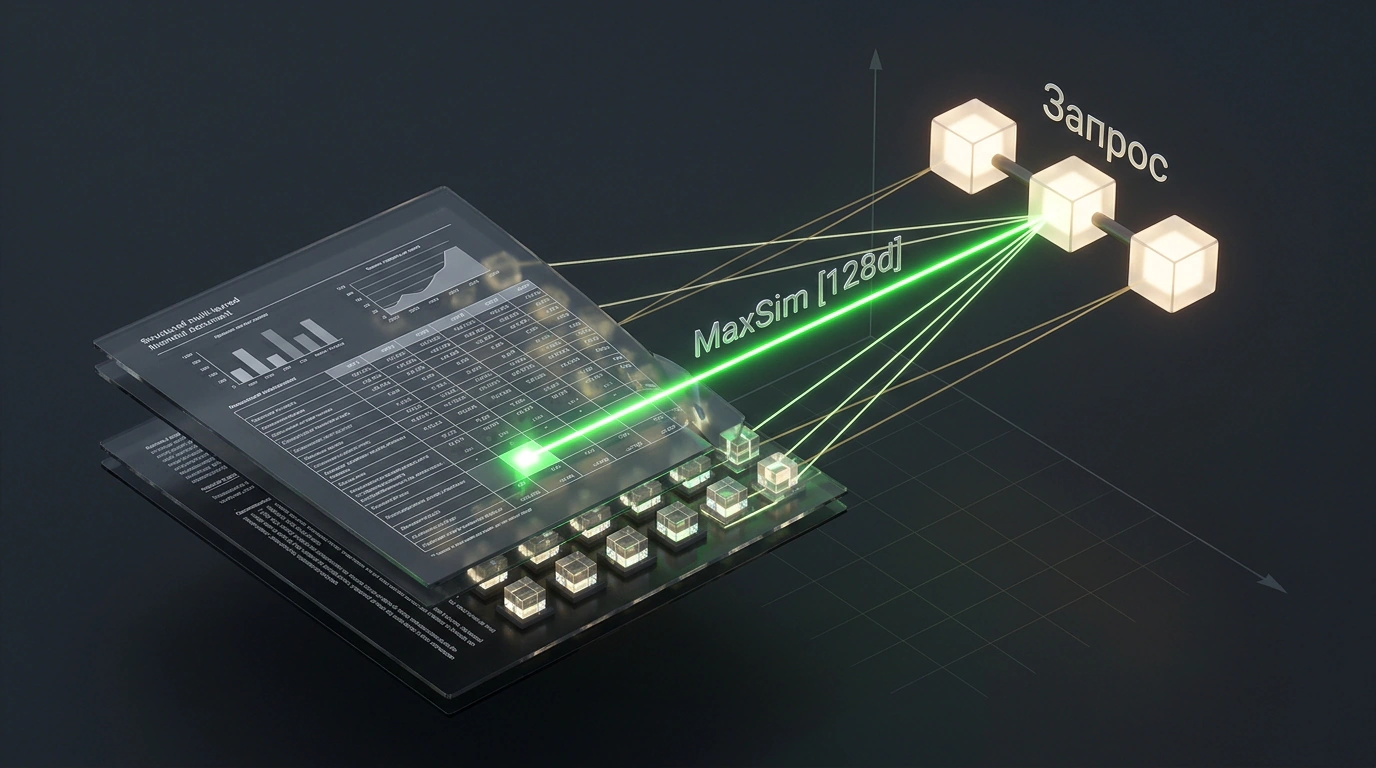
Building enterprise semantic search and RAG over complex documents—like financial reports, scans, tables, and slide decks—has long hit a bottleneck in classic Bi-Encoder models. A standard encoder compresses an entire page into one fixed-size vector (768 or 1,536 numbers). As a result, exact figures in table cells and chart labels get blurred out.
Perplexity AI has released the open-source multimodal model family pplx-embed-v2-late (in 0.6B and 9B parameter sizes) under the MIT license.
The release uses a Late Interaction architecture that builds on ColBERT while adding support for visual tokens. We previously followed the company's ecosystem in our Perplexity Computer review, and now the research team is opening up its core search foundation to the community.
How Late Interaction and MaxSim Work
Unlike standard models, pplx-embed-v2-late never flattens a document into a single point in latent space. Instead, it keeps a compact 128-dimensional vector for every individual token in both the query and the document.
Relevance is scored using the MaxSim operator:
- For each query token, compute the cosine similarity against every token in the document.
- Record the highest similarity score found.
- Sum those maximum scores across all query tokens.
This preserves fine-grained context. If a user asks about a specific financial figure in a footnote, the model finds a strong match directly on that token. Better yet, you can feed PDF pages directly as images—the model aligns visual table tokens with the text query without needing a separate OCR step.
Loading the Model and Computing MaxSim
Here is how you load the model with Hugging Face Transformers and calculate relevance in PyTorch:
import torch
import torch.nn.functional as F
from transformers import AutoTokenizer, AutoModel

model_id = "perplexity-ai/pplx-embed-v2-late-0.6b"
tokenizer = AutoTokenizer.from_pretrained(model_id)
model = AutoModel.from_pretrained(model_id, torch_dtype=torch.bfloat16).cuda().eval()

query = "What were the operating expenses in Q3?"
document = "In the third quarter, operating expenses totaled 14.2 million dollars."

with torch.no_grad():
    q_inputs = tokenizer(query, return_tensors="pt").to("cuda")
    d_inputs = tokenizer(document, return_tensors="pt").to("cuda")

    # 128-dimensional per-token embeddings
    q_embeds = F.normalize(model(**q_inputs).last_hidden_state, p=2, dim=-1)
    d_embeds = F.normalize(model(**d_inputs).last_hidden_state, p=2, dim=-1)
The second step computes the MaxSim late-interaction score:
def calculate_maxsim(query_embeds: torch.Tensor, doc_embeds: torch.Tensor) -> float:
    # Cosine similarity matrix: [query_len, doc_len]
    sim_matrix = torch.matmul(query_embeds[0], doc_embeds[0].transpose(0, 1))

    # Maximum match for each query token
    max_sim_per_token, _ = torch.max(sim_matrix, dim=-1)

    # Final score is the sum of maximums
    return torch.sum(max_sim_per_token).item()

score = calculate_maxsim(q_embeds, d_embeds)
print(f"MaxSim Score: {score:.4f}")
Because the vectors are normalized, this operation runs on a GPU in fractions of a millisecond while delivering accuracy comparable to heavy Cross-Encoder rerankers.
Storage Overhead and Verdict
The trade-off for Late Interaction precision is index size. Storing a vector for every token takes more memory than storing a single vector per chunk. Still, the smaller 128d size and native quantization support in engines like Vespa, Qdrant, and LanceDB keep the architecture practical for production.
Bottom line: the open-source MIT release of pplx-embed-v2-late is a major win for RAG. Searching tables and scanned documents without losing detail gives developers a much stronger retrieval tool.