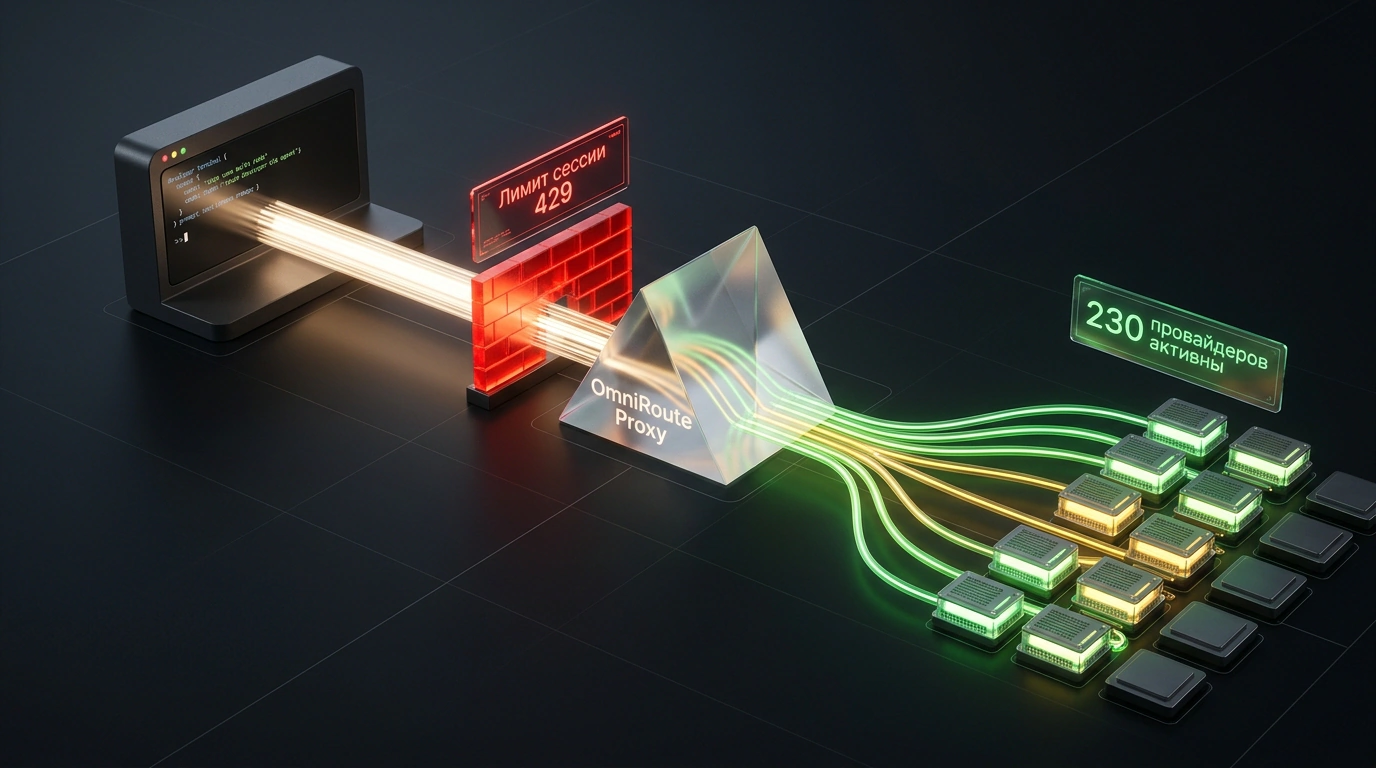
Anthropic's terminal agent, Claude Code, quickly won over developers thanks to its tight terminal integration and its ability to explore codebases and run tests on its own. Heavy daily use, however, often hits hard walls: five-hour session limits, sudden server overload errors (HTTP 429), and regional account restrictions.
Pausing for several hours in the middle of a critical bugfix is not an option. The open-source local gateway OmniRoute (omniroute.online) solves this by turning Claude Code into a multi-vendor workstation connected to more than 230 inference providers.
Earlier, we shared 45+ practical tips for Claude Code covering how to optimize agent loops. Adding OmniRoute takes that terminal reliability even further with smart request routing.
Local Gateway Architecture: Transparent Translation and Auto-Fallback
OmniRoute runs on your machine or a team gateway, exposing a lightweight proxy server at http://localhost:20128/v1.
All the routing happens under the hood:
- Anthropic protocol emulation: The gateway accepts
/v1/messagesrequests from Claude Code and converts them on the fly into OpenAI-compatible/v1/chat/completionscalls or native vendor APIs. - Cascade fallback: If your primary provider hits a rate limit or times out, the gateway immediately routes the request to a backup node—such as OpenRouter, Together AI, Groq, or a local server—without dropping your active terminal session.
- Centralized key management: You manage all provider credentials in one place instead of editing agent environment variables every time you switch backends.
Setting Up Redirects and Router Config
Setup takes only a couple of minutes. First, install the proxy and define your routes in the configuration file:
# ~/.omniroute/config.yaml: Model routing and fallback chains
gateway:
  listen: "127.0.0.1:20128"
  timeout_seconds: 60

routes:
  - path: "/v1/messages"
    primary:
      provider: "anthropic"
      model: "claude-3-7-sonnet-latest"
      api_key_env: "ANTHROPIC_PRIMARY_KEY"
    fallback_chain:
      - provider: "openrouter"
        model: "anthropic/claude-3.7-sonnet"
        api_key_env: "OPENROUTER_KEY"
      - provider: "together"
        model: "meta-llama/Llama-3.3-70B-Instruct-Turbo"
        api_key_env: "TOGETHER_KEY"
    retry_on_status: [429, 500, 502, 503]
Next, point the official Claude Code client's base URL to your local gateway:
# Redirect Claude Code traffic to the local OmniRoute port
export ANTHROPIC_BASE_URL="http://localhost:20128"
export ANTHROPIC_API_KEY="omniroute-local-token"

# Start the agent normally with rate-limit protection
claude
To the agent, the swap is completely invisible. It keeps running in the same terminal interface, while the gateway quietly shifts inference to backup infrastructure whenever the primary API runs out of quota.
Pitfalls and Verdict
The main technical snag with fallbacks is Tool Use compatibility. Claude Code relies heavily on specific formatting for code blocks and file operations. Switching mid-session to models with looser structured-output support can cause occasional response-parsing hiccups.
Still, if you spend your workday inside Claude Code, OmniRoute is a lifesaver. It removes single-vendor dependency, protects you from session-limit downtime, and helps keep development costs down.