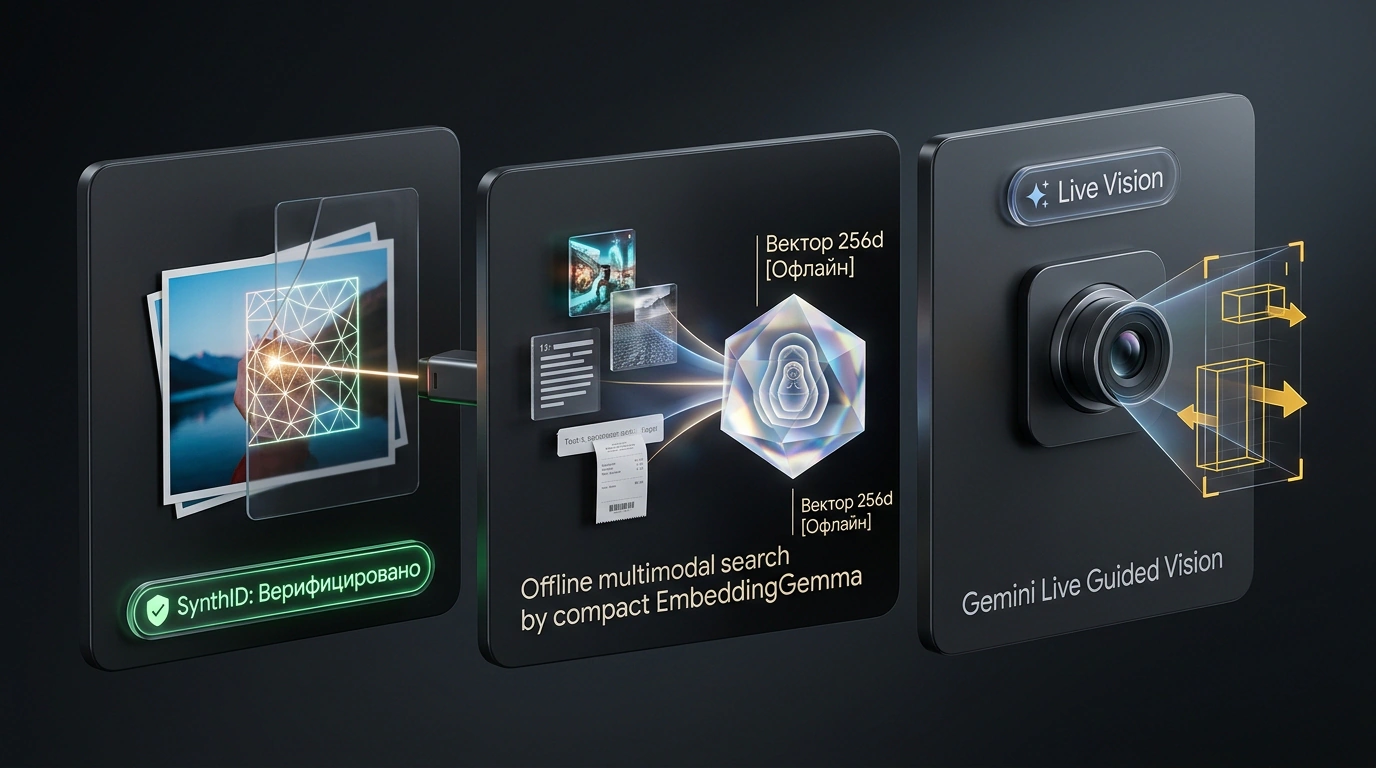
The Google Gemini ecosystem just received a coordinated wave of updates. Google DeepMind and its product teams rolled out tools targeting two major industry challenges: verifiable watermarking for AI-generated content and on-device multimodal search that keeps private data off the cloud.
We already tracked earlier releases in our Google Gemini ecosystem update. Today's update brings together public verification APIs, open local weights, and real-time streaming vision.
Three Core Additions: SynthID, EmbeddingGemma 2, and Guided Vision
The release centers on three technologies:
- Public SynthID Detector: DeepMind's digital watermarking tech has left closed beta. An invisible statistical mark is embedded directly into image pixels or audio frequency spectra, surviving compression, cropping, and filters. Publishers and developers now get an API to verify content automatically for regulatory compliance (such as the EU AI Act).
- Local Multimodal Search with EmbeddingGemma 2: A compact 740-million-parameter model released under the Apache 2.0 license. It maps text, code, photos, and audio into a shared 768-dimensional space while using only 190–560 MB of smartphone RAM. Matryoshka Representation Learning (MRL) lets you truncate vectors down to 128 or 256 dimensions without hurting ranking quality.
- Guided Vision in Gemini Live: Low-latency live video streaming from a phone's camera, allowing the assistant to guide users by voice while assembling hardware or cooking.
Watermark Verification and Local Vector Search
Here is how to call the SynthID detector via the official SDK to check a suspicious image:
import google.genai as genai
from PIL import Image

# Initialize the content verification client
client = genai.Client()

def verify_media_watermark(image_path: str):
    image = Image.open(image_path)
    result = client.models.detect_watermark(
        model="synthid-detector-v2",
        media=image
    )

    print(f"Verification status: {result.status}")
    print(f"AI generation probability: {result.confidence_score:.2%}")
    print(f"Watermark integrity rating: {result.integrity_rating}")

verify_media_watermark("suspicious_photo.jpg")
The second key workflow deploys EmbeddingGemma 2 for offline search across a phone's photo gallery using truncated vectors:
import torch
import torch.nn.functional as F
from transformers import AutoProcessor, AutoModel

model_id = "google/embeddinggemma-2"
processor = AutoProcessor.from_pretrained(model_id)
model = AutoModel.from_pretrained(model_id, torch_dtype=torch.float16).to("cuda")

# Multimodal input: text query and local photo
inputs = processor(
    text=["Find the payment receipt from September"],
    images=[Image.open("receipt.jpg")],
    return_tensors="pt"
).to("cuda")

with torch.no_grad():
    outputs = model(**inputs)
    # Full 768-dimensional vector
    full_embeds = F.normalize(outputs.last_hidden_state[:, 0, :], p=2, dim=-1)

    # Matryoshka truncation to 256d for compact SQLite storage
    compact_embeds = F.normalize(full_embeds[:, :256], p=2, dim=-1)

similarity = torch.cosine_similarity(compact_embeds[0:1], compact_embeds[1:2])
print(f"Match score: {similarity.item():.4f}")
Practical Caveats and Verdict
Each tool has clear boundaries. SynthID accurately detects media created within Google's ecosystem and partner platforms, but it won't flag images from unknown custom models that lack watermarks. Meanwhile, continuous video streaming in Guided Vision puts noticeable drain on a phone's battery.
Still, pairing open local models like EmbeddingGemma 2 with DeepMind's verification tools pushes AI in the right direction: more local, more private, and easier to audit.