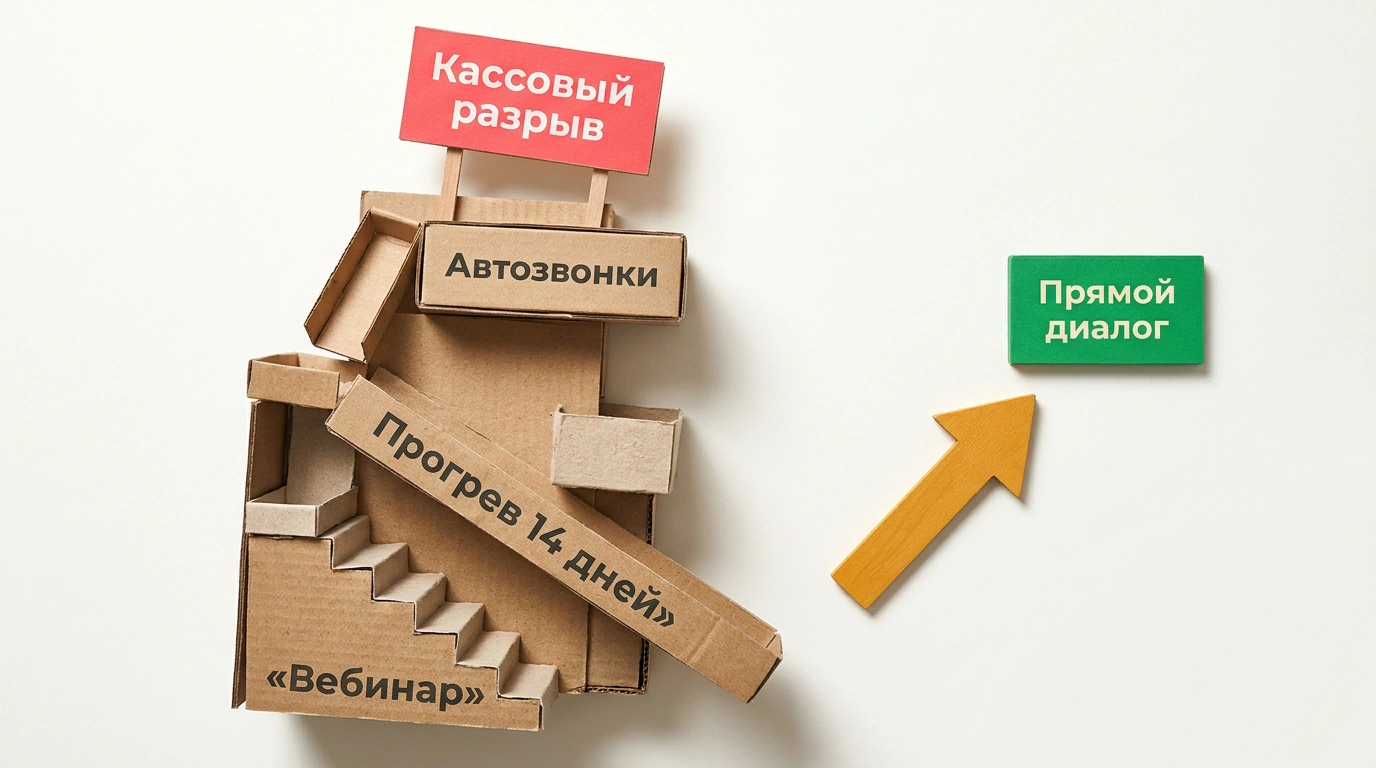
Every time a novice entrepreneur or expert sits down to write a promotion strategy, their hand automatically reaches to open the social media and websites of industry giants. We look at massive webinar funnels, glossy special projects, and multi-level lead magnets and think: "If this works for them and brings in millions, it means I just need to repeat every step." This is the classic benchmarking trap that buries the budgets of thousands of promising projects every year.
Marketing tools do not exist in a vacuum. Their effectiveness is directly tied to a company's scale, margin of safety, and volume of accumulated trust. Trying to copy someone else's external attributes without understanding the financial model behind them is like trying to take off on plywood wings while watching a Boeing fly past.
Four Stages of Business and the Fatal Resource Gap
In the development of any commercial project, four clear stages can be identified:
- Startup stage: Understanding of the customer profile is only just forming, sales are sporadic, and there is a constant search for a working offer.
- Craftsman income: Leads come in regularly, but the founder has locked all processes onto themselves — from communicating with clients to fulfilling obligations. Personal capacity is running out, and the budget is limited.
- Systemic business: Operations are delegated to a team, transparent end-to-end analytics are built, and there is free working capital for long-term tests.
- Diversification: Launching adjacent lines of business, holding structures, and investing in large-scale media presence.
The main catch is that popular business speakers, course authors, and heads of large agencies broadcast exclusively from the perspective of the third and fourth stages. When they advise pouring 200,000 rubles into testing a multi-step automated webinar funnel, at their scale that's a penny experiment with acceptable risk. A major player has dozens of sales reps closing leads, an intricate retargeting web connected, and, most importantly, a financial cushion that lets them wait six months for an acquired customer to pay off through repeat sales (LTV).
If an expert at the first or second stage tries to pull off the same trick, they will run into a cash gap in the very first week. Cold traffic won't pay back direct ad spend, and there simply won't be money left for retention and a long warm-up. We analyzed in detail how small businesses lose controllability when trying to play by big players' rules in the piece on the trap of large ad agencies.
In addition, industry leaders are backed by a brand cushion. When a well-known brand publishes an abstract post about sustainability or values, people read it and buy because of its accumulated reputation. If a beginner specialist posts the exact same thing, the reaction will be silence. Nobody gives a small business credit of trust in advance.
How a Small Project Can Sell Without Bloated Funnels
To avoid burning working capital on someone else's playbooks, at the first two stages of development you need to completely abandon complex multi-step structures and focus on direct response.
Instead of long automated funnels, bet on an ultra-clear conversion offer that hits a specific, quantified client pain point. Don't promise abstract "prosperity" — show what specific problem you will solve within a clear timeframe and for reasonable money.
Cut the distance to a minimum. The best funnel for a small business is a direct transition from an ad into a personal dialogue in a messenger. While corporations spend weeks approving estimates and confuse clients with call-center voice menus, you can reply in five minutes, dig into the person's situation, and close the deal through personal involvement and flexibility. Human attention and speed of response are the exact competitive advantages that cannot be bought for any budget.