When large language models became accessible to every marketer, a tempting picture loomed in the minds of many entrepreneurs: fire half the copywriters, set up automatic article generation from a collected keyword list, and flood search results with thousands of pages. It seemed the law of large numbers would work flawlessly: if you publish forty articles a day instead of four a month, search traffic will grow tenfold.
But dry analytics ruthlessly shattered these illusions. Research firm Graphite analyzed over 55,400 English-language materials from the open Common Crawl archive, running them through leading machine-text detection systems (GPTZero, Copyleaks, Pangram). It turned out that by early 2026, roughly half (49.9%–50.9%) of all new publications on the global web are created with the direct participation of generative AI.
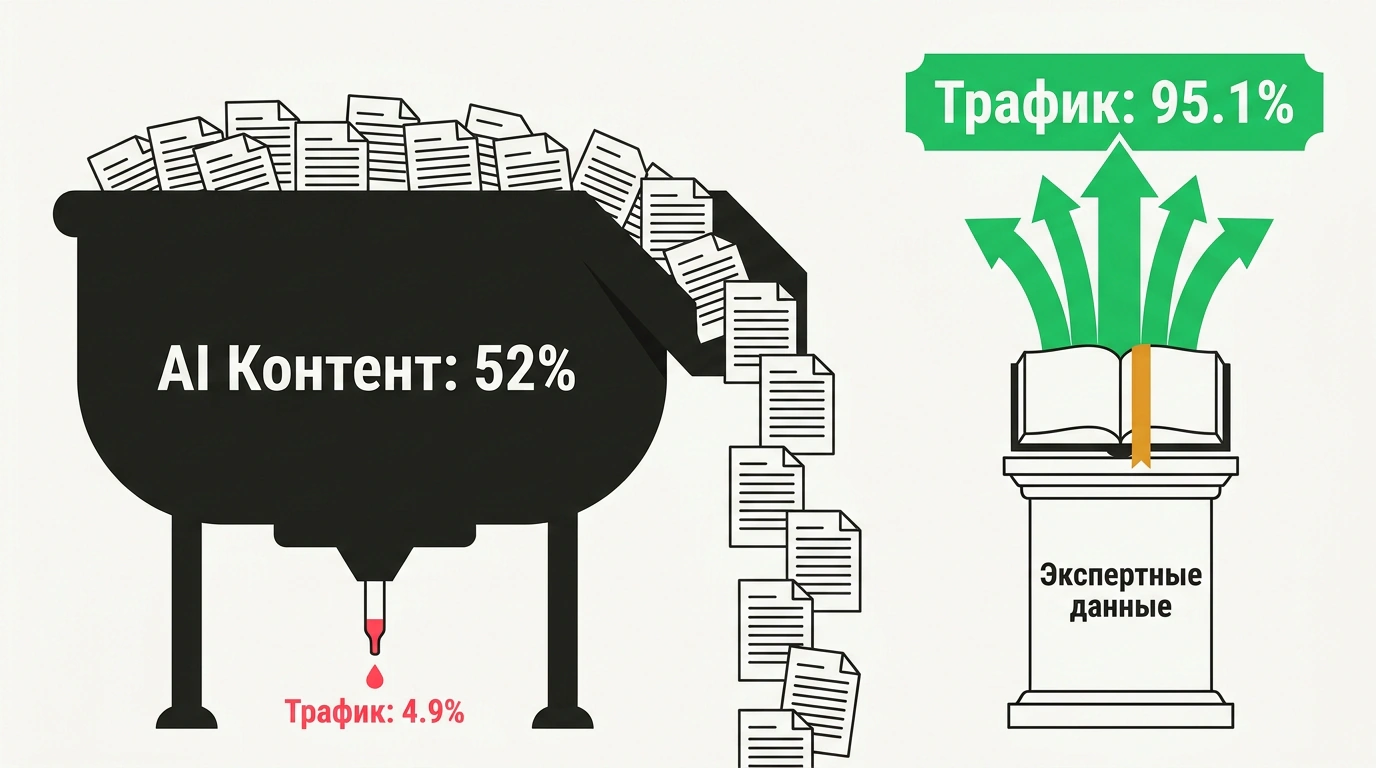
And a parallel audit of a hundred commercial companies revealed a catastrophic imbalance: automatically generated pages accounted for 52.1% of all published materials, yet together they delivered only 4.9% of search traffic. The remaining 95.1% of clicks continue to be steadily collected by articles written by live industry experts.
Why Search Engines Cut Synthetic Content
Search engines don't need to launch a witch hunt or impose an outright ban on using neural networks. Their algorithms evaluate incoming information by a fundamental parameter — Information Gain Score (the addition of unique information).
A large language model is by nature a generator of statistical consensus. When you ask it to write an article on "How to Choose a CRM for a Retail Store," it takes ten existing articles from the top of search results, mixes their talking points, and outputs a smooth, grammatically flawless, but completely derivative text. It contains not a single new fact, not a single live figure, and not a single unique entity that wasn't already in the search engine's knowledge base.
A search crawler scans such material, compares it against the information graph, and sees zero added value for the user. Why show a person the eleventh copy of what's already sitting on the first page? As a result, the page is sent to the far corners of the index, never even reaching the top 50. Why this happens is clearly confirmed by research on why search engines give expert texts 2.5 times more traffic.
How to Resuscitate Content Marketing
This doesn't mean neural networks should be thrown in the trash. AI is a magnificent assistant for initial research, clustering ideas, and stylistic proofreading. But the core of the material must remain human.
For an article to bring leads, you need to embed three components that a model is physically incapable of inventing on its own:
- Your own figures and measurements. Show real conversion rates, exact cost per click in your niche, analytics screenshots, or defect rates.
- Anti-cases and mistakes. Neural networks love writing about ideal abstract success. A real story about how you burned 200,000 rubles on a flawed offer and what exactly you reworked immediately grabs the attention of both readers and E-E-A-T algorithms.
- Direct quotes from participants. A comment from a service department head, a client quote, or a live dialogue with a buyer creates the exact density of experience that pushes a publication to the top.