When a marketing team is tasked with gathering tens of thousands of registrations on a tight deadline, the first natural reaction is to pour budget into broad targeting and hope for a miracle. But if your product isn't a one-click free cinema subscription, and instead is a multi-step qualification form requiring passport details, selecting a regional route, and writing an essay, a classic funnel chokes immediately. Click-to-completed-application conversion in such projects rarely exceeds 1–2%.
The all-Russian project "Знать. Любить. Гордиться!", implemented by the "Больше, чем путешествие" program, faced exactly this challenge. Over six weeks — right in the middle of exam sessions and vacations — the team at digital marketing agency VIRUS led by Daniil Lazarev had to attract youth and family audiences amid fierce competition with commercial tourism.
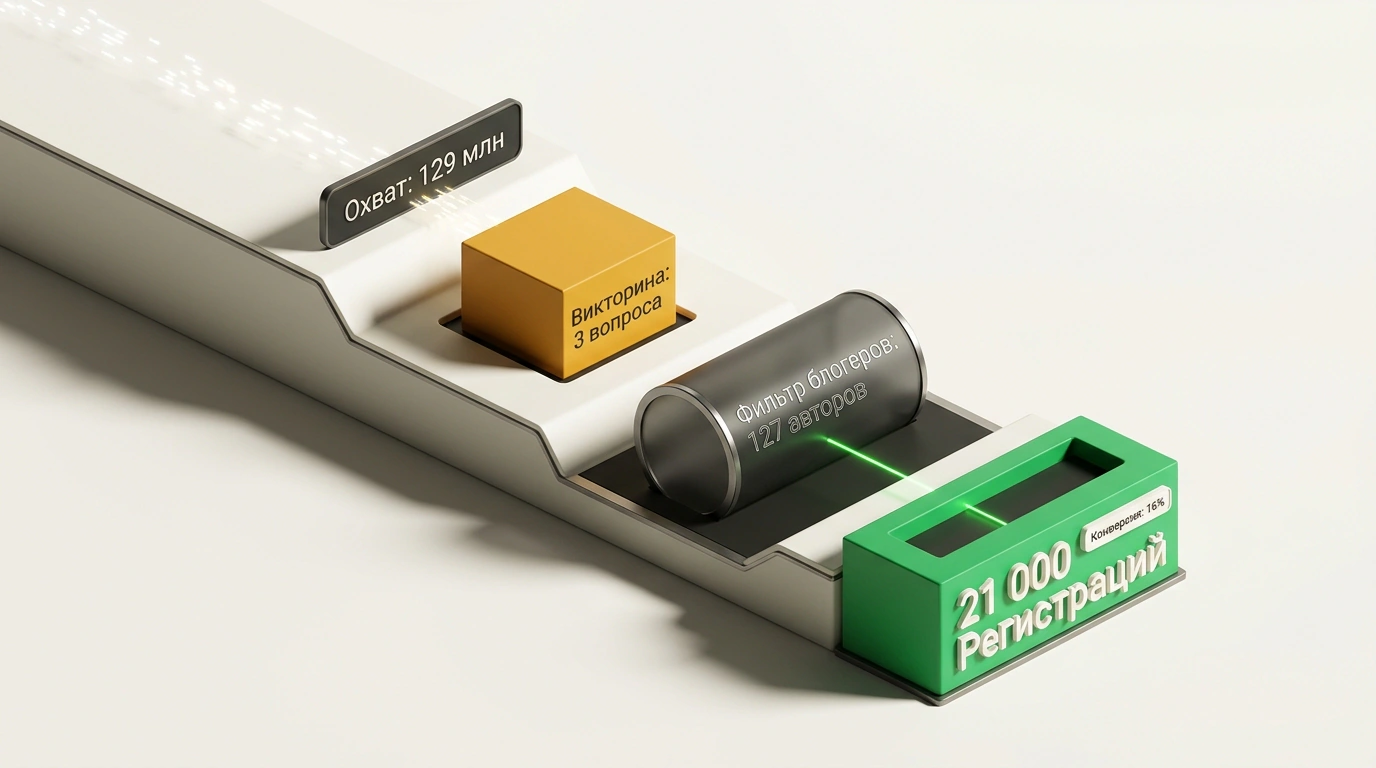
The campaign's outcome is impressive: 129 million impressions, 673 thousand site visits, over 10 million views from influencers, and 21,000 fully completed registrations. At the same time, visitor-to-completed-application conversion reached a record 16%. Let's break down which levers made this precision possible.
Strict Influencer Screening and Working with Stop-Factors
The foundation of the media split was working with 127 influencers on VK and Telegram. Instead of buying ads from mega-bloggers with diluted audiences, the agency introduced a multi-level safety filter.
Each candidate was checked against a list of critical stop-factors:
- Presence of fake engagement and bots in comments.
- Participation in dubious financial giveaways and toxic scandals.
- Mismatch between subscribers' real geography and the project's priority regions.
As a result of this tight sieve, only micro-influencers with engaged regional communities entered the campaign. Creators weren't handed dry, boilerplate press releases: each blogger shared a personal story about traveling around their home region, organically weaving in an interactive poll and inviting subscribers to apply.
First-Screen Gamification and Funnel Warm-Up
The second key victory was redesigning the landing page. Instead of immediately overwhelming visitors with a massive form of twenty mandatory fields, the VIRUS team introduced an interactive quiz on the first screen.
Users were invited to answer three simple and engaging questions about Russian geography and history. People got drawn into the game-like process, received pleasant feedback, and psychologically agreed to the next step. Only after clearing the first barrier were they asked to fill in participant profile details.
In parallel, dozens of geo-targeted visual creatives were continuously tested in VK Ads and Yandex Direct: a resident of Kazan was shown the beauties of Tatarstan, while an audience from Yekaterinburg saw Ural routes. We wrote in detail about how to build dense lead generation at high volumes without losing margin in the breakdown of the website and Direct combo for 6,800 leads.
The VIRUS case proves that even in complex social and government projects, a smart performance approach, respect for influencer context, and splitting the conversion path work wonders.