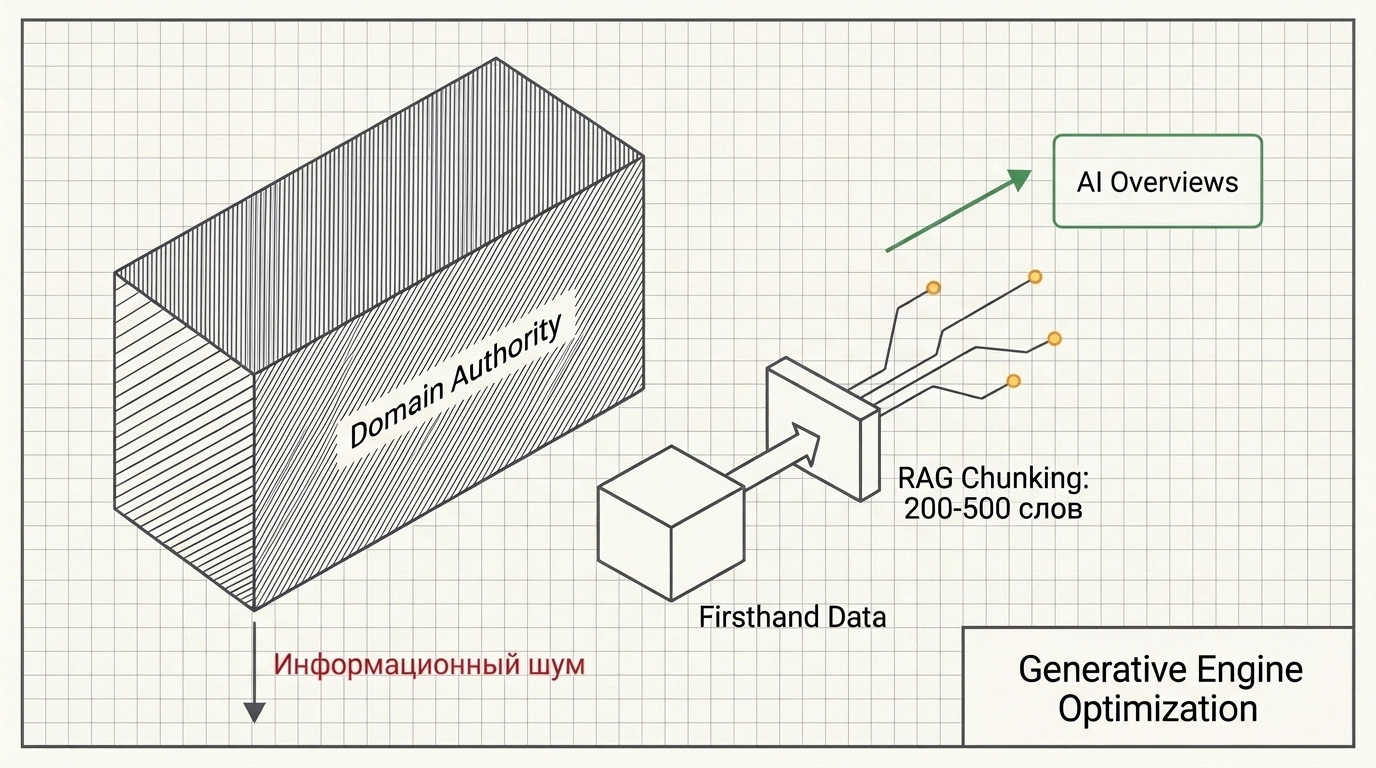
For two decades, absolute feudalism reigned in search engine optimization. The rules of the game were simple, cynical, and determined entirely by the thickness of the corporate wallet: if you had million-dollar budgets for external links, a team of a hundred technical specialists, and an old domain with history, you were guaranteed to occupy the first line for any high-frequency commercial query. For a small regional business, a niche workshop, or a young startup, storming the top for queries like "flower delivery" or "legal services" felt like trying to break through a concrete wall with your head.
But the emergence of generative search engines — Google AI Overviews, ChatGPT Search, Perplexity AI, Gemini, and the updated Alice — brought down the old ranking structure. A phenomenon emerged in the industry that experts called the Authority Paradox: generative language models are increasingly citing and recommending compact niche resources in the first paragraph of their answers instead of old, lumbering portals.
The NP Digital agency team led by Neil Patel conducted a fundamental breakdown of Generative Engine Optimization (GEO) methodology. It turned out that winning in the new search results requires actions directly opposite to classic link buying. Let's break down layer by layer how AI search mechanics work and how a small brand can outmaneuver market titans.
1. The Authority Paradox: Why Million-Dollar Link Budgets No Longer Save Corporations
In classic SEO, small businesses always ran into a closed "chicken and egg" loop: to rank in Google or Yandex, a site needed thousands of natural links and high Domain Authority. But for those links to appear, the site already had to be in the top positions and attracting millions of readers. Breaking out of this loop without gigantic financial injections was practically impossible.
Corporations exploited this mechanism for decades. They bought exchange links, launched private blog networks (PBNs), and churned out multi-page longreads bloated with "watery" paragraphs just to hold keywords and volume. If a large marketplace or a federal bank published a 15,000-character article where the useful substance took up three lines and the rest of the space was filled with abstract musings on the importance of choosing a reliable partner, search crawlers still put it in first place thanks to the domain's colossal link weight.
In generative systems, this logic suffers a systemic failure. Neural networks do not calculate a classic PageRank graph at the moment of generating an answer. Their task is to synthesize a concise, factually flawless answer to a user's complex, often conversational question. And here, bloated corporate walls of text work against their creators: they have too low a concentration of concrete data per thousand characters. As noted in the analysis of new search visibility rules in the era of generative AI, the search bot simply snatches a concise fragment from a niche site, completely skipping the corporate mastodon.
When a user asks Perplexity: "Which pump should I choose for a 45-meter well with high sand content?", a corporate bank or aggregator site outputs a long introductory article on the history of water supply. Meanwhile, a local engineering center from Voronezh publishes an exact table with three pump models featuring floating impellers, real pressure measurements, and the permissible sand grain diameter. The neural network immediately pulls the Voronezh table into its answer and places the link to the engineers' website right at the top.
2. Under the Hood of AI Search: How RAG Pipelines and Entity Extraction Change the Rules
To understand how to end up in AI citations, you need to look under the hood of modern search agents. Unlike traditional algorithms that work with lists of documents, generative search engines use RAG (Retrieval-Augmented Generation) architecture.
When a person enters a complex question, the process unfolds in three consecutive stages:
- Vector search and semantic chunking: The search engine does not read pages whole the way a human does. A document is sliced into semantic chunks of 200 to 500 words. Each fragment is converted into a vector embedding — a mathematical point in a multidimensional space of meanings. The search engine looks for fragments that sit closest to the user query vector by cosine distance.
- Factual density scoring and cross-consensus: Extracted fragments move to the scoring stage. The model compares facts pulled from different sources. If several independent resources state the same technical specifications, formulas, and price ranges, the algorithm considers that data verified. If a site presents abstract verbal fluff, the fragment is filtered out as informational noise.
- Final synthesis with footnote placement: The language model forms the final text, placing links and footnotes to the primary sources whose wording, terms, and calculations formed the basis of specific points in the answer.
A fundamental study by Princeton University researchers, who tested nine different GEO optimization methods across thousands of search scenarios, confirmed: including verified statistics, exact quotes from industry specialists, and verifiable numerical facts in content increases a resource's probability of appearing in a generative system's final answer by 30–40%. Algorithms need building blocks for thought, not sprawling philosophical reflections.
3. The Weapon of Small Teams: Producing Firsthand Data
The main advantage of a small local business over a faceless corporation is direct contact with live reality. Corporations carry cumbersome approvals, compliance, and legal filters behind them, which strip their publications down to bland political correctness. They cannot write that a specific popular equipment model breaks down in 30% of cases due to a defective plastic valve, because that equipment manufacturer is their key advertiser.
Industrial product still life on a workshop workbench: jars with exact grams of automotive enamel, a material consumption logbook, and a painted bumper part.
In your hands is unique Firsthand Data that no language model in the world possesses:
- Real expense and cost-price figures in your region.
- Live breakdown and failure statistics for equipment of specific brands based on service logs.
- Exact service execution timings and non-obvious installation pitfalls.
- Summaries of typical customer mistakes that your sales department encounters daily.
Let's look at a concrete scenario. A local auto body repair shop decides to write a piece about painting car bumpers. A corporate portal publishes a standard article: "Bumper painting is a responsible process requiring professional equipment." The local auto shop does it differently: a technician photographs the stages of applying plastic primer, publishes the exact material breakdown per element (120 grams of primer, 150 grams of base enamel, 130 grams of clearcoat), and shows what happens to the part a year later if you skimp on adhesion promoter.
When a user asks search AI: "Why does paint peel off a plastic bumper after winter?", the model won't find the answer at corporations. It will take the concrete fragment of the auto shop's article, cite the drying temperature regimes, and place a link to the technicians' publication. This is precisely what is built into E-E-A-T search evaluation standards: demonstrating real practical Experience.
4. Digital Footprint Beyond Your Own Site: Why Reddit and Industry Databases Matter More Than PageRank
The old paradigm taught us: drive all traffic exclusively to your own domain and hold a tight defense. In the world of GEO, that strategy leads to isolation. Search neural networks train on the entire palette of the public internet, building your brand's Entity Graph based on external mentions.
Citation studies show that in Google AI Overviews blocks, the Reddit forum ranks second in source frequency, behind only YouTube. ChatGPT and Perplexity chatbots actively scan open discussion platforms, industry directories, expert channels, and review databases.
If the algorithm sees that your company's name is regularly mentioned by real people in niche communities, forums, and professional chats in the context of solving a specific engineering or marketing task, the model links your brand to that entity. A cross-confirmation effect is created: the search engine trusts your site not because you wrote about your own exceptionality, but because an independent external consensus confirms your competence.
We detailed how to build a reputation framework in knowledge bases and audit brand presence in neural networks in the study on auditing a brand in AI answers and ChatGPT Search. To kick off this process, you don't need to spam links: it's enough to answer real user questions in niche threads, share calculations, and publish summaries of practical tests on open platforms.
5. Technical Framework for AI Crawlers: Inverted Pyramid and Microdata
Even the most valuable factual material will go unnoticed if the search bot gets tangled in complex markup or can't quickly extract the essence. To communicate with generative engines, text must be organized on the Inverted Pyramid principle.
The essence of the principle is strictly utilitarian:
- Direct answer in the first sentence. The first 40–50 words under a heading or subheading must give a clear, complete answer to the posed question. No lyrical introductions or cliché phrases about "in today's world of dynamically developing technologies." The bot must immediately grab a ready-made phrasing for its generative snippet.
- Arguments and evidence. Next come concrete calculations, references to methodology, comparisons of alternatives, and tabular data.
- Nuances and limitations. At the end of the section, edge cases, exceptions to rules, and practical implementation tips are covered.
An essential technical foundation is Schema.org microdata. Implementing structured FAQPage, HowTo, Product, and TechArticle blocks in JSON-LD format lets crawlers read entities without having to interpret surrounding HTML code. This removes any doubt for the search engine about which exact number represents the price and which represents the warranty period.
In addition, generative search bots are extremely sensitive to clean semantic markup. Using list tags, bulleted enumerations, and short sentences increases the probability of error-free parsing by algorithmic parsers severalfold compared to solid walls of text. If a piece presents a step-by-step algorithm, each item should be clearly numbered and given a concise subheading. The same applies to tables: publish comparative data as plain text or HTML tables rather than screenshots. The neural network reads table cells as ready-made "property — value" pairs and transfers them into the generative answer with maximum accuracy.
6. Zero-Click Era Economics: How to Extract Clients from Dark Traffic Without Direct Clicks
Entrepreneurs' main fear of GEO sounds like this: "If the user reads the AI answer right in search, they won't click through to my site. Why should I spend resources on content if clicks are shrinking?"
This phenomenon has been named Zero-Click Search. Indeed, the era of easy, cheap clicks on broad informational queries is irreversibly fading. According to industry monitoring, up to 60–70% of informational search sessions today end on the first page without a single click on external links.
However, clicks are being replaced by a new type of conversion — building branded demand and monetizing dark traffic:
- The expert anchor effect: When a potential client sees time after time that a smart search assistant cites your company as the main source of verified figures, a steady sense of expert leadership forms in their mind. The user's next step won't be an abstract search, but typing your brand name directly into the search bar.
- Patenting proprietary terms: If you call your method not just "ad setup," but package it under a memorable name (for example, "End-to-End Demand Filtering Matrix"), the neural network will name that exact term when citing. An interested reader will go looking for the original source of the proprietary methodology.
- Tracking brand echo in end-to-end analytics: Traditional web analytics loses track of users who arrive after interacting with AI Overviews. To quantify this effect, track branded search query dynamics in Yandex Wordstat and Google Trends, and add a mandatory question to your lead form: "Where did you first hear about our company?"
A step-by-step roadmap for a small business to break into the top of generative search comes down to four clear steps:
- Audit real customer questions: gather the 50 most frequent technical doubts asked by managers or technicians on the front line.
- Publish primary protocols: post a concise factual card with figures, measurements, and calculations for each question instead of general reasoning.
- Implement FAQPage and Product microdata: set up automatic generation of JSON-LD blocks so search crawlers immediately read entities.
- Distribute talking points in niche communities: share test summaries on external independent platforms, building an external consensus around the brand.
Beating giants in the era of generative search is not a question of budget. It's a question of having the courage to share real numbers, speak to your audience in human language, and package your practical experience so that no neural network can pass it by.