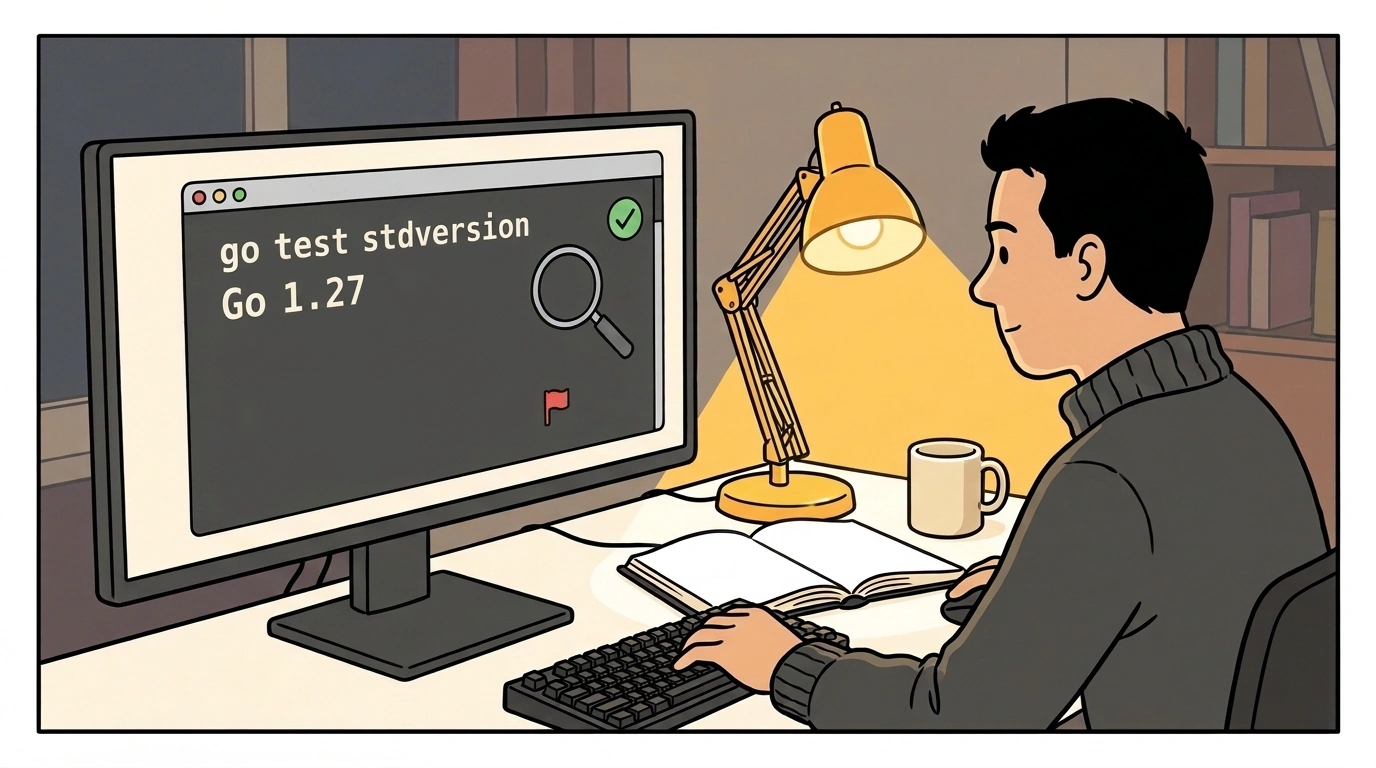
On the exact same machine with a fresh Go 1.27 compiler, the exact same ten-line project behaves in two mutually exclusive ways. You run go build, and the terminal silently produces a ready binary without a single warning. Right after that, you run go test ./..., and the package build immediately aborts with exit code 1, as if the compiler had suddenly forgotten how to understand a function it compiled a second ago.
The reason is that starting with Go 1.27, the test command enables the stdversion static analyzer by default. When I saw a breakdown of this case in the «Библиотека Go-разработчика» channel, it struck me how silently this issue used to slip through: if a project's go.mod declares go 1.25 while the code calls a function from a newer standard library, the regular compiler builds the program without complaint, and only the test suite now catches it in time. Let's look at why local builds created a false sense of security for years and how the toolchain now protects package authors from shipping updates that break downstream projects.
The Illusion of a Successful Build with an Older Version in go.mod
Every Go project has a go.mod manifest where a line like go 1.25 pins the minimum language version for the module. For a private web service running solely on your own server, that number rarely causes trouble: whatever compiler sits in the container is what builds the project. But the moment you publish a shared library or an internal package for teammates, go 1.25 becomes a public promise: the code is guaranteed to compile for anyone on version 1.25 or newer.
That is where a subtle cause-and-effect trap appears. Suppose you upgrade your work laptop to Go 1.27 and decide to clean up an old text-processing helper. Your editor's autocomplete suggests a handy standard library method—say, strings.CutLast or its byte counterpart bytes.CutLast, both introduced in the August Go 1.27 release. If you drop that call into a file, your local 1.27 compiler recognizes the function immediately because it sits right inside its own standard library on disk.
From there, the chain plays out predictably: since local go build sees the familiar function in its system sources, it builds the binary without question. If your repository's CI pipeline also runs on a fresh Go 1.27 image, the build passes with a green checkmark and you happily ship a minor library release. Half an hour later, a bug report arrives from a user whose corporate project is pinned to Go 1.25: their build fails complaining about an unknown identifier undefined: strings.CutLast.
Why didn't the compiler itself reject that call right away when it can see go 1.25 in the manifest? It comes down to separation of concerns inside the toolchain. Language syntax constructs—such as generic methods on structs or nested fields in literals added in the same release—are checked by the compiler's parser. If you write new syntax under an older go.mod directive, the parser halts the build immediately. The standard library (std), however, is just a collection of regular packages to the compiler. During compilation, it does not check the historical age of every individual function in strings or net/http, so newer calls slipped into code unnoticed.
How the stdversion Analyzer Checks Every Call's Passport
To close this blind spot without slowing down regular compilation, the language authors moved standard library version checks into the testing phase. Even before, go test automatically ran a compact set of the most reliable go vet rules (atomic, bools, buildtag, directive, errorsas, ifaceassert, nilfunc, printf, stringintconv, and tests) before executing tests. Starting in Go 1.27, the stdversion analyzer from golang.org/x/tools/go/analysis joined that mandatory default list.
It works like a security checkpoint at a building entrance, where the guard checks each badge's issue date against an access table. When go test runs, the analyzer finds every reference to the standard library (a function call, method, type, or constant) and looks up the toolchain metadata database to see which exact Go release introduced that public symbol.
Next, stdversion computes the target language version for each specific source file. The analyzer looks not only at the global go directive in go.mod, but also at build tags (//go:build) at the top of the file. If go.mod says go 1.25, but the file header carries //go:build go1.27, the analyzer knows that file will not be compiled on older toolchains and permits 1.27 features. Without such a tag, the go.mod threshold applies, and any newer symbol blocks the test run.
The stdversion analyzer only checks symbols from the Go standard library (std). It does not inspect functions from third-party packages in the require block, nor does it guarantee identical runtime behavior across language versions.
A Failure Scenario Using strings.CutLast
Let's see how this safeguard triggers in a real example on Go 1.27.3. Suppose we maintain the example.com/check module with go 1.25 declared in go.mod and write a Split function that extracts a file extension at the last dot using strings.CutLast:
// File go.mod:
// module example.com/check
// go 1.25

package example

import "strings"

func Split(s string) (string, string, bool) {
    return strings.CutLast(s, ".")
}
The Split function passes the input string s to strings.CutLast(s, ".") to split it at the last occurrence of a dot and return three values: the name before the dot, the extension after it, and a boolean success flag. Running go build on a machine with Go 1.27.3 compiles cleanly because the function is physically present in the installed strings package.
Now let's run the standard test command in the terminal, followed by commands to temporarily bypass the check or officially bump the module version:
# Standard test run on Go 1.27.3 exits with code 1:
go test ./...
# ./split.go:6:12: strings.CutLast requires go1.27 or later (module is go1.25)
# FAIL  example.com/check [build failed]

# Temporary bypass of vet checks during debugging and migration:
go test -vet=off ./...

# Official bump of the module's minimum version to 1.27:
go mod edit -go=1.27
go mod tidy
The go test ./... command aborts building the test package with exit code 1 and pinpoints the line, symbol name strings.CutLast, required version go1.27, and current module version go1.25. If you need to temporarily skip the check during a staged CI migration, -vet=off (or a targeted go vet -stdversion=false ./...) will do the trick, while go mod edit -go=1.27 paired with go mod tidy officially updates the minimum version in the manifest.
Bump go.mod or Preserve Code Compatibility
When stdversion halts your tests, the right fix depends on who consumes your code. If it is an internal microservice where build servers and containers have already moved to the Go 1.27 release, I consider bumping the version via go mod edit -go=1.27 the most pragmatic step. As a bonus, in modules with a go 1.27 directive, go mod tidy automatically merges scattered require blocks into at most two clean sections (for direct and indirect dependencies) while preserving comments.
On the other hand, if you maintain a public open-source library or a shared SDK, raising the go.mod version for a single helper function forces every user to upgrade their compiler immediately. Here it makes more sense to keep go 1.25 and replace the call with a classic index search via strings.LastIndex. And when a new function brings a measurable speed boost, you can split the implementation across two files: tag the fast path with //go:build go1.27 and the compatible fallback with //go:build !go1.27.
That is where sound judgment with built-in toolchain checks comes in. You should neither hardcode a permanent -vet=off flag in your scripts—stripping away automatic protection—nor blindly bump go.mod on every minor refactor. Treat a stdversion failure calmly, as a reminder to weigh the convenience of one new line of code against the real constraints of everyone who depends on your package.