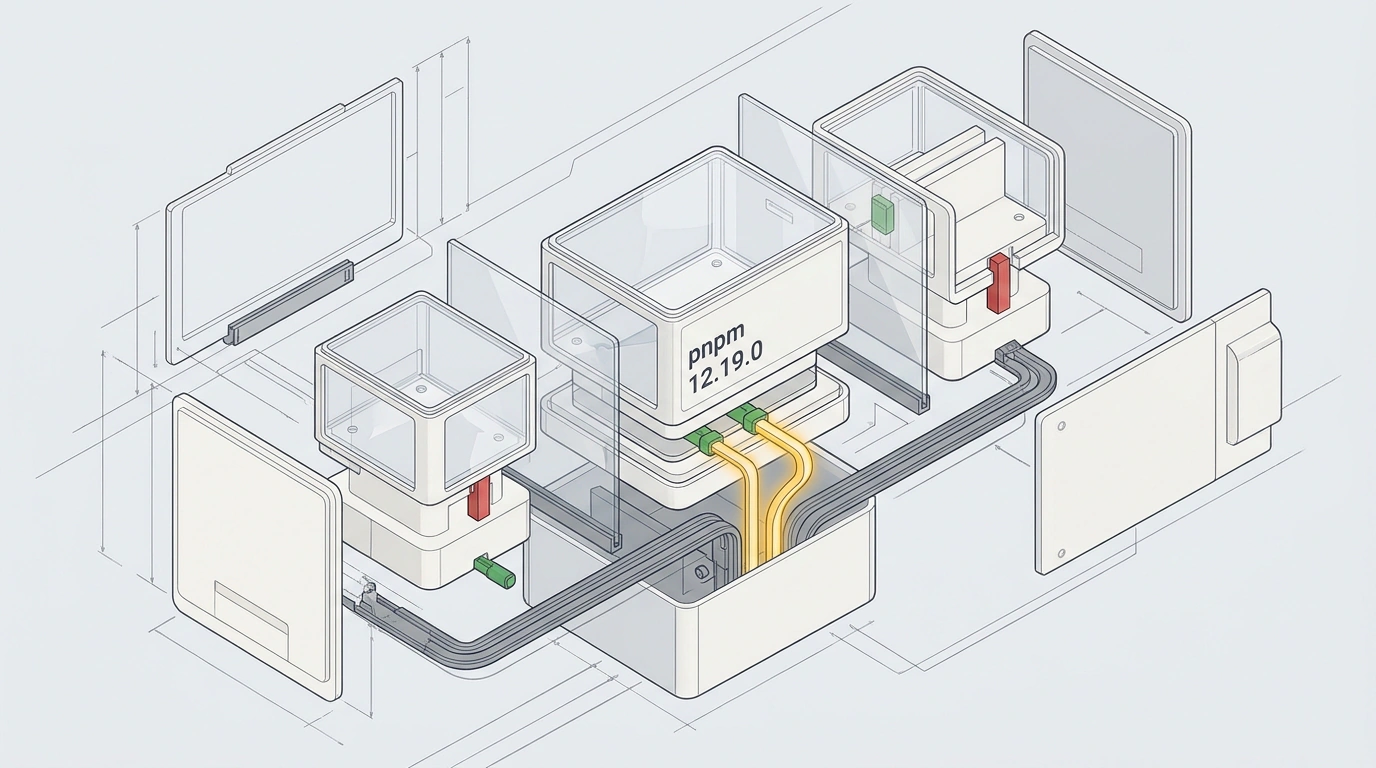
On November 10, 2026, lead maintainer Zoltan Kochan published the release of the pnpm 12.19.0 package manager on the official blog, developed in the open-source GitHub repository. By version number alone, the update is easy to mistake for a routine patch, yet it brings changes that reshape day-to-day work in large projects. What immediately caught my eye in the changelog was how the authors tackled package builds inside the shared store and hidden links within a single repository.
When several projects share one workspace (pnpm workspace)—say, a @my-org/web storefront and a neighboring backend service—friction often builds up between them. How do you keep such a monorepo from recompiling the same modules over and over, and prevent one package's dev tools from leaking into a neighbor's production build? Version 12.19.0 solves these problems through build caching in the global store, strict boundaries for optional peer dependencies, and a new lockfile format.
Transparent Author Support via the pnpm fund Command
Let's start with a CLI addition that was missing for parity with standard ecosystem tools. A modern project relies on hundreds of open-source libraries, and many authors include funding links in their manifests. Previously, collecting those in a pnpm project meant digging through configuration files by hand.
Now the manager ships with a built-in pnpm fund command. It walks installed dependencies and prints a tree of funding page links in the terminal. To open a package's page directly in your browser, just pass its name: pnpm fund <pkg>. If a library lists multiple donation platforms, the --which flag lets you pick the link by number.
In a monorepo, dumping details for every service at once is noisy, so the command supports --recursive, --filter, and --json. For instance, pnpm fund --filter @my-org/web --json outputs a JSON report solely for the @my-org/web storefront's dependencies. That export plugs straight into an internal company dashboard for allocating sponsorship budgets. And once the package list is clear, the next challenge is how to link and build those modules on disk quickly.
Evolution of the loaded node linker and Build Caching in sideEffectsCache
Standard pnpm mode builds a maze of symbolic and hard links inside node_modules pointing to a central store. In 2026, an alternative mode called nodeLinker.type: loaded arrived (we covered its mechanics in our piece on the pnpm 12.10.0 release). Put simply, it shifts from hanging paper signposts in every room to a unified filing cabinet: the runtime loads library code directly from the global store without thousands of symlinks.
Until version 12.19.0, this mode had a weak spot—packages with build scripts (postinstall). Previously, you had to manually list them in nodeLinker.excluded. The new release drops that mandatory requirement by pairing loaded mode with the side-effects cache (sideEffectsCache).
Here is how the speed gains and caveats balance out when reading and writing sideEffectsCache is enabled:
- Speed and disk savings: when a package in
@my-org/webneeds a build, pnpm compiles it once in a private directory, saves the result insideEffectsCache, and serves it straight from the store. Even if the script modified zero files, the manager remembers that and skips re-running the script in other projects sharing the store. Packages with cache misses, native.nodeaddons, and their dependencies are automatically materialized on disk. - Applicability limits and exclusions: you cannot cache everything blindly. First, packages whose scripts must run fresh in every project (such as git hook installers) still need to be listed explicitly in
sideEffectsCache.exclude. Second, pnpm scans JavaScript sources for__dirname,import.meta, and file imports, materializing such packages on disk. The static scanner catches direct references, but it cannot detect dynamically computed paths—libraries with paths concatenated at runtime still belong innodeLinker.excluded.
Workspace Isolation with projectScopedOptionalPeers and Protection from Neighboring Packages
Once module builds are tuned, monorepos reveal an even sneakier class of bugs—optional peer dependencies leaking across projects. Picture a shared kitchen where each tenant has their own shelf, yet someone accidentally grabs spices from a neighbor's counter.
Suppose @my-org/web has a bundler CLI tool installed in devDependencies for local layout work. Sitting next to it in the same monorepo is a backend service using a plugin that declares that tool as an optional peer dependency. Previously, the resolver saw the tool already present in the neighbor's devDependencies and wired it straight into the backend package's production (production) dependencies. Tests pass locally, but when you deploy the backend service into its own container, the build changes behavior or crashes.
To close this loophole, version 12.19.0 adds the projectScopedOptionalPeers setting (configured in .npmrc as project-scoped-optional-peers=true). When enabled, a workspace project receives an optional peer dependency only if it is explicitly installed in its own dependencies. A neighbor's devDependencies no longer leak across project boundaries, while dedupePeerDependents continues to deduplicate remaining packages as normal. Even with dedupePeerDependents: false, missing optional peer packages are no longer pulled from neighbors (resolution from the root is preserved only with resolvePeersFromWorkspaceRoot: true).
At the same time, the authors fixed adjacent dependency-graph edge cases, building on the dependency auditing from our pnpm 12.17.0 release overview. The manager no longer substitutes an optional peer dependency if its required peer packages conflict with the project's versions. And pnpm install --filter under sparse checkout now accounts for dependencies of workspace packages absent from disk, keeping the lockfile identical to a full checkout.
Experimental lockfile v13 Format and Workspace Environment Checks
Even with clean package isolation, teams still run into merge conflicts in pnpm-lock.yaml. In the old structure, version metadata lived under packages while resolved peer dependency links sat separately under snapshots, so updating one package touched the file in two places at once.
Release 12.19.0 introduces the experimental lockfile.format: v13 option. It switches pnpm-lock.yaml to a JSON-like YAML syntax with tab indentation and trailing commas. Instead of splitting packages and snapshots, each package version gets a single entry under packages, with peer dependency versions listed directly as properties. Updating a peer package only changes lines for its own version, reducing git conflicts. While pnpm itself reads both formats under any setting, v13 remains experimental: third-party CI scanners and bots that parse pnpm-lock.yaml outside the CLI may not recognize the new layout yet.
Beyond these four headline features, the release brings security and performance improvements. When an offline install fails on a missing tarball, registry auth tokens are stripped from the URL in the output, and unexpanded ${VAR} placeholders in registry URLs inside pnpm-workspace.yaml and .npmrc now raise an error. Install and execution commands (pnpm run -r, pnpm exec -r) validate engines (pnpm, node) and platform fields (os, cpu, libc) across every workspace package, including the root and devEngines.runtime. Unpacking large packages is 30% faster (benchmarked on the TypeScript archive), cold installs of a 1,350-package project with cloning on macOS under active security software got 29% faster, pnpm store add recursively adds folders of tarballs, and the release builds now include a NetBSD 10 x64 binary.
To upgrade your monorepo without surprises, follow this three-point checklist:
- Add
project-scoped-optional-peers=trueto.npmrcto cut off silent resolution of optional peer packages from neighboring services'devDependencies. - When enabling
nodeLinker.type: loadedwithsideEffectsCache, add git hook installers tosideEffectsCache.excludeand keep packages with computed file paths innodeLinker.excluded. - Before moving your team to
lockfile.format: v13, test the newpnpm-lock.yamlagainst your CI security scanners and auto-update bots.
This setup lets you immediately unlock fast builds from the shared cache and true package isolation in your workspace without breaking your existing delivery pipeline.
