Package manager pnpm has long earned a reputation in web development as the fastest, strictest, and most deterministic tool in the Node.js and JavaScript ecosystem. Its architecture—built on hard links and isolated symlinks—doesn't just save tens of gigabytes of disk space on developer laptops and CI runners; it also shields projects from the "phantom dependencies" that classic npm's flat node_modules tree is infamous for.
In late October, the team shipped pnpm 12.17.0, with full release notes posted in the pnpm repository. The update brings several long-awaited features for enterprise-scale monorepos, including a global peer-dependency conflict audit, declarative runtime pinning, and a surprise expansion of pnpm outdated into Rust (Cargo) and Python ecosystems.
Global Peer Dependency Checks Across Monorepos
One of the sneakiest, most frustrating bugs in large monorepos with dozens of internal packages has always been silent peer-dependency mismatches.
Picture a classic day in a growing repo:
- An internal shared UI library expects
react@^19.0.0; - A neighboring microservice or admin panel in the same workspace accidentally pulls in a dependency pinned to
react@^18.2.0; - Locally in dev mode, everything appears to work fine;
- Then the project builds in Docker or hits production, and suddenly duplicate React instances collide, hook contexts crash, and server-component hydration breaks.
Version 12.17.0 introduces a new pnpm peers check -g (or --global) command that scans every package in the workspace as a single dependency graph and prints a clear report of any peer-contract mismatches:
# Run a comprehensive peer-dependency check across the entire monorepo
pnpm peers check -g

# Recursively check for outdated dependencies across all workspaces
pnpm outdated --recursive
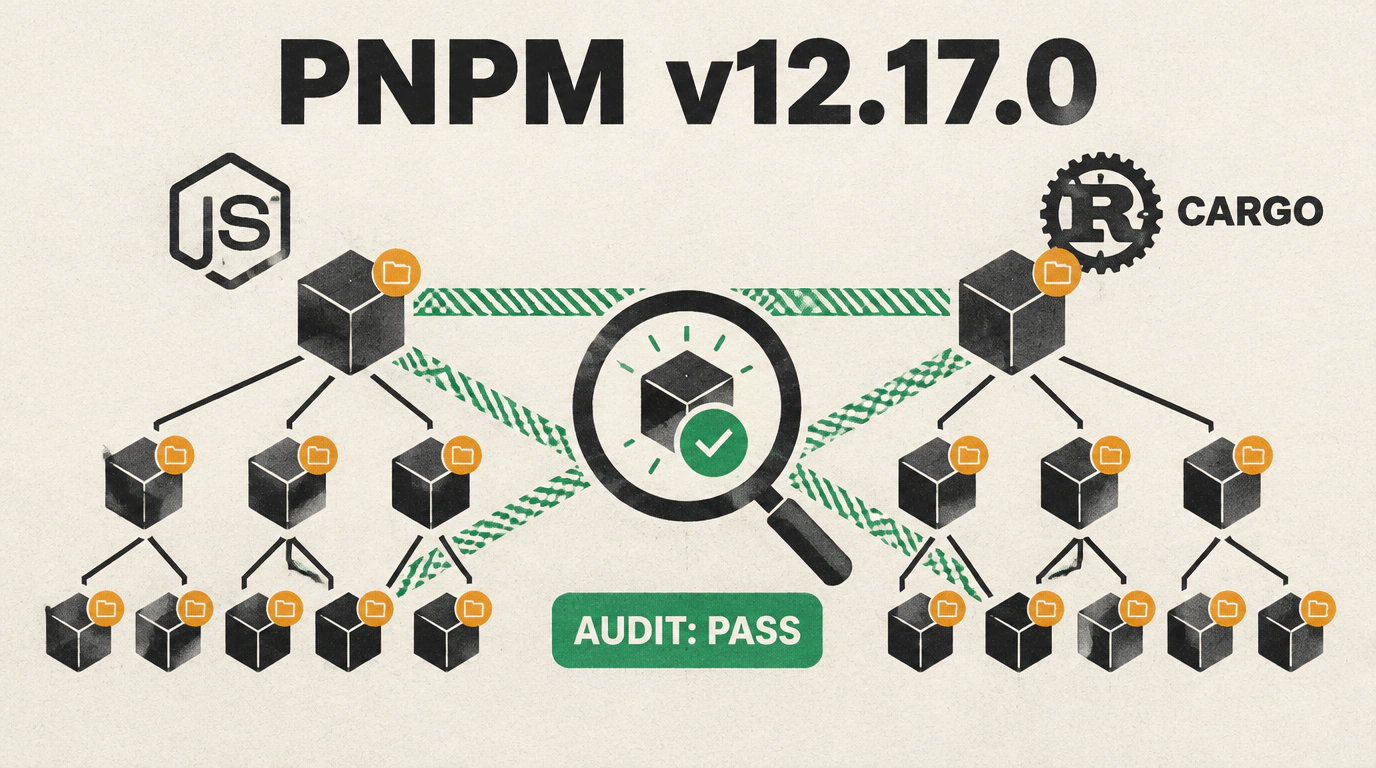
Look at what else changed in pnpm outdated: thanks to a modular analyzer architecture, pnpm can now peek into neighboring manifests in polyglot repos (Cargo.toml for Rust and pyproject.toml for Python) and flag outdated backend packages right inside the same CLI output. That's a massive quality-of-life boost for teams building compute backends in Rust or ML pipelines in Python alongside a TypeScript web frontend.
Strict Environment Pinning: The devEngines Section
The second major addition is native support for the devEngines field in package.json. Historically, teams enforced Node.js and package-manager versions using preinstall scripts, .nvmrc files, or external helpers like check-node-version.
Now you can declare those constraints natively right inside package.json:
{
  "name": "@my-company/core-platform",
  "version": "2.4.0",
  "private": true,
  "devEngines": {
    "node": ">=22.10.0",
    "pnpm": ">=12.17.0",
    "packageManager": {
      "name": "pnpm",
      "version": "12.17.0"
    }
  },
  "pnpm": {
    "overrides": {
      "lodash": "^4.17.21"
    },
    "peerDependencyRules": {
      "ignoreMissing": ["@types/react"]
    }
  }
}
If a developer or CI runner tries to execute pnpm install with an older Node.js version or an incompatible pnpm binary, the process aborts immediately with a clear error message before downloading gigabytes of packages. That puts an end to classic "worked on my laptop" environment drift and saves hours of debugging CI mismatches.
Lockfile v9 Evolution and Cache Reliability
If you've been following the pnpm v12 series, you may remember our deep dive into remote-cache optimizations in pnpm 12.15.0. In 12.17.0, the pnpm-lock.yaml v9 format gains extra submodule checksum integrity checks, preventing dependency-tree desyncs during messy Git branch merges.
The maintainers also tuned parallel tarball downloads from private npm registries. On corporate networks behind flaky proxies with high jitter, retries now use exponential backoff—eliminating spurious install failures over slow links.
You can upgrade right away via Corepack or global npm (corepack prepare pnpm@12.17.0 --activate). It's fully backward-compatible and doesn't require regenerating your lockfile—another reminder that strict, predictable builds and high speed go hand in hand.
