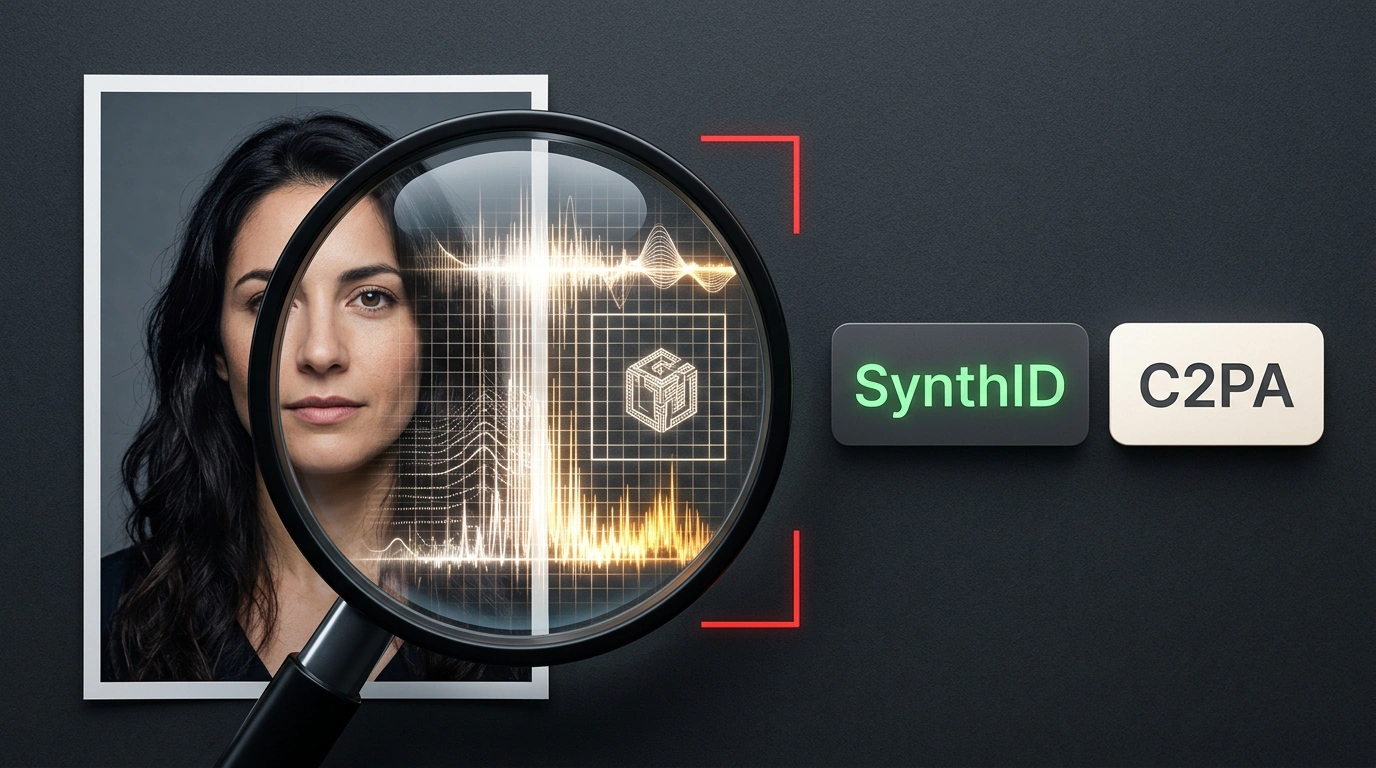
If you scroll through social feeds regularly, you've probably caught yourself thinking: "Is that photo actually real? Did that politician really say those words, or did someone clone their voice?" Over the past two years, generative models have gotten so good that spotting an Imagen 3 image or a Veo video clip with the naked eye is practically impossible. Six-fingered hands, plastic skin sheen, and out-of-sync lips are gone.
The digital world is staring down a full-blown trust crisis. Worse, the old defenses against fakes have completely fallen apart:
- Cryptographic metadata (the C2PA Content Credentials standard). Great idea on paper: a camera or generator embeds a cryptographic creator certificate into the file header. The moment someone forwards that photo on Telegram, posts it to VK, or takes a screenshot, compression servers strip the metadata clean off.
- Neural artifact detectors. Training classifiers to hunt for "unnatural pixels" turned into a false-positive nightmare. A slightly blurry twilight photo got flagged as "100% fake," while a polished deepfake with subtle film grain sailed right through.
Google DeepMind's research team came up with a mathematically grounded fix: invisible SynthID watermarking. Now that tool is built straight into the Gemini chat interface across all platforms. Let's look at how the check works under the hood.
Two-Factor Verification: How Gemini Inspects Incoming Files
The updated Gemini interface adds a dedicated media validation flow. You can drag any suspicious photo, audio clip, or video into a chat and ask: "Check if this file was generated by AI."
Under the hood, the system runs a two-stage forensic pipeline:
- Layer 1: C2PA Credentials. The system checks the integrity of Content Credentials headers, tracing the file's provenance chain, source device, and editing history.
- Layer 2: SynthID Scan. If metadata was stripped or corrupted, deep spectral analysis kicks in. The algorithm hunts for an invisible statistical watermark woven directly into the signal structure.
When Gemini spots signs of generation, it doesn't just shrug with a flat "yes/no." It outputs a detailed breakdown: highlighting specific regions of an image or pinpointing exact timestamps in an audio track (for instance, "speech segment from 0:14 to 0:28 was generated by AI"), along with a statistical confidence score.
Spectral Magic: Why Filters Can't Wash Off SynthID
What sets SynthID apart from legacy watermarks? Traditional watermarks are either a translucent logo stamped in the corner or hidden noise tucked into least-significant bits (LSB steganography). Crop the image or re-save it as a compressed JPEG, and those marks vanish in a second.
SynthID takes a different route. Instead of modifying raw pixels, it embeds the watermark across the frequency bands of a mathematical signal transform:
- Images: The watermark spreads across the frequency spectrum. Invisible to the human eye, it survives heavy JPEG compression, resizing, cropping, and even aggressive Instagram color filters.
- Audio: The mark modulates the microstructure of the sound spectrogram. You can re-encode audio to low-bitrate MP3, speed playback up 1.5x, or layer street noise over it—the mathematical pattern holds and the detector reads it cleanly.
- Video: Synchronous frame-by-frame marking survives re-rendering and uploads to YouTube or TikTok.
Limits of Trust: Where the Tool Hits a Wall
As clever as it is, SynthID isn't an all-seeing eye. The system has one fundamental limitation you need to keep in mind.
SynthID can only detect content that had the watermark embedded at creation time. If an image came out of Google's tools (Imagen 3, Veo, Gemini), the detector catches it with near-100% reliability. Adobe, Microsoft, and OpenAI are also part of the C2PA alliance adopting similar standards.
If a bad actor spins up an open-source Stable Diffusion or FLUX model locally without watermarking modules, though, there is physically no SynthID spectral mark inside the file. In that case, Gemini will honestly report that no verified watermarks were found.
There's also the "analog hole": print an AI photo on a color printer and snap a picture of it with a cheap phone camera, and the physical distortion of paper and optics can break the delicate spectral harmonics.
Still, baking this check into a mass-market consumer interface is a huge leap forward. Millions of people now have a fast, free fact-checking tool to filter out viral digital fakes in seconds.
