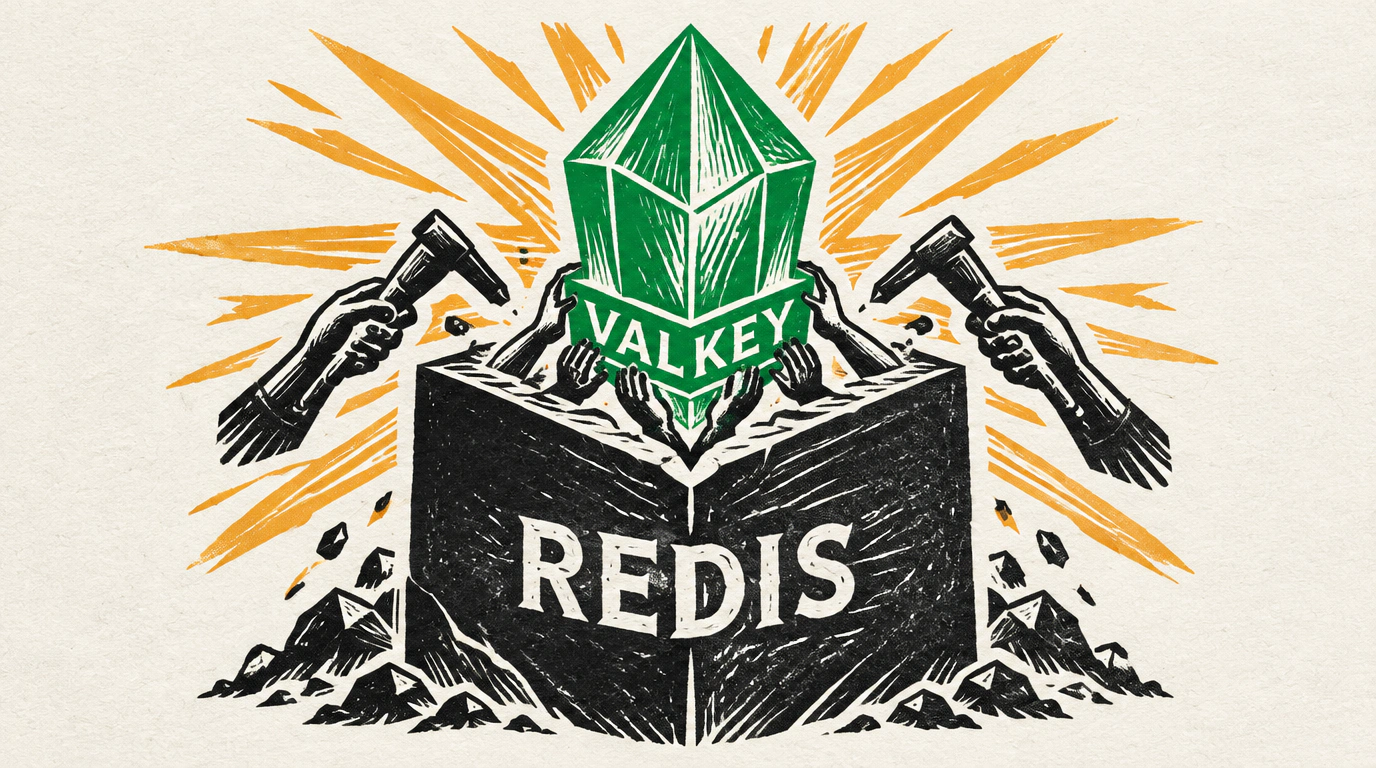
The saga around Redis—one of the world's most popular and beloved in-memory databases—will go down in software-project management textbooks as a case study in how to torch fifteen years of engineering community trust with a single press release.
For well over a decade, Redis stood as a gold standard of free and open-source software. Created in 2009 by Italian engineer Salvatore Sanfilippo (antirez), the project shipped under the ultra-permissive BSD-3-Clause license. Any developer, startup, or corporation could freely use, modify, and embed Redis into their products with zero licensing fees.
After antirez stepped back, however, commercial steward Redis Ltd. decided to rewrite the rules: the company abandoned open source in favor of source-available licenses RSALv2 and SSPLv1, barring cloud providers from offering managed Redis without paying for a commercial license.
Born in Eight Days: The Rise of Valkey
Redis leadership bet that cloud giants would come hat in hand and start writing million-dollar licensing checks. Instead, the industry did the exact opposite.
Core database contributors who opposed the commercial squeeze teamed up with major tech players—Amazon Web Services (AWS), Google Cloud, Oracle, Ericsson, and Snap Inc. Under the neutral umbrella of the Linux Foundation, they launched a fully open-source fork named Valkey, cementing their public commitment in the Linux Foundation announcement.
From there, momentum snowballed:
- Valkey forked the last open-source release, Redis 7.2.4, preserving 100% backward compatibility across wire protocols, command APIs, and RDB/AOF data formats.
- The project legally locked in a perpetual BSD-3-Clause license and formed a neutral Technical Steering Committee where no single corporation holds a deciding vote.
- Major Linux distributions (Debian, Fedora, Ubuntu, Arch Linux, Alpine) dropped proprietary Redis from their official package repos, making Valkey the default system cache server.
- AWS migrated millions of ElastiCache nodes onto the Valkey codebase, sparing customers from third-party vendor licensing fees.
If you're also curious about modern alternatives in in-memory storage, take a look at our recent breakdown of KiviDB, a high-performance store written in Rust.
The Core Lesson of Open Governance
The Redis licensing drama taught the industry a tough but healthy lesson. You can't privatize a public utility built by thousands of contributors worldwide. The real strength of Open Source is that code can't be locked in a vault: the moment a commercial owner tries to strong-arm the community, the community forks the repo and moves on without them.