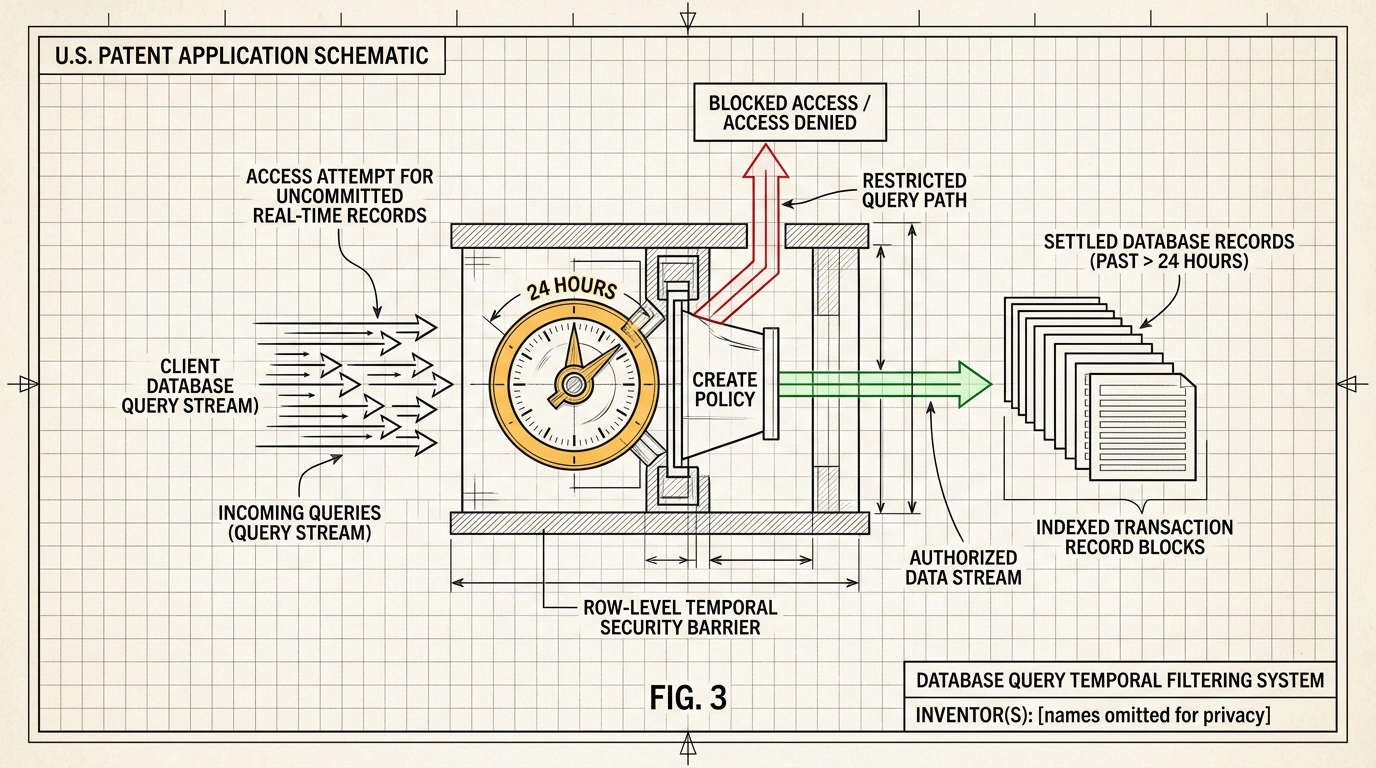
From the outside, data security in a fintech service appears to rest entirely on the backend: controllers check permissions, and the ORM appends date filters to queries. Yet under the hood, a quiet loophole opens up: alongside the main application, reporting marts, BI dashboards, and engineers with a psql console all query the tables directly.
A breakdown by SQL Portal illustrates a real fintech requirement: analysts need access to the transactions table, but strictly with a 24-hour delay to protect against fraud and insider trading. How do you block reading fresh rows at the DBMS level so that no direct SQL query can bypass the quarantine? The answer is the Temporal RLS pattern—PostgreSQL Row-Level Security policies with a time condition.
Why Application and Mart Filters Miss Direct Queries
The usual approach is to add WHERE transaction_time <= now() - interval '24 hours' in service code or configure a filter inside the BI tool. The trouble is that this restriction only lives inside that specific client. The moment an analyst connects to the database via a SQL client for an ad-hoc export or points a dashboard straight at transactions, application filters are bypassed and operations from one second ago show up in the results.
Hiding the table behind a VIEW does not always save you either: while debugging reports, someone can easily grant a direct SELECT on the underlying table or create an admin view without security invoker mode. For protection not to depend on human vigilance, the rule has to move inside the table itself—where the database kernel checks every row before returning it.
Built-In Time Filter and Forced Mode for the Owner
Row-Level Security (RLS) acts as an automatic filter on table output: you define a rule for a role once, and the planner appends the condition to every query. I checked the syntax against the PostgreSQL documentation—look at the three commands that establish a 24-hour quarantine for the analysts role on the transactions table with a transaction_time column:
ALTER TABLE transactions ENABLE ROW LEVEL SECURITY;
ALTER TABLE transactions FORCE ROW LEVEL SECURITY;

CREATE POLICY delay_24h ON transactions
    FOR SELECT
    TO analysts
    USING (transaction_time <= now() - interval '24 hours');
The first command turns on row-level filtering, and the third creates the delay_24h policy: the expression in USING checks that the record's timestamp trails the transaction start now() by at least 24 hours. Now an analyst can run a plain SELECT * FROM transactions; from psql or a BI panel and, without a single WHERE, receive only records older than a day.
The second line—FORCE ROW LEVEL SECURITY—closes an important gap. By default, the table owner (table owner) reads all rows bypassing any policies. If scripts or data marts connect under the schema owner's account, the barrier will not apply to them without FORCE. Forced mode restricts bypasses strictly to superusers (SUPERUSER) and roles with the BYPASSRLS privilege. The DDL commands themselves live in Git migrations and are verified in automated tests, as we covered in our overview of tools for testing RLS against a real database.
Time Indexes and Nuances of Combining Policies
Won't such a check trigger a full table scan (Seq Scan) across millions of rows? The shape of the condition transaction_time <= now() - interval '24 hours' saves you here. Because the transaction_time column sits on the left with no function wrappers, and now() returns a constant transaction timestamp, the optimizer uses a standard B-Tree index on transaction_time and prunes fresh data in milliseconds.
As the schema grows, keep two details in mind. First, PostgreSQL combines multiple policies with OR by default. If you need to add a branch filter on top of the time delay, declare the second policy AS RESTRICTIVE so the conditions combine with a strict AND instead of exposing fresh rows for that region. Second, hidden rows still participate in foreign key checks, so a cascading delete on a referenced row will return an error if a transaction from today points to it.
Moving time-based rules into the database schema eliminates duplicate checks across services and connectors. Ultimately, all of this strict engineering serves a simple human need—peace of mind: when the database holds the perimeter itself, you never have to wonder whether someone forgot one WHERE clause in the latest report.