"A bundler rewritten from scratch in Rust that runs as a standalone binary without Node.js and speeds up cold builds of React Spectrum by up to 100x"—that is how the Parcel 3 Alpha authors opened their November announcement in JavaScript Weekly. When I lined this release up against the week's other updates, a clear engineering theme emerged: tools are shedding intermediate layers and tightening type checks across every tier of a project.
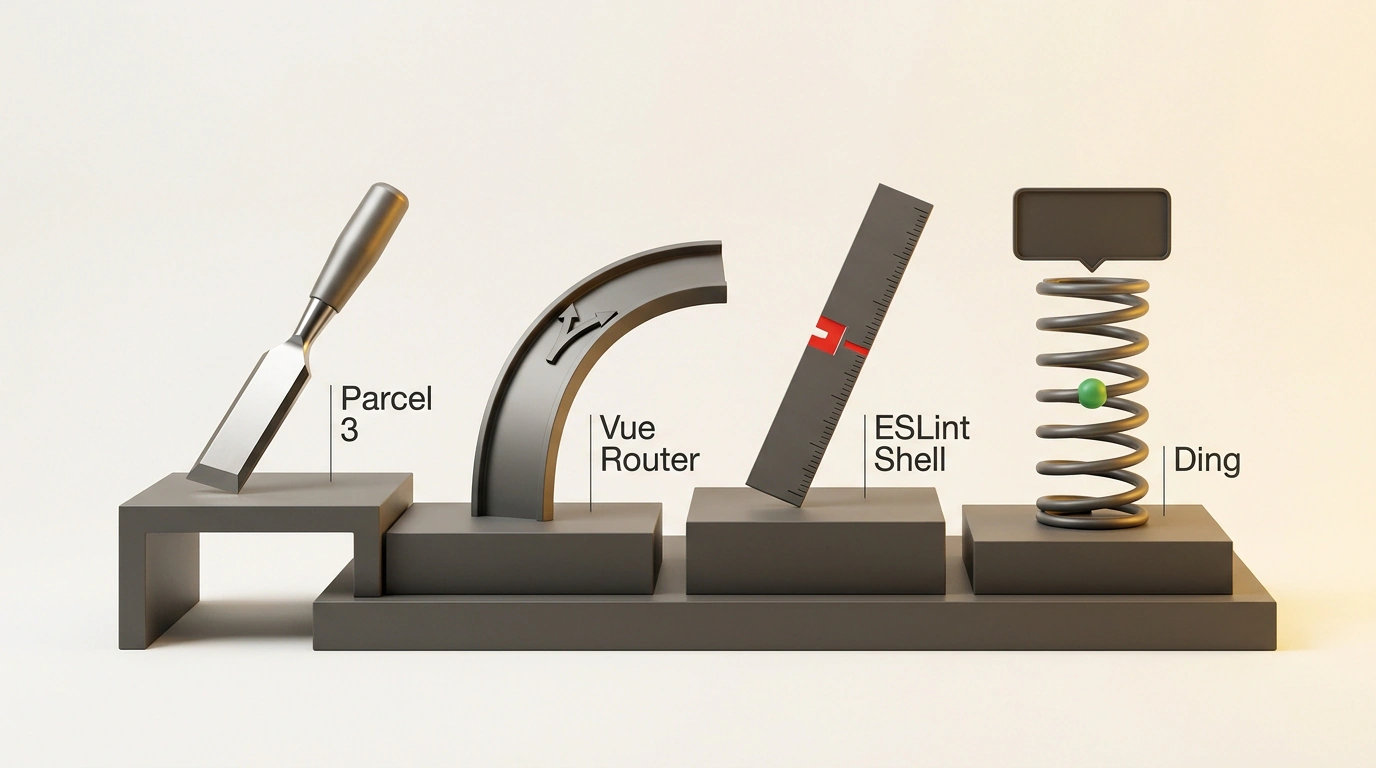
You have probably seen how technical debt quietly piles up in an app: the bundler wastes seconds shuttling data between threads, the router confuses identically named URL parameters, Bash deploy scripts live without any audit, and toasts drag in extra styles. Let's look at how Parcel 3 Alpha, Vue Router 5.5.0, the @eslint/shell plugin, and the Ding library tackle these issues.
Parcel 3 Alpha
For years, bundlers relied on a hybrid architecture, which Parcel 2 followed too: coordination stayed in Node.js while heavy work moved into native modules. The compiler itself was fast, yet on large repositories the boundary between the V8 virtual machine and native code became the bottleneck. Constant serialization of the module graph between JavaScript and Rust, combined with garbage collector pauses, ate up the lion's share of build time.
In the November Parcel 3 Alpha release, the team removed Node.js from the build loop completely. Version 3 runs as a single standalone Rust binary where graph traversal and bundling happen in shared memory. On the large React Spectrum library, that shift sped up cold builds by up to 100x compared to Parcel 2.
To preserve ecosystem compatibility—a trade-off we examined in our analysis of porting toolchains to Rust and Go—the authors split plugins into two tracks. Native extensions are written in Rust, Go, or Swift over a C ABI, while existing JS plugins run inside an embedded lightweight QuickJS engine inside the binary. For now, the v3 branch is in Alpha and meant for test runs rather than production.
Vue Router 5.5.0
Once builds fly, reliability focus shifts to navigation. It is easy to assume the address bar and browser history just work on their own. In reality, the moment a user opens a route with an :id parameter and lands with an ad tag like ?id=promo, a subtle value collision happens inside the component.
Released on November 10 by Eduardo San Martin Morote (@posva) and noted in VueDigest, Vue Router v5.5.0 emits a warning whenever query parameter names collide with route params. At the same time, the build plugin and language server pair now types defineProps() with route parameters when definePage({ props: true }) is enabled, stripping internal fields at build time.
Scroll handling changed as well. Previously, scroll coordinates were stored in history.state, which overflowed browser history memory limits during heavy navigation. In version 5.5.0, position saving moved to sessionStorage with an in-memory fallback and configurable capture triggers.
@eslint/shell
In almost any project's scripts/ folder sits a familiar contradiction: TypeScript code is checked down to the last comma, while Bash deploy scripts are written blind. One forgotten quote around a variable with a space can break a midnight release, yet few teams bother installing a separate system linter for a handful of files.
The official November @eslint/shell plugin brings linting for Bash, POSIX sh, and mksh scripts straight into a standard ESLint run. The mvdan-sh parser converts shell commands into an ESTree AST, letting you enable ShellCheck-grade rules inside your shared flat config and extending the workflow from our ESLint v10.14.0 update overview.
Let's add deploy-script auditing to eslint.config.js to catch unquoted variables and deprecated backticks automatically:
import { defineConfig } from "eslint/config";
import shell from "@eslint/shell";

export default defineConfig([
  {
    files: ["scripts/**/*.sh"],
    plugins: { shell },
    language: "shell/posix",
    rules: {
      "shell/no-unquoted-expansions": "error",
      "shell/no-backticks": "warn"
    }
  }
]);
When the linter runs, files: ["scripts/**/*.sh"] activates the shell/posix language mode for automation scripts. The shell/no-unquoted-expansions rule set to "error" fails the build if it spots an unquoted variable expansion that could split into separate arguments on a space in a path.
The shell/no-backticks rule flags legacy backticks and suggests replacing them with $(...), which handles nested calls predictably. The plugin requires the modern flat eslint.config.js format.
Ding
In the user interface, that same fight against extra noise shows up clearly in toast notifications. Conventional libraries stack up cards on rapid clicks with rigid CSS Bézier curves that stutter if you interrupt an animation mid-flight. The new open-source Ding library by Yusuf Cengiz, featured in Best of JS, keeps exactly one toast on screen, morphing its shape and text in place.
Motion is driven by a spring physics solver. When a toast.loading indicator transitions into a toast.success response, the pill preserves its current momentum and smoothly resizes, while race-condition protection prevents an older request from overwriting a newer message. The @yusufceng1z/ding core has zero dependencies, injects styles from JS, and includes packages for React 18+, Svelte 5, vanilla DOM, and installation via npx shadcn@latest add @ding/ding with Alt + T and Esc navigation, prefers-reduced-motion support, and sound cues.
Putting these four releases together makes it easy to see where the ecosystem is heading. Web development tools are moving away from fragmented script wrappers toward standalone native binaries, a unified static-analysis pipeline for every file in a repository, and concise status components with no external dependencies.
