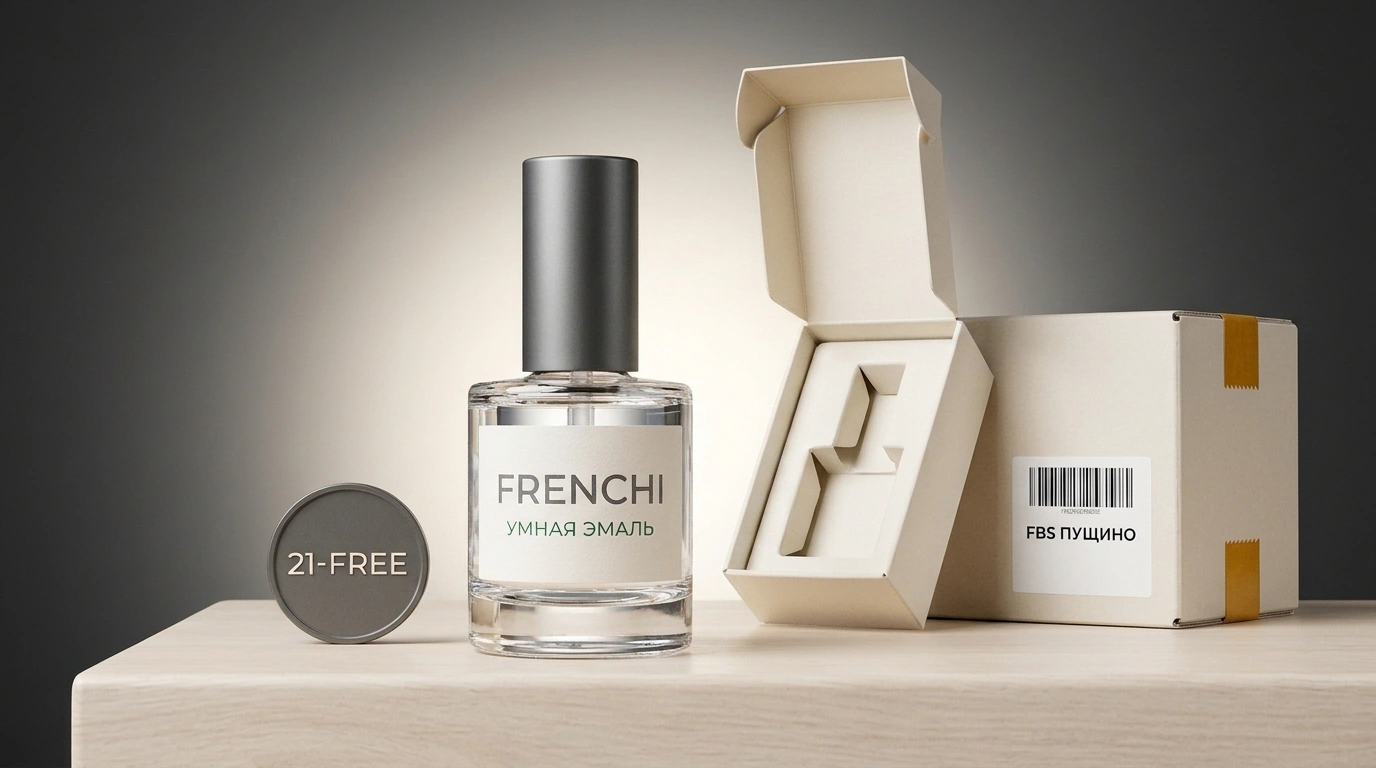
When a legacy manufacturer with a 25-year track record decides to enter marketplaces, it usually starts with the same naive assumption: "We've been in every pharmacy across the country for a quarter-century, millions of women know our name—we'll just dump inventory into the warehouse and skim the cream off the top." You've probably watched plenty of big factories try to kick down the e-commerce door like that. Nine times out of ten, the experiment ends in a quiet disaster: marketplace hubs lose pallets, pharmacy chains slap them with million-ruble fines for price dumping via the Permanent Buyer Discount (SPP), and unit economics crater under paid intake and returns.
The story of Frenchi (Umnaya Emal, or "Smart Enamel") is a rare exception where a conservative cosmetics giant didn't just survive on Wildberries—it completely rewired its internal DNA. The brand has been on the Russian market since 2001. For a quarter-century, it grew strictly through traditional distribution: national pharmacy chains, L'Etoile and Rive Gauche shelves, and regional wholesalers operating on 90-to-120-day payment terms.
Today, the picture has flipped completely: e-commerce generates over 50% of the company's total revenue. Commercial Director Mikhail Batkov recently walked through the inner workings of this transformation. I dug into their playbook so we can trace the entire chain without the marketing fluff—from sealing bottles at their own factory in Pushchino to a forced pivot into FBS and a ruthless purge of dead-weight SKUs.
Pushchino Over Chinese Outsourcing: Inside a Full-Cycle Factory
The first thing that jumps out about Frenchi's model is its flat-out refusal to use contract manufacturing. Most modern cosmetics brands on marketplaces follow a basic script: find a factory in China or a workshop outside Moscow, slap their label onto a stock base, and pray aggressive ads do the rest. When you're selling therapeutic nail care, that path guarantees failure on the very first quality audit.
Umnaya Emal's production base is its own 8,000 m² facility in the science town of Pushchino, Moscow Region, staffed by roughly 100 people. The entire cycle happens under one roof: from synthesizing formulas in the R&D lab to cooking enamels in reactors, bottling, and automated quality control.
Every product meets strict European 21-free safety standards—meaning 21 potentially toxic ingredients, including formaldehyde, toluene, dibutyl phthalate, camphor, and heavy resins, are completely excluded. Pharmacy retail has always demanded tight formula compliance, but on marketplaces, owning the factory unlocked an unexpected edge: controllable cost of goods and instant reaction to stockouts.
When a seller relies on third-party factories, every attempt to scale hits production queues and missed deadlines. As we saw when breaking down Bonito Kids' manufacturing model and unit economics on Wildberries, owning production lines only pays off when the machines are synced with demand analytics. At Frenchi, developing a new formula in the R&D lab takes 6 to 12 months. Once approved, though, the plant can flexibly scale batch sizes and push out up to 100,000 units in peak months without paying middlemen rush fees.
The Logistics Pivot: Why They Cut FBO and Pushed FBS to 50%
When Frenchi first launched on Wildberries, the brand took the path of least resistance—100% FBO (Fulfillment by Operator, shipping from the marketplace's warehouses). On paper, sending mono-pallets to Koledino, Elektrostal, and Kazan looked like the fastest way to grab the green fast-delivery badge and max out the localization index.
That illusion shattered as soon as systemic bottlenecks hit the central sorting hubs. Pallets sat in receiving queues for weeks, pre-holiday warehouse congestion piled up, and sudden intake freezes threatened steady sales. When FBO inventory gets stuck in line, a top-performing listing loses organic search visibility overnight.
So the brand made a radical call: it rebuilt its Pushchino factory warehouse for FBS (Fulfillment by Seller, shipping from its own facility) and raised FBS from an initial 25–30% to 50% of all shipments.
Here is how that hybrid setup works in practice:
- Core bestsellers stay on FBO: high-turnover SKUs with predictable demand are palletized across key marketplace clusters to guarantee 24-hour delivery in Moscow and major regions.
- Wide assortment and new launches run on FBS: orders are packed and dispatched directly from the factory warehouse as customers buy. If a central WB hub seizes up, the listing never goes out of stock—the system automatically routes orders to the Pushchino warehouse.
Glass nail polish bottles also forced a complete overhaul of the packing line. A glass bottle is fragile, and boxes on WB sorting conveyors take serious drops. To avoid bleeding money on breakage and leaks, Frenchi introduced tight individual shrink-wrapping for every bottle, reinforced inserts for sets, and mandatory barcode scanning before sealing each master carton. As a result, logistics-related claims stay minimal, and the business is insulated from warehouse meltdowns.
Winning the Shelf Without Dumping: Channel Conflict and the SPP Trap
The single most painful knot any offline-first brand has to untangle is channel conflict.
Picture the classic standoff: you have long-term contracts with national chains (L'Etoile, Rive Gauche, pharmacy distributors) locking in a strict Recommended Retail Price (RRP)—say, 450 rubles per bottle. Then your product lands on Wildberries, where the platform's algorithm automatically applies a 20–25% Permanent Buyer Discount (SPP). Shoppers see a 340-ruble price tag, online sales spike, and the next morning a pharmacy chain's commercial director calls with an ultimatum: match the price or pull your stock off our shelves.
Frenchi solved this dilemma by structurally splitting its product matrices. Instead of fighting WB's SPP algorithm, the company built product differentiation.
Separate your online and offline SKUs: if you sell single bottles with SPP on a marketplace, retail chains will bury you in RRP violation claims. Curated 2–3 product sets create a unique SKU that simply doesn't exist on supermarket shelves.
For Wildberries, the team created dedicated formats you cannot physically buy in brick-and-mortar stores:
- Dual-action promo bundles (for example, the signature clear Nail Strengthener paired with nourishing cuticle oil);
- Family-size care kits with increased volume;
- Exclusive nail-plate regeneration sets in individual gift boxes.
Marketplace shoppers get a great deal on the bundle, offline chains see zero direct dumping on core single SKUs, and the seller's unit economics win on a higher average order value: shipping one 700-ruble bundle under WB's tariffs is dramatically cheaper than shipping two separate 350-ruble bottles. We explored a similar anti-dumping play when analyzing how 21 Vek Svet avoided price wars on Wildberries: sustainable margin always comes from managing bundle value rather than racing to the bottom.
Ruthless ABC Analysis: How 200 SKUs Get Trimmed of Dead Weight
Today, Frenchi's Wildberries account runs roughly 200 active SKUs—a hefty cosmetics lineup spanning strengtheners, calcium gels, brighteners, oils, decorative colored enamels, and polish removers. Keeping 200 items stocked evenly across marketplace warehouses is a surefire way to freeze working capital and rack up massive paid-storage bills.
Studio composition with nail polish bottles on a three-tier ABC analysis podium with labeled sections A, B, and C.
Mikhail Batkov enforces a regular ABC matrix review with a strict rotation rule:
- Group A (revenue drivers): the undisputed leaders—the classic Nail Strengthener and core therapeutic complexes. They generate the lion's share of orders, so warehouse stock is maintained at 30–45 days of coverage.
- Group B (steady second tier): specialized treatments like cuticle oils, anti-peeling formulas, and base coats that build repeat customer baskets.
- Group C (high-risk zone): decorative colored polishes and niche launches. Color trends shift in waves, and locking cash into dozens of slow-moving shades is fatal.
If a Group C SKU fails to hit its target turnover within 60 days, its fate is sealed immediately: the item is cleared out via temporary promos and pulled from active production. Even though the official shelf life is 36 months, the company refuses to let stock gather dust. The Pushchino lines quickly retool to bottle high-margin Group A bestsellers instead.
AI in Beauty and Systematic LTV Work
One of the sharpest parts of Umnaya Emal's strategy is how it uses AI and manages customer retention. The brand refused to replace real photographers with cheap AI-generated product shots, but found a practical niche for generative AI: creating contextual lifestyle backgrounds for real studio bottle photography and automating first-pass review analytics.
In beauty, reviews make or break a listing. No one is putting a treatment on their nails if comments mention burning, a weird smell, or peeling. At Frenchi, feedback management is treated as a core business process.
The real goal here is maximizing LTV (Lifetime Value). With regular course use, a bottle of strengthener runs out in 1.5 to 2 months. If the buyer sees real results, she comes back for a refill. Every marketplace package includes a clear instruction insert with an application calendar and cross-sell recommendations for complementary care products. And replies to Wildberries reviews aren't robotic copy-paste templates—they are real specialist recommendations explaining how to combine products for the best therapeutic effect.
Key Takeaways for Sellers
Frenchi's experience proves that in an era when marketplaces are rapidly reshaping under new platform-economy regulations (something we covered in Wildberries' history and the platform economy law), the winners aren't resellers chasing quick flips—they are operators building a real system.
If you're growing a brand or scaling manufacturing on marketplaces, keep Umnaya Emal's four rules in mind:
- Don't put all your eggs in FBO: a 30–50% FBS hybrid buffer protects your listings from hub meltdowns and sudden stockouts.
- Protect offline retail with unique SKUs: build marketplace-exclusive bundles so SPP algorithms never trigger price wars with retail chains.
- Cut Group C without mercy: 60 days below target turnover is your cue to liquidate and free up warehouse space for top performers.
- Optimize for LTV, not one-off sales: in repeat-purchase categories, real profit sits in reorders 6–8 weeks later—good packaging and clear usage guides pay for themselves many times over.