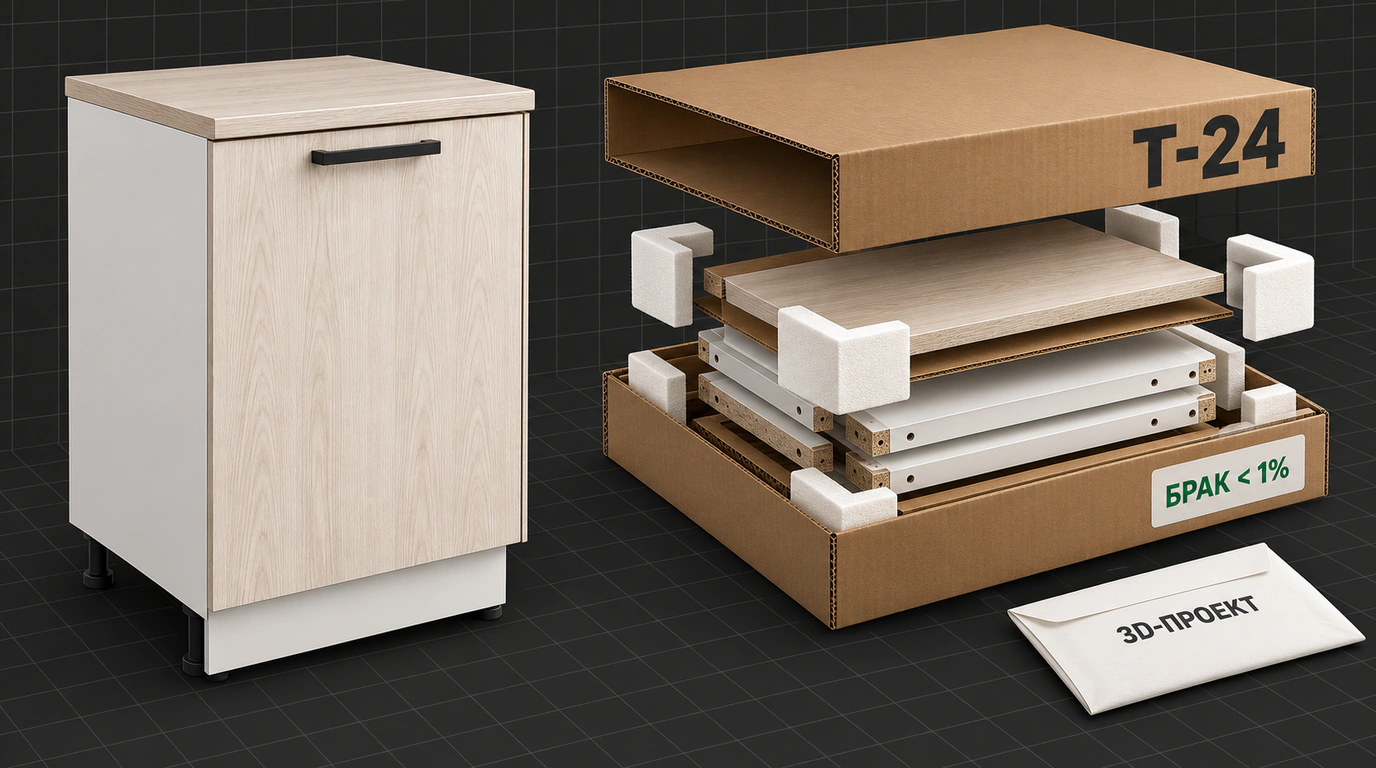
Selling oversized furniture on marketplaces was long viewed among sellers as a suicide mission. Ask almost any veteran supplier and they'll wave you off: jumping into wardrobes and kitchens on Wildberries is a fast track to going broke. Bulky-cargo (KGT) logistics are expensive, sorting hubs drop heavy boxes from waist height, and if a buyer spots a single chipped door at the pickup point, they reject the entire set. You end up paying to ship hundreds of kilos of particleboard back and forth.
Yet the Belarusian brand SpadarDreva and its founder Alexey proved that if you treat furniture like an engineering system instead of box-flipping, high-ticket items on marketplaces can deliver steady profit. Alexey started on Wildberries back in 2016 reselling everyday Chinese goods. Endless price wars and erratic margins pushed him into a radical pivot: in 2022, the brand launched its own line of modular kitchens on WB.
I studied their operating model closely and pulled out three engineering and logistics decisions that keep their defect rate below 1% while scaling across Russia, Belarus, Kazakhstan, and Armenia.
Ditching Custom Orders: The Magic of a Standardized Kit
Traditional furniture retail runs on two extremes: cheap mass-market cabinets of questionable quality, or bespoke kitchens with home measurements, weeks of revisions, and price tags starting at 200,000 rubles. Trying to transplant that custom showroom model onto a marketplace is doomed—online buyers won't wait two months for a pig in a poke.
SpadarDreva chose a hybrid path: a modular construction kit. The company partnered with major factories in Belarus to mass-produce standardized modules from quality laminated particleboard (LDSP) and MDF.
Here is how their product matrix is structured:
- 15 modular lines: spanning kitchen sets, bathroom vanities, walk-in closets, and dressers;
- Roughly 40 interchangeable modules per series: upper and lower cabinets, tall pantries, and corner units in matching colors and textures;
- Batch manufacturing: every component stays in stock, cutting delivery from months of waiting down to just a few days.
Flat-Pack Engineering: Beating Transit Damage
The biggest bottleneck in furniture logistics is transit. According to the brand's data, roughly 60% of all damage happens on the road—boxes shift during truck transfers or take corner hits on Wildberries sorting lines.
To drive breakage down, their engineers designed a true flat-pack system:
- Heavy-duty five-layer corrugated cardboard (T-24 grade and up): holds structural geometry and absorbs point impacts.
- Polyethylene foam corner bumpers: take the brunt of the kinetic energy when a carton lands on an edge.
- Tight stretch-wrap: keeps moisture out and prevents cardboard delamination at transit terminals.
Still, the real secret weapon isn't just cardboard—it's how they handle claims.
How Replacement-Part Service Saves Unit Economics
When a buyer unboxes a kitchen and finds a chipped cabinet door, most sellers force them to return the entire heavy box through the pickup point. SpadarDreva does the opposite: every carton includes a direct link to customer care. The buyer sends a photo of the damaged part, and the factory immediately couriers out a single replacement front. Unit economics win big: shipping one panel costs a fraction of hauling an entire heavy cabinet back and forth.
3D Layouts in Chat: Removing the Buyer's Biggest Fear
Why do people hesitate to buy furniture online? The number-one barrier is fear of getting dimensions wrong—missing a pipe, a range hood, or a gas meter. It's tough for an everyday shopper to picture how separate cabinet SKUs will come together on their actual wall.
SpadarDreva turned customer support into its primary conversion engine:
- The buyer measures their kitchen, snaps photos of utility hookups, and drops them into the brand's support chat;
- In-house designers build a full 3D layout and exact parts spec free of charge;
- The customer gets a ready-to-buy list of Wildberries SKUs tailored to fit their wall down to the centimeter.
In peak months, Alexey's team processes up to 1,500 custom 3D layouts. That service removes buyer anxiety and shields the seller from size-mismatch returns. We've seen similar high-ticket nurturing mechanics in our breakdown of custom furniture lead funnels: upfront expert guidance builds trust and protects pricing power even in crowded niches.
FBO vs. Dedicated Distribution Warehouses
Early on, the brand leaned heavily on FBO, sending pallets into marketplace warehouses. As dimensions grew and the catalog expanded, relying on marketplace intake limits became too risky.
Today the company runs a hybrid setup: it operates its own central distribution hub in the Moscow Region alongside partner warehouses in key regions. Everything ships strictly from stock—a module is packed and handed off for delivery within 24 hours. The buyer gets factory-grade furniture at two to three times below showroom prices, complete with clear DIY assembly videos.
SpadarDreva's track record shows that bulky goods on marketplaces aren't a dead end—they're a wide-open blue ocean for sellers willing to engineer packaging, nail post-sale service, and take the stress out of buying.