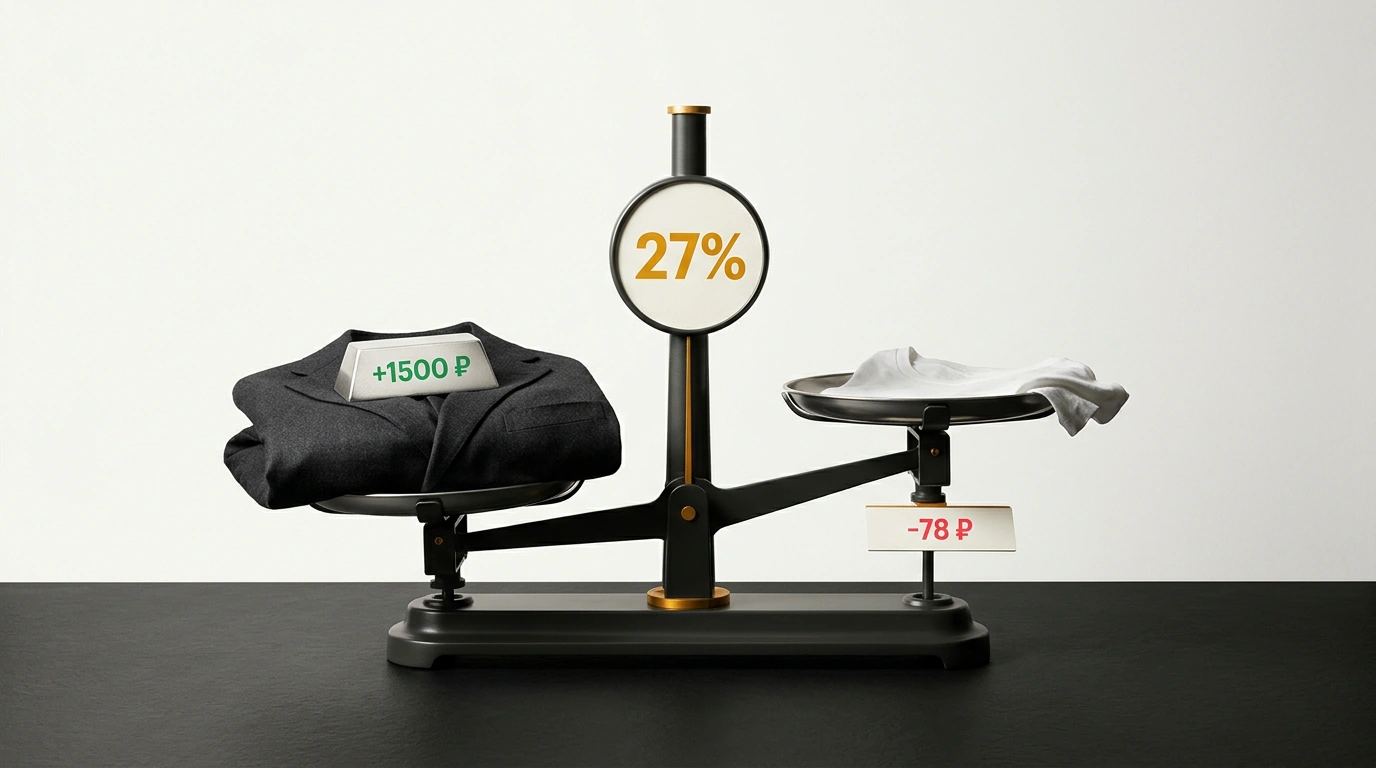
When a marketplace drops a headline like "Slashing Fashion Commissions to 27%!", every seller's first instinct is to open their pricing sheet and celebrate the platform's sudden generosity. After all, total commission loads in apparel and footwear routinely climb past 40–50%.
In e-commerce, though, free cheese only exists in mousetraps. Practicing expert Marta Chistilina audited Ozon's updated rate card and flagged the fine print that's easy to miss in the hype. Let's take off the rose-colored glasses, grab a calculator, and see who actually comes out ahead at 27%—and who walks away empty-handed.
Who Qualifies: New Accounts and 'Sleeping' Sellers
First, check eligibility. Ozon initially pitched the discount strictly for newcomers registering a brand-new seller account with a tax ID (INN) never before seen on the platform. Then the marketplace decided to wake up dormant sellers too, extending the promo to "reactivation."
Here are the exact qualifying rules:
- New sellers: automatic enrollment when registering a new legal entity or sole proprietorship;
- Existing sellers: at least one Fashion sale before August 31, and zero sales between September 1 and October 20;
- Promo window: the 27% rate is locked in through March 31, 2027 inclusive;
- Fulfillment models: applies across all major schemes—FBO (Ozon warehouse), FBS (seller warehouse), and realFBS;
- Storage perk: if you ship apparel or footwear into Ozon FBO warehouses before year-end, intake and storage are free through December 31.
We touched on the early announcement yesterday in Ozon's 27% Fashion commission cut, but the real devil sits in the fine print.
X-Raying the Rate: What's Inside the 27% and What's Billed on Top
The biggest mental trap for sellers is the word "commission." Many assume 27% is the total cut Ozon takes out of revenue for everything.
In reality, 27% covers only the marketplace's sales referral fee. Every other infrastructure cost is still billed at standard rates:
- Linehaul logistics: calculated by volumetric weight in liters from origin cluster to destination cluster;
- Last-mile delivery: flat fee for pickup-point handover or courier delivery to the door;
- Return logistics: every non-buyout or return charges you the trip back to the warehouse;
- Payment acquiring: card-processing fee;
- Internal ads: search promotion tools (Stencils / Top Placement)—without them, a listing in crowded apparel niches gets virtually zero organic reach.
Now factor in how Fashion actually behaves: average buyout rates hover around 30–50%. Shoppers order dresses and shoes in multiple sizes, try them on at the pickup point, and keep just one. That means the bulk of your cost structure is return-trip logistics, which a lower referral fee doesn't touch.
Checklist Before Switching to Ozon's Preferential Rate
- Confirmed zero Fashion sales in your seller account from September 1 to October 20
- Recalculated average order value: under 1,000 ₽, commission savings are minimal
- Checked SKU return rate (buyout should be at least 40–45%)
- Budgeted ad spend for Stencils to offset weaker platform co-investment compared to older accounts
Ticket-Size Battle: A 12,000-Ruble Suit vs. a 600-Ruble T-Shirt
To see clearly who wins and who loses under the 27% rate, let's compare two opposite price points—just like we did in our step-by-step unit economics breakdown for apparel on Ozon.
Scenario 1: Men's Tailored Suit (12,000 rubles retail)
- Under a standard 40% commission, Ozon took 4,800 rubles per sale.
- At 27%, the referral fee drops to 3,240 rubles.
- Net seller savings per suit sold: over 1,500 rubles!
- On high-ticket items, linehaul and last-mile fees are a tiny sliver of the price, so the commission cut flows straight into a 35–40% jump in operating profit.
Scenario 2: Basic Cotton T-Shirt (600 rubles retail)
- Standard commission was 240 rubles; at 27%, it's 162 rubles.
- Total savings on commission: just 78 rubles.
- If a buyer orders that tee and sends it back, return linehaul and last-mile charges instantly wipe out that 78-ruble gain and push the unit into a net loss.
The Co-Investment Factor: What Marketers Leave Out
There's one more catch: Ozon's subsidized discount (platform co-investment). Established, high-volume seller accounts with items above 300 rubles often receive up to 50% co-investment funded by Ozon itself.
A brand-new or reactivated account on the 27% rate starts with minimal co-investment. On the storefront, an established competitor with the exact same base price looks 20–30% cheaper to shoppers. To stay competitive, a newcomer either has to slash their own price out of margin or pour paid traffic into the listing.
The bottom line is straightforward: 27% in Fashion is a genuine gift for mid-market and premium brands with average tickets from 2,500–3,000 rubles up. If you sell budget basics with a 30% buyout rate, don't count on platform discounts—police your return logistics instead.