For a long time, a convenient myth held sway around marketplaces: that the platform worked like an open order book with equal rules for everyone, and "individual terms" from a personal manager were an unconditional ticket to a private club of high profitability. When I cross-check fresh contracts and seller financial models, not a trace of that illusion remains. The standard offer agreement no longer levels the playing field, and special tariffs increasingly act as a financial trap with a delayed trigger.
For most sellers on Wildberries, Ozon, and Yandex Market, total deductions—combining category commission, per-unit logistics, storage, and mandatory ad spend share (DRR)—have already crept up to 40–50% of the retail price. Against this backdrop, product business owners face a practical question: how to survive under such tariffs—sign rigid bonus agreements with platforms for a reduced rate, or build an independent online store delivering via partner pickup points (PVZ)—and under what conditions does an owned channel actually pencil out.
Why the standard offer no longer levels the market: the tariff gap between giants and mid-sized businesses
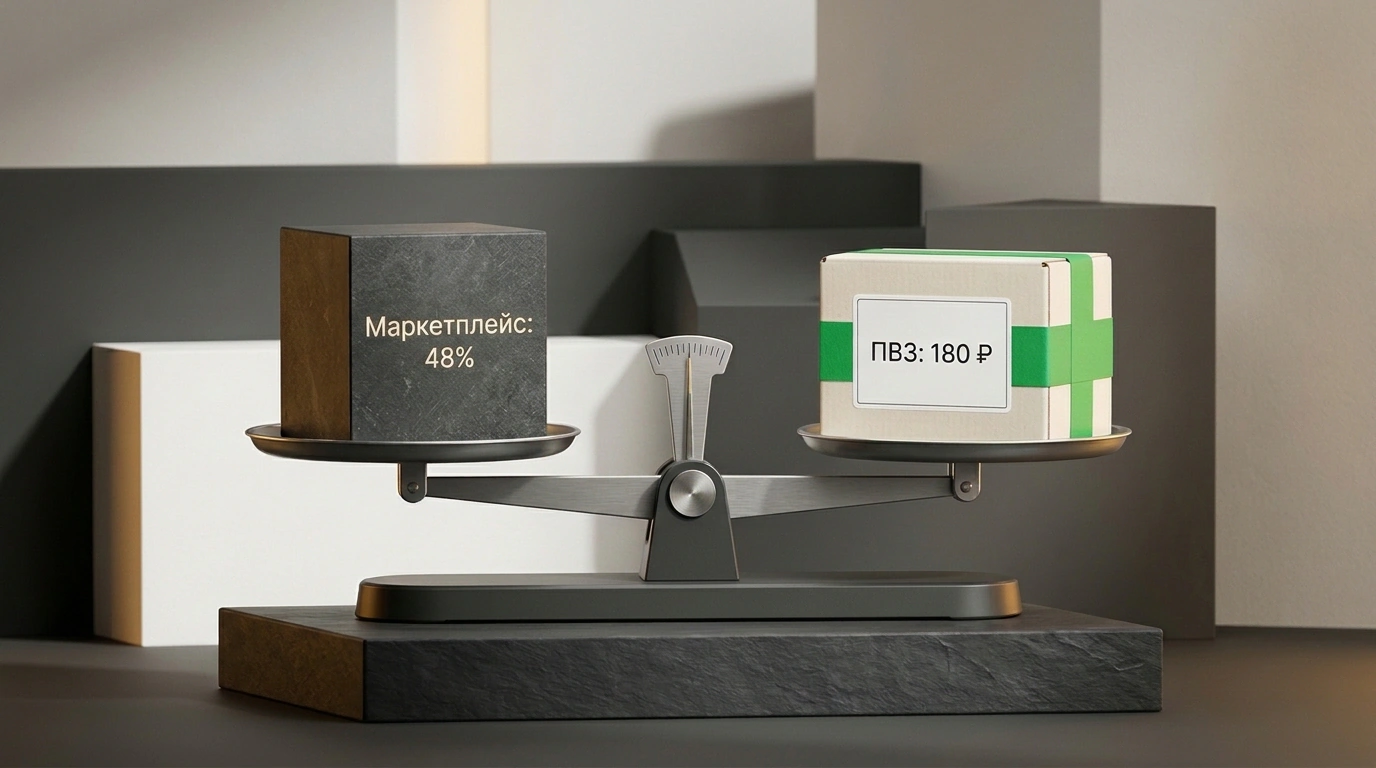
If you pull up archives from 2017, Wildberries had a flat 38% commission that covered both delivery and storage. Today, base commissions in popular categories like apparel reach 48% (and the market is already discussing a 54% ceiling), while per-unit logistics, storage, and promotion are billed separately. If you add up every expense without fooling yourself—as we did in the step-by-step unit economics calculation without revenue illusions—half of your revenue on standard terms stays inside the platform.
The reason for this split lies in extreme turnover concentration. SellerDen partner Ivan Kolykhalov cited a telling ratio used by the platforms themselves on the "Логово продавцов" podcast with Denis Vetrennikov: 1% of sellers—around 10,000 large "white-market" companies—generate 75% of all turnover. The remaining 99% of sellers bring in just 25% of revenue while creating most of the operational load with taxes, "Chestny ZNAK" labeling, and counterfeit disputes.
As APET presidium chairman Alexey Moskalenko noted following Platform Economy Day, marketplaces have entered fierce competition for strong sellers and major brands. While small and mid-sized businesses bear the full brunt of the standard offer—like the one we analyzed in the article on real Ozon tariffs and the discount-points mechanism—large players are offered special tariffs. Since late 2024, Wildberries has been offering closed individual agreements to companies with annual turnover starting at 50–100 million ₽ (on Ozon, the entry threshold for direct deals is typically 1–2 billion ₽ per year, or structured as trading co-investment discounts for lower commission). Moreover, clause 5.2 of the non-disclosure agreement (NDA) sets heavy fines even for publicly mentioning that you work on an individual tariff.
The individual tariff trap: how a preferential rate turns into retroactive quarterly debt
On paper, an individual tariff looks like a margin lifesaver: instead of 48% plus separate logistics bills, an apparel seller locks in an "all-inclusive" rate of 26%, 28%, 30%, or 34% (with logistics and storage built in) plus a mandatory DRR percentage. In exchange, the platform demands hitting a strict GMV growth target. Sometimes those targets are flat-out unachievable: a garment company doing 400–500 million ₽ a year can be handed a 3 billion ₽ target for the first quarter—24x growth. To keep the preferential rate, mid-sized sellers even pool together in "syndicates" of 50–100 people on a single account, pushing combined turnover to 100 million ₽ a day.
The main trap is hidden in the legal mechanics. According to SellerDen analytics, special tariffs are structured under the Russian Civil Code (GK RF) as a conditional discount or retro-bonus with a suspensive GMV threshold. If at the end of the quarter you fall short of the plan by even 1–2% (or step outside the allowed 75–90%+ fulfillment corridor), the preferential rate is voided retroactively across the entire sales volume for the reporting period, and the difference is deducted from your payouts without acceptance.
Let's look at the numbers. An apparel store with 15 million ₽ in monthly turnover gets a preferential 28% rate instead of the 48% base commission, conditioned on 20% monthly growth. For two months the team stays on schedule, but in the third month the factory delays a fabric batch and the brand misses its quarterly plan by 5%. The platform automatically recalculates the entire quarter at 48% and deducts 3 million ₽ in a single hit from weekly payouts—paralyzing supplier payments and payroll.
In reality, the cash hole can be even deeper. Ivan Kolykhalov described a seller who opened their dashboard in the morning to see a balance of −4.5 million ₽ after a retroactive commission recalculation for a missed target. Trying to make up the volume over the next three months ended in a second recalculation and a −8 million ₽ debt. We covered why chasing revenue leads sellers into cash gaps in detail in a separate breakdown.
Own online store with PVZ delivery vs. marketplace: honest math on logistics and traffic
Given these risks, it makes sense to run the numbers on an alternative—your own online store. Five years ago, an independent site ran into expensive courier delivery, buyer fear of prepayment, and complex development. Today that infrastructure barrier is gone: via Yandex Delivery (using the Yandex Market PVZ network), CDEK, Boxberry, "Ozon для бизнеса", and Russian Post, any store can ship orders from PVZ to PVZ nationwide.
According to Ivan Kolykhalov's calculations, shipping a box from PVZ to PVZ in Moscow via Yandex Delivery costs about 180 ₽ per box—not per unit, as on a marketplace, but for the whole box holding 20 pairs of headphones or several garments; returning an unclaimed parcel costs 50% of the tariff (90 ₽). The catalog is built on InSales, Tilda, or 1C-Bitrix, receipts are issued by a payment agent with its own online cash register, and the customer pays by card at the PVZ terminal after inspecting the item. To protect against swaps (like the case where a 500,000 ₽ night-vision scope was swapped for a bottle of water at a PVZ), delivery rules mandate unboxing the parcel under the pickup point's camera.
Still, each channel has strict boundaries of applicability:
- Where the marketplace wins: the platform brings ready-made "warm" demand. Individual tariffs here only fit manufacturers and major brands with high repeat purchase rates and liquidity reserves capable of absorbing a quarterly clawback without a cash gap.
- Where an independent store loses money: when buying cold traffic on Yandex Direct or targeted ads, cost per order (CPO) shoots up to 35–45% or more of the item's price, eating up all the commission savings.
- When your own site becomes profitable: an independent store beats marketplace unit economics only when CPO stays within 25–30% of the average order value. That acquisition cost is achieved through an in-house "content factory"—vertical videos (Reels and Shorts getting 100k–1M views), Telegram channels, micro-bloggers, and a repeat-customer base.
Architecture of resilience: how to split your assortment between platforms and a direct channel
Walking away from marketplaces completely is just as extreme as 100% dependence on a single account with a special tariff. The optimal resilience balance today is 60–70% of sales on marketplaces and 30–40% in direct channels (your own site with PVZ delivery, social media and blogs, Avito, wholesale).
At the same time, it's critical to split your product matrix: leave basic mass-market items and clearance stock for organic marketplace traffic, and move high-margin new arrivals, branded lines, and repeat-purchase goods to your own site so you aren't handing a platform up to 48% commission for a customer you brought from your own social channels.
Margin protection and sales diversification checklist
- Check your special-tariff contract for retro-penalties: make sure there is no clause recalculating the entire quarter's commission at the base rate if you miss turnover by 1–5%.
- Model a stress scenario (−15–20% vs. plan): assess whether your cash flow can survive a one-time automatic deduction if factory raw materials are delayed or a listing gets blocked.
- Pick 5–10 high-margin SKUs for a direct channel: select flagship items with a loyal audience to sell through your own website.
- Test the "CMS + PVZ delivery" stack: launch a storefront with a payment agent and pay-on-pickup at PVZs, measuring your real content-traffic CPO against the 25–30% threshold.
Ultimately, this entire choice comes down to what you're building your business for. You can spend years churning hundreds of millions of rubles in someone else's turnover, staying hostage to a quarterly counter where a single delayed fabric batch wipes out three months of profit overnight. Or you can step by step build your own 30–40% direct sales with transparent logistics and the quiet certainty that the margin you earn actually belongs to you.