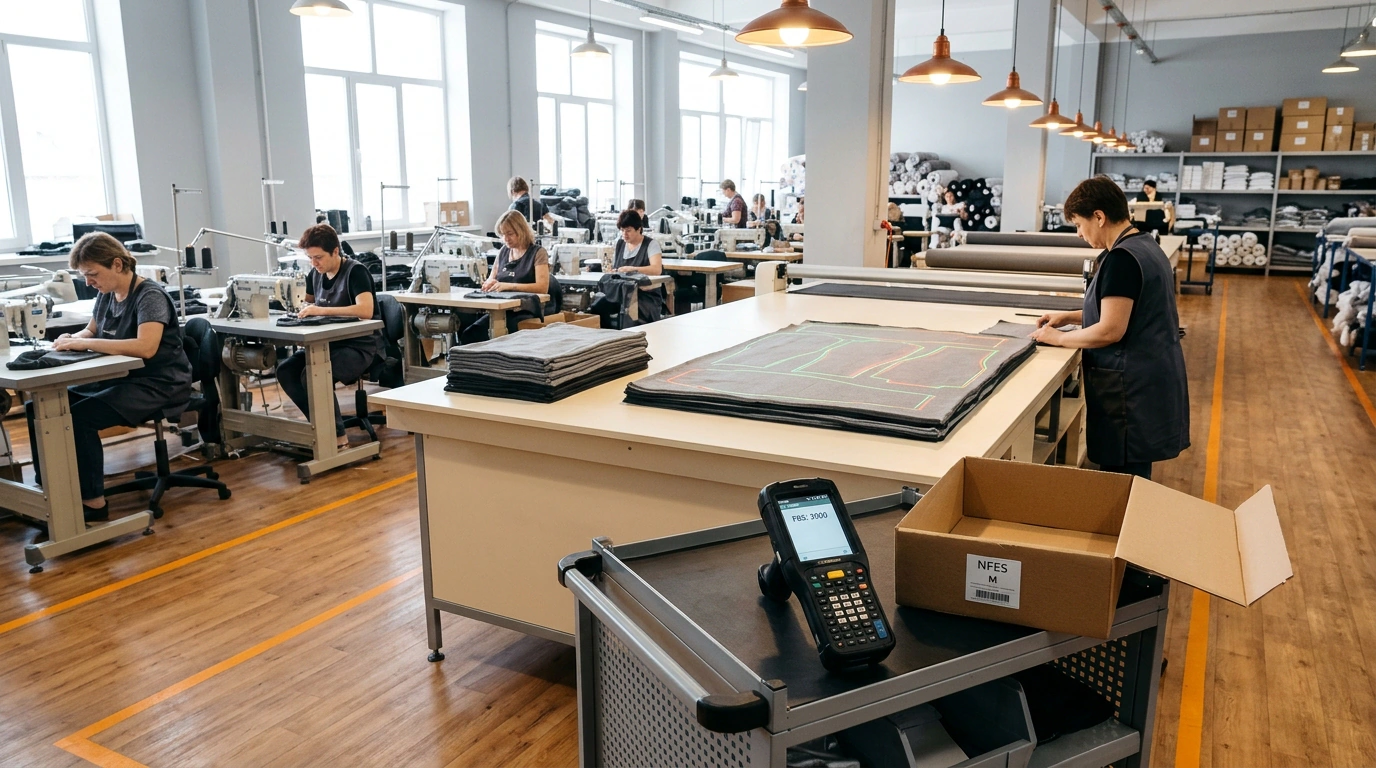
When a truck belonging to the Ivanovo apparel brand NFES unloaded two-plus pallets of clothing at the Wildberries warehouse in Shushary, exactly two hours remained before news of the fire broke. Company founder Kerim Zhumaev had held onto the classic FBO model—selling from the marketplace's warehouse—for as long as possible, sewing large batches of knitwear for central hubs. That day, Kerim gathered the warehouse staff on the third floor of his complex on Lezhnevskaya Street in Ivanovo and laid down a condition: the platform warehouse problem must not climb to the fourth floor to the seamstresses and cutters. There would be no layoffs, yet the company would not bloat its headcount either—starting the next morning, all shipping would switch to the FBS scheme, meaning fulfillment from their own warehouse.
Behind that decision lies the core question for any manufacturer on marketplaces: how do you switch from FBO to the FBS model so you don't freeze working capital in warehouse stock or bloat payroll? The experience of the NFES factory, spanning over 2,000 sq. meters, shows that switching to FBS in apparel manufacturing pays off through sewing small batches for real daily orders and fast turnover, which cuts storage costs and dead-stock risks far more than the difference in warehouse fees.
Why freezing batches in FBO warehouses eats up a manufacturer's working capital
Let's trace step by step what happens to a workshop's cash when operating solely through platform warehouses. Under FBO, you have to forecast demand blindly and send 1,000–5,000 units per style into cutting, freezing up to 10,000 garments in distribution centers like Koledino or Elektrostal. At that scale, live cash goes into fabric, trims, and seamstress wages long before the first purchase. Then the offer agreement kicks in: miss slightly on a shade or sell out the popular M and L sizes while leaving the extremes on the shelves, and the platform charges paid receiving and daily paid storage. In the end, the seller dumps the stock at a loss during promos or pays for returns and disposal of dead inventory.
We broke down how warehouse fees shift profitability in the article on unit economics when switching fulfillment between FBO and FBS. For a manufacturer, however, the main FBO trap is capital paralysis: while millions sit in inventory a month ahead, there is no cash left to test new arrivals or buy fabric for bestsellers. At NFES, switching to sewing for FBS freed up to 70% of working capital and shrank the cash gap: the workshop began producing core assortment in batches of 200–300 units and compressed new-style tests to runs of 5–15 units.
Morning picking and evening shipping: rebuilding an FBS warehouse without adding staff
Here you'll probably feel skeptical: "It's one thing to stack goods on pallets for FBO, and quite another to pick thousands of individual FBS orders every day. Won't you have to hire a second shift of warehouse workers?" The same thought always crosses my mind when analyzing manufacturers, because a bloated payroll easily wipes out all storage savings.
Kerim Zhumaev—who moved to Ivanovo to study in 2010, started as a loader and warehouse worker at a textile company, and rose over seven years to assistant CEO—knew the warehouse inside out. Before switching to FBS, his third-floor team picked an average of 500 units per shift. Instead of hiring people, they rebuilt the warehouse system in one and a half to two months:
- Bin storage and data terminals (TSD). They divided the warehouse into addressed bins, customized the "Мой ТСД" software, and issued handheld terminals to every employee—the task on the screen guides the picker from bin to bin automatically.
- 5-minute API stock sync. They configured the "МойСклад" integration with Wildberries so that once a batch from the workshop is scanned in, storefront stock updates within 5 minutes, protecting the listing from dropping out of search.
- 10-day horizon and morning stand-up. The factory abandoned monthly plans: if an item doesn't turn over in 10 days, sales are lagging. Every morning by 8:30, an analyst compiles data on cutting, stock, and orders, and by 9:00 a stand-up takes place with the head of sales, their deputy, the analyst, the planner, and the technologist.
As a result, the exact same warehouse crew—without a single new hire—began picking up to 3,000 units per shift, a sixfold jump in output.
How the "morning order — evening shipment" cycle works is clear from the launch of a new women's top. At launch, the workshop sews a test batch of 15 units (and for certain tests, 2, 3, or 5 units). Usually a new item brings 5–10 orders a day, but suddenly 30 orders land by morning. Fifteen tops are sitting in the warehouse—another 15 must be sewn before the evening truck.
At the stand-up before 9:00, the analyst checks the traffic source, and the missing 15 tops go onto the "urgent list," pushing non-urgent batches back. The list goes to cutters at an automated complex with digital patterns, print operators (size labels are printed directly on the fabric without sewn-in tags), seamstresses on a Turkish operation-by-operation line, pressers, and packers. Every station lets these garments jump the queue. The technologist's deadline is to hand the finished goods over to the warehouse by 17:00. By 16:30, the 15 newly sewn tops come down from the fourth floor to the third, get scanned, stock updates via API in 5 minutes, and in the evening all 30 orders leave for the sorting center with zero penalties.
Fabric and sewing economics: why expensive local raw materials in small batches beat wholesale
Looking at this kind of sewing through an old-school lens raises a cost question: small fabric lots cost 5–10% more than wholesale rolls, while outside workshops demand a minimum order of 5,000 units with a one-month lead time.
Let's count the money through capital turnover, the way Kerim does. When you order 5,000 units from an outside contractor with a one-month turnaround—or source from China with prepayment and two-month shipping—cash is frozen for 60 days, and the trend can die in the meantime. That's why 95% of NFES products are sewn from Ivanovo raw materials: at a local mill, two knitting machines run continuously for the brand using custom yarn and proprietary density and dyeing recipes. Producing fabric takes a week, and an urgent lot is dyed overnight—the next day the fabric is in the workshop, and in 2–3 days the clothing is selling on the storefront. While an importer waits two months for a container just to save 10% on sourcing, a local workshop on FBS turns the same ruble over several times.
When cash isn't frozen in FBO inventory and the workshop's minimum daily output is calculated, you capture an audience that rigid players turn away. In 2022, NFES noticed that competitors in basic apparel only carried 5 sizes (from 42 to 48–50), afraid of freezing slow-moving edge sizes in platform warehouses. Switching to flexible sewing, the brand expanded its grid to 13 sizes—from 2XS to 8XL: a new style is tested in 7 sizes, and if it takes off, the workshop immediately sews the rest to match demand.
FBS risk control, hybrid logistics, and the owner stepping out of daily ops
The FBS model also comes with strict constraints:
- Timing and penalties. If a truck breaks down or hits traffic on the way to the sorting center, the seller pays out of pocket: penalties for late delivery or order cancellation reach 35–50% of the item's price. We covered route-insurance rules in the guide on rebuilding logistics from FBO to FBS after warehouse disruptions.
- Delivery speed. From a warehouse in Ivanovo, an order takes longer to reach the buyer than from the nearest FBO hub—and in apparel, every day shaved off raises the buyout rate.
To close both risks, NFES built a hybrid scheme. Within 5 days of the partner program's launch, Kerim opened two goods reception points (PPT) in Ivanovo for FBS drop-offs and return intake, while simultaneously sending trucks to Moscow, Krasnodar, and Kazan. And when, a month after the Shushary fire, the factory restored its lost stock without any drop in orders, proven hits began returning to FBO: new arrivals and the 13-size grid trade on adaptive FBS without dead-stock risk, while bestsellers ship to FBO for fast delivery.
To avoid getting stuck on the shop floor, Kerim periodically "comes down from the mountain" into operations, personally fine-tunes a process with the department head, and translates control into daily CRM numbers. In the fourth-floor sewing hall, he has a small table and chair overlooking the entire production floor. Following lean manufacturing principles and the McDonald's assembly line, he measures internal logistics: moving a garment one step backward wastes 1 minute, and twenty hiccups steal 20 minutes of a shift. They designed wheeled carts with addressed bins for the workshop, and now department heads report daily in numbers only: how much fabric was received, cut, sewn, packed, and shipped.
If frozen inventory is holding your business back, lean on the rule of Kerim Zhumaev, who has "Crisis = Opportunity" written on the board in his office: never take "it can't be done" at face value—visit at least ten factories in your profile, adopt at least two working practices, calculate every step through capital turnover, and build a system that runs on daily numbers rather than the owner's manual heroics.