In the WB Media ad dashboard (part of the RWB Media ecosystem), a new "Audiences" ("Аудитории") section has launched, and platform sales development manager Igor Shulgin broke down the mechanics of the update in detail. Many sellers still treat the media dashboard as a showcase reserved for market giants, close the tab, and go back to auto-campaigns.
In this release, however, the platform has for the first time given sellers direct self-service access to behavioral targeting. How does the "Audiences" section work in practice, and how can you use segments to stop paying for empty impressions to casual browsers and cut your ad spend share (DRR/ACOS)?
Where the system learns about your buyers and how it builds segments
More than 82 million unique visitors come to Wildberries every month, spending an average of 10 minutes on the platform and viewing up to 17 pages per visit. Standard display ads blasted across that entire crowd without filtering act like firing a cannon at sparrows—at the expense of your margin.
The "Audiences" section relies on the marketplace's internal Data Management Platform (DMP). Before building a segment, I always cross-check the buyer profile in the seller portal, "Джем" subscription analytics, and reviews and questions on product listings. Then three selection levers are switched on in the builder:
- Behavioral triggers: who browsed a category, opened your brand's listings, added an item to favorites, put it in the cart without paying, placed an order, or clicked your past banners.
- Activity windows and logic: you set the period (7, 14, or 30 days) and use
AND,OR, andEXCLUDEoperators to filter out customers who already bought from retargeting ads. - Order value and sizes: layered on top of behavior are geography, gender, age, monthly average check, and a size-grid filter that suppresses impressions for shoppers whose sizes are out of stock.
Three precision targeting scenarios: from abandoned carts to upsells
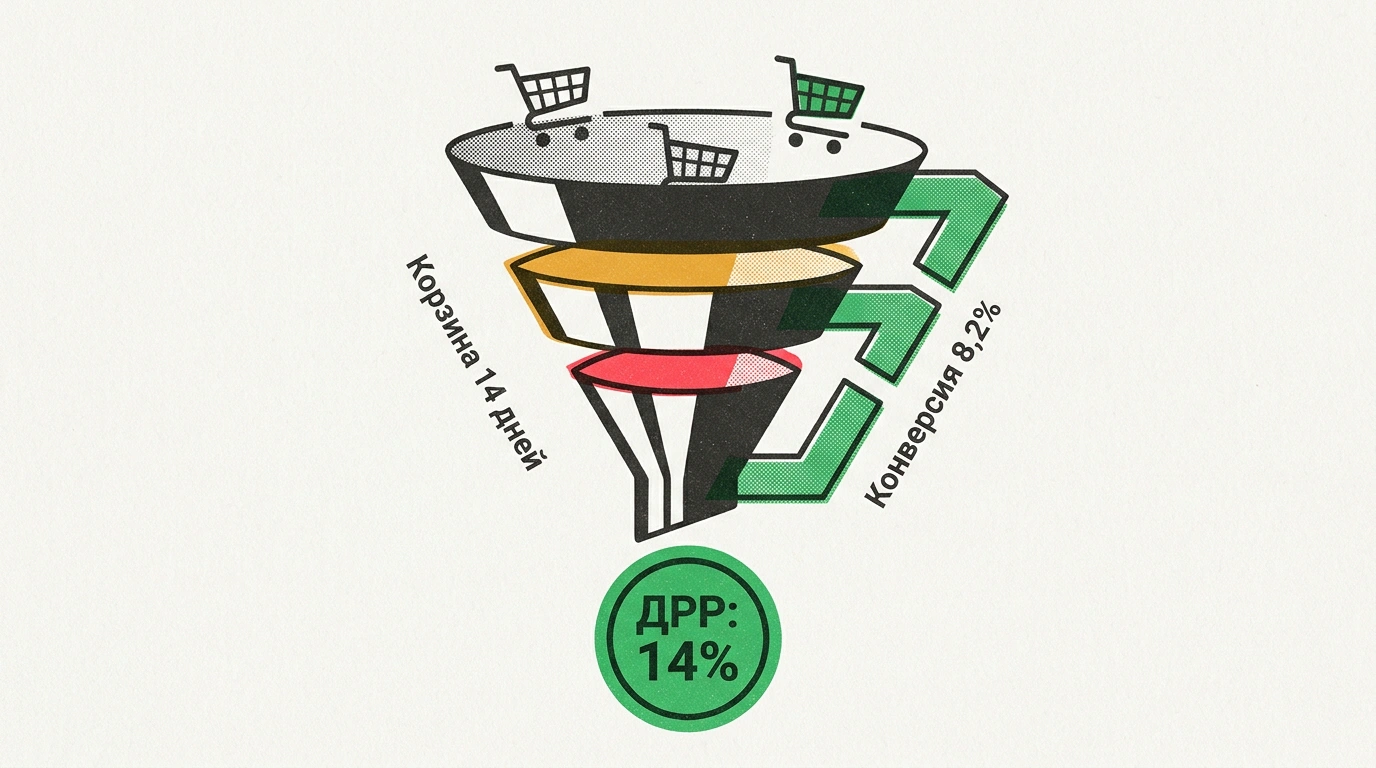
The difference between spray-and-pray reach and a tight selection shows up immediately at the register—take the math for a women's apparel brand. When showing a banner to the entire "Dresses" category, order conversion stood at 1.8%, while DRR hit 28%, eating up net profit. Once the seller isolated buyers in "Audiences" who had added the brand's dresses to their cart over the past 14 days without checking out, click-to-order conversion jumped to 8.2%, and DRR dropped by half—to 14%.
In day-to-day trading, three scenarios pay back fastest:
- Recovering "abandoned carts" (retargeting). As an RWB study on sale preparation showed, shoppers often treat the cart like a wishlist. Set the condition "added brand item to cart in the last 14 days" plus "exclude: purchased in the last 30 days" and follow up with a special-price banner.
- Repeat purchases and cross-selling. For consumables like face cream or paper towels, it pays to remind buyers after 30 days when supplies run low. And if a customer bought a winter puffer jacket or a coffee machine, targeting the "purchased in the last 30 days" segment works great for accessories: hats and membrane waterproofing sprays, or coffee beans and descaling cleaners.
- Traffic cleanup and finding lookalike buyers. Exclude repeat customers from reach campaigns (they'll buy organically) as well as users who saw a banner and didn't click. Meanwhile, smaller stores without their own customer base can target category browsers or a "Look-alike" segment with low, medium, or high match precision.
How to scale with media formats without boxing your campaign into a corner
A saved segment connects to WB Media placements—banners on the homepage and in categories, video banners, and screens inside Wildberries pickup points. You can read how media reach pairs with search in the breakdown on combining WB Media formats with WB Продвижение bids.
At the same time, keep the tool's payback boundaries in mind. Targeting delivers steady returns when a segment holds at least 5,000–10,000 profiles, a budget is allocated for starting CPM, and the creative matches the funnel stage (a spec comparison for listing viewers or a discount for cart abandoners). If you pile on too many AND conditions or tighten lookalike precision down to fewer than 1,000 people, impressions stall out—or a single banner burns through CTR on a couple hundred profiles.
Once you build your first 14-day cart segment in WB Media, check three things before launch: did you exclude buyers who already completed a purchase in the last 30 days, does the audience exceed 5,000 shoppers with sizes in stock, and does your banner give a clear reason to close the order right now?