You have probably seen the movie Dark Waters with Mark Ruffalo—or at least heard about the high-profile lawsuit against chemical giant DuPont in West Virginia. After a story like that, it is hard not to eye your favorite nonstick skillet with suspicion, wondering if every morning omelet is quietly dosing you with toxic chemicals. Honestly, after reading the first wave of alarming headlines myself, I was tempted to toss my entire nonstick collection in the trash and switch exclusively to cast iron and stainless steel.
Let's take a breath, sort through the facts, and separate a real environmental crime from fifty years ago from everyday home cooking. The lawsuits and the massive C8 Science Panel medical investigation—which tracked the health of nearly 70,000 residents—centered on perfluorooctanoic acid (PFOA). That toxic compound was dumped into a local river by a factory for decades and seeped into the municipal tap water, causing cancer and thyroid disorders. The International Agency for Research on Cancer (IARC/WHO) rightly classified PFOA as a Group 1 carcinogen.
PFOA vs. PTFE: What Is the Crucial Difference?
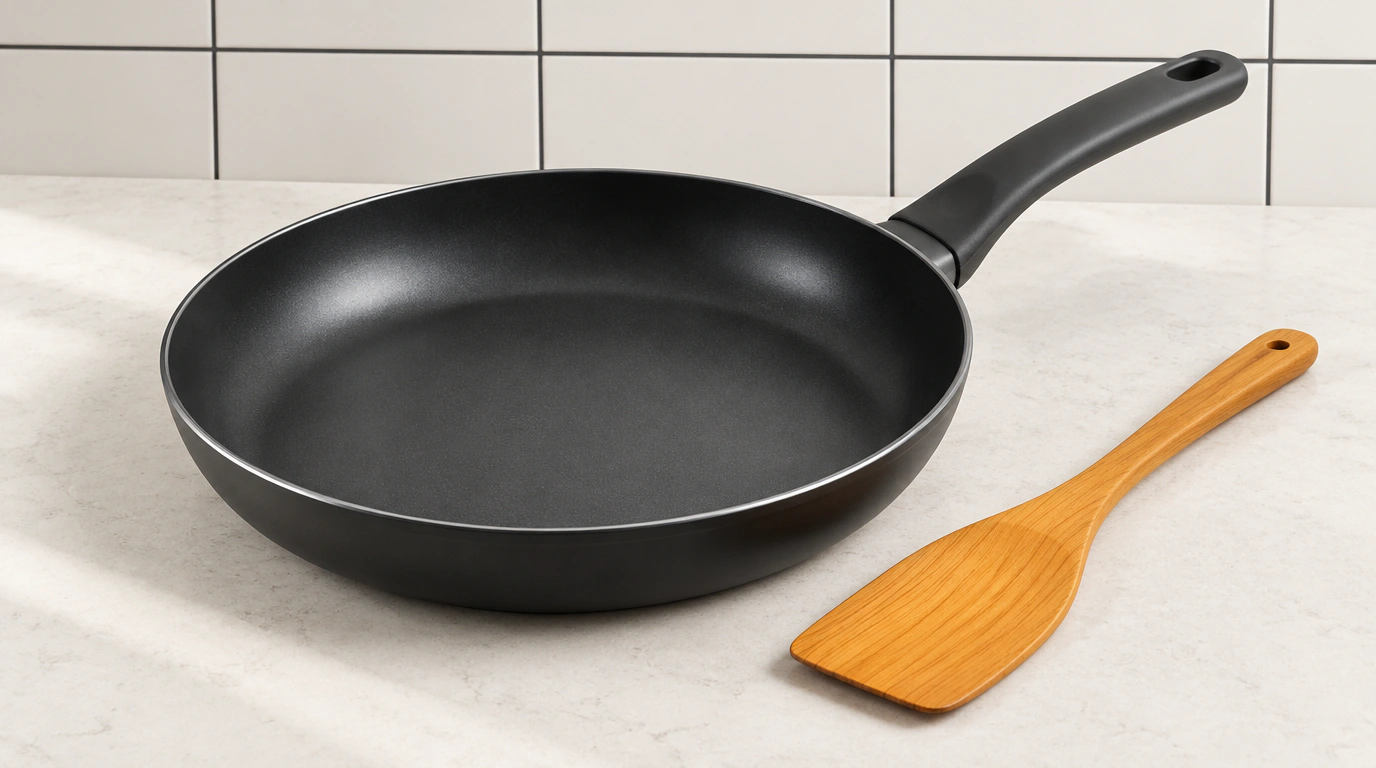
So what is actually coating the surface of your frying pan? Finished nonstick cookware uses a completely different substance: polytetrafluoroethylene (PTFE, commonly known as Teflon). PFOA was never part of the Teflon polymer chain itself; it was only used as a processing aid during synthesis and practically burned off when pans were cured in the factory at 400–430 °C. On top of that, major manufacturers phased PFOA out of production entirely by 2015, and modern certified cookware carries a strict PFOA-free label.
In the official IARC oncology classification, PTFE sits in Group 3—meaning it is not classifiable as carcinogenic to humans. The carbon–fluorine bond is one of the strongest in organic chemistry. Once cured, the coating is biologically inert: it does not dissolve in acids, does not react with alkalis, and passes straight through stomach acid untouched.
Temperature Limits and the Scratch Myth
Germany's Federal Institute for Risk Assessment (BfR) studied how Teflon behaves under heat in detail. During normal cooking—searing meat, sautéing vegetables, or baking—the pan's surface stays within a safe 160–220 °C window, where the polymer film remains completely stable. Minor surface degradation only begins around 260 °C, and thermal breakdown releasing acrid fluoroorganic fumes does not start until temperatures exceed 350 °C.
In real-life cooking with oil or food in the pan, hitting 350 °C is virtually impossible: your food would char to ash, and cooking oil would smoke unbearably long before that point (most oils have a smoke point of 190–230 °C). The only way to inhale hazardous fumes and come down with short-lived "Teflon flu"—fever and chills—is to leave a dry, empty pan sitting over max heat for ten minutes. We covered the roots of similar household scares earlier in toxicology myths in everyday life.
And what if you accidentally scratch the bottom with a metal spatula? Even if a tiny flake of Teflon ends up in your food, stomach acid cannot break it down. It simply passes through your digestive tract harmlessly and leaves the body. The time to replace a pan isn't out of fear of poisoning—it's when the coating loses its nonstick performance, food starts welding itself to the surface, or the layer blisters and exposes the bare metal underneath.
Stick to wooden or silicone spatulas, skip abrasive metal scrubbers, and never plunge a piping-hot pan into cold water—sudden thermal shock warps the metal base. Also, keep pet birds in mind: parrots and canaries have extremely sensitive respiratory systems that react badly to any polymer fumes, so their cages should never be kept in the kitchen.
Common sense and a little basic physics are the best defense against marketing panic. Cook with peace of mind, avoid overheating an empty pan, and modern nonstick cookware will stay a safe, reliable ally in your kitchen.