You know the routine: someone decides to eat healthier and starts the morning with a "virtuous" bowl of oatmeal. They grab a bright packet labeled "ready in one minute," pour boiling water over the flakes, take a few spoonfuls, and the bowl is empty. Forty minutes later, their stomach is growling, focus evaporates, and their mind drifts straight toward a croissant or office cookies.
Meanwhile, a bowl of slow-simmered buckwheat or traditional pearl barley keeps you comfortably full for four or five hours straight. Why do foods from the same grain family behave so differently? Endocrinologist Maxim Kuznetsov points to factory processing and the physics of stomach emptying.
Intact Grain vs. Pre-Cooked Instant Flakes
The whole difference comes down to what happens at the processing plant:
- Instant rolled oats (extra-thin): The grain is stripped of its tough bran and aleurone layer—where most insoluble fiber lives. The starchy core is then steamed under high pressure and pressed through hot rollers into paper-thin flakes under 0.4 millimeters thick. The starch gelatinizes right in the factory, so in your kitchen it turns into a fast-digesting porridge almost instantly.
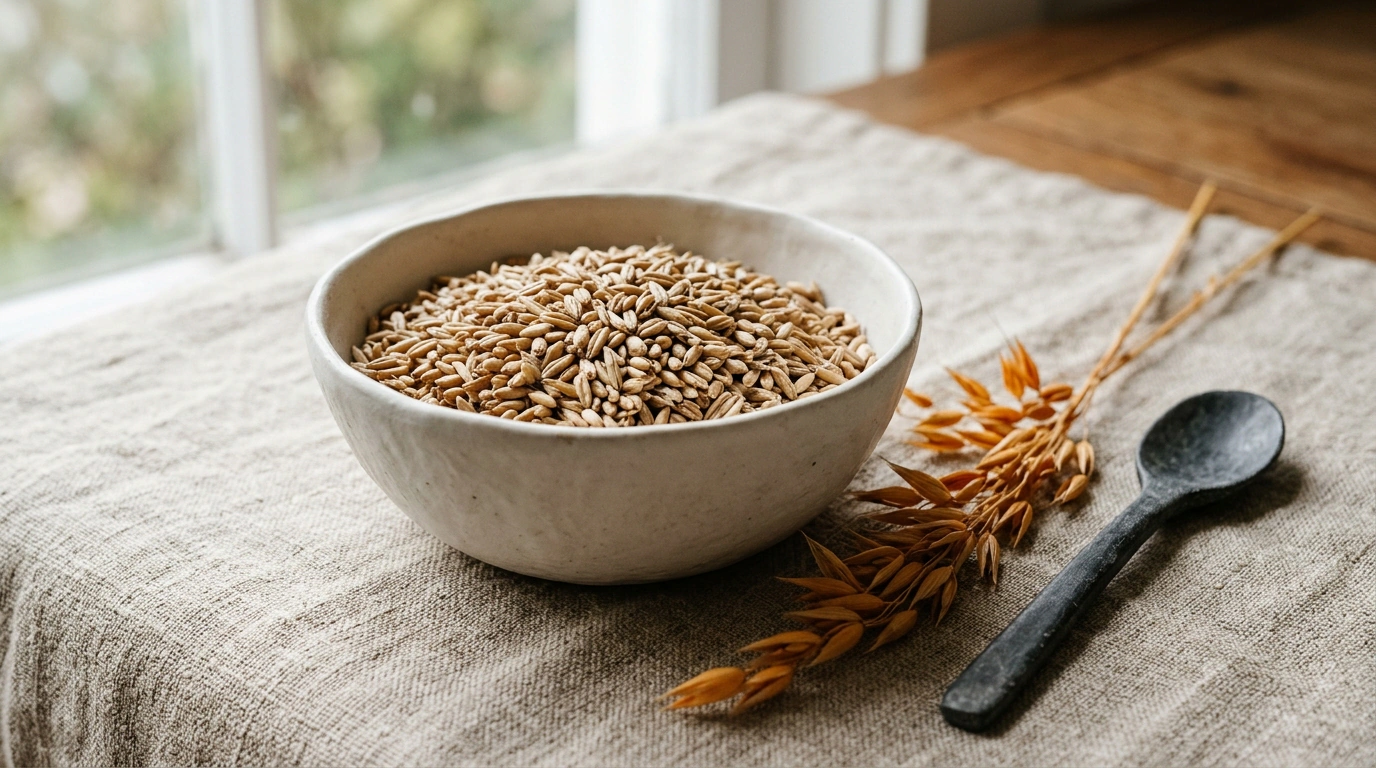
- Whole, slow-cooking grains (15–20+ minutes): Steel-cut or thick old-fashioned oats, whole buckwheat groats, and pearl barley keep their cellular walls of cellulose and lignin intact, locking starch granules inside a dense protein matrix.
When instant flakes hit your stomach, salivary amylase breaks them down rapidly and they empty into the small intestine within 15 minutes. Stomach volume drops, stretch sensors turn off, and glucose floods the bloodstream. Your pancreas fires off a heavy wave of insulin, clearing the sugar quickly and triggering reactive hypoglycemia—so your brain yells, "We're starving, get something sweet!"
Whole grains, by contrast, force your stomach to churn with muscular waves for hours until particles shrink below one millimeter. Your stomach stays pleasantly full for two to four hours, sending steady mechanical satiety signals to the brain. We explored this further in gut motility and slow carbohydrates.
The Satiety Index and the Power of Beta-Glucans
In Susanna Holt's classic study at the University of Sydney (European Journal of Clinical Nutrition), researchers measured the satiety index of 38 common foods at an equal 240 kcal serving. Thick porridge made from coarse whole oats scored 209% compared to white bread, taking first place among all carb-based breakfasts (dry flakes and muesli barely reached 100–118%).
Oats and barley have a second secret weapon: soluble beta-glucan fiber. Mixed with water in the stomach, it forms a thick gel that slows digestive enzymes from reaching starch. Further down in the small intestine, that gel triggers the "ileal brake," prompting gut cells to release natural satiety hormones PYY and GLP-1.
Check the cooking time on the box: pick grains that need at least 15–20 minutes on the stove (steel-cut or thick rolled oats, whole buckwheat, pearl barley). To stretch fullness another couple of hours, pair those slow carbs with solid protein—two soft-boiled eggs or a slice of low-fat cheese.
Don't trade your all-morning comfort to save ten minutes at breakfast. Whole, minimally processed grains steady your energy and spare you from fighting snack cravings all day.