One of the most common and discouraging complaints in an endocrinologist's office sounds almost identical every time: "Doctor, I eat the exact same amount I did at thirty. The scale stubbornly shows my usual 62 kilograms. Yet my favorite jeans refuse to button at the waist, my belly sticks out, my arms have lost firmness, and my body feels like it has gone soft. What is happening?"
Most people's first reaction is to blame a "slowed-down metabolism" and go on a semi-starvation diet of kefir and cucumbers. Endocrinologist Maksim Kuznetsov warns, however, that a stable number on the scale creates a dangerous metabolic illusion. A massive restructuring is underway inside the body: skeletal muscle is quietly disappearing while fat changes its address, shifting from the hips deep into the abdominal cavity. Let's look at how these biological mechanics work and how to protect your body without miserable starvation.
The Illusion of Stable Weight: The SWAN Study Phenomenon
To see the real picture, scientists needed decades of observation. In the largest longitudinal study, SWAN (Study of Women's Health Across the Nation), thousands of women were followed through the menopausal transition using regular dual-energy X-ray absorptiometry (DXA)—a method that sees every gram of fat, bone, and muscle in the body.
The findings were striking: roughly two years before menopause, the rate of fat accumulation doubles, while the rate of muscle loss hits its peak. The catch is that fat density is significantly lower than muscle density: one kilogram of fat takes up 15–20% more volume than a kilogram of dense muscle fibers.
When a woman simultaneously loses two kilograms of muscle and gains two kilograms of fat, the bathroom scale needle does not budge a millimeter. Her weight is ideal and her BMI is normal, yet her body composition changes drastically. In clinical medicine, this condition is called sarcopenic obesity. We broke down in detail why a slowed metabolism after forty is a myth: cellular basal metabolism stays stable, and energy expenditure drops specifically because of muscle mass loss.
Why Muscles Melt Away: Anabolic Resistance and Hormones
Sarcopenia is the progressive loss of skeletal muscle mass, strength, and function. While in your 20s and 30s the body forgives inactivity thanks to a high anabolic baseline, after 45 two powerful factors kick in:
- Anabolic resistance of aging myocytes: With age, muscle fibers become less sensitive to amino acids from food. While a young adult only needs to eat 15–20 grams of protein to trigger muscle protein synthesis, in mature age this threshold (the so-called leucine trigger) shifts upward. Muscles require 25–35 grams of complete protein per meal; otherwise, the signal to build new fibers simply fails to fire.
- Waning protective effect of estrogens: Female sex hormones (specifically 17-beta-estradiol) exert a potent anabolic effect. They stimulate the division of satellite cells (muscle stem cells) and distribute fat in a female pattern—under the skin of the hips and glutes. When ovarian function fades, that protective shield vanishes. The body immediately switches to an android storage pattern: reserves begin accumulating around the abdomen.
The Invisible Enemy: Why Visceral Fat Is Dangerous
Belly fat comes in two fundamentally different types. The soft fold you can pinch with your fingers above your belt is subcutaneous fat. You may dislike how it looks, but from a cardiology standpoint it is relatively harmless.
The real threat is visceral fat. It sits deep inside the abdominal cavity, tightly wrapping around the intestines, pancreas, and liver. Visceral adipocytes behave aggressively:
- They continuously dump free fatty acids straight into the liver's portal vein, driving the development of fatty liver disease.
- They act like a slow-burning endocrine gland, releasing inflammatory molecules (tumor necrosis factor-alpha, interleukin-6) that damage blood vessels.
- They jam insulin receptors, triggering type 2 diabetes, hypertension, and early atherosclerosis.
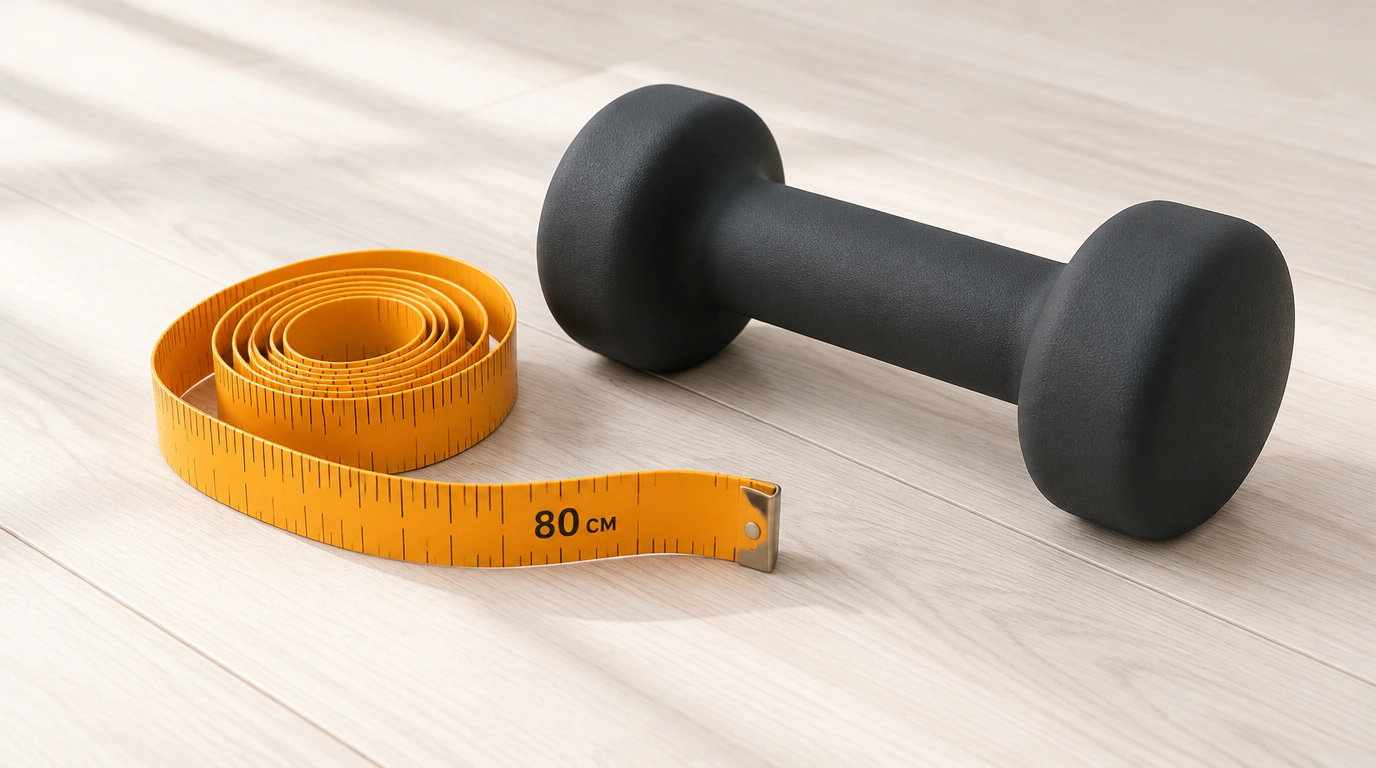
That is why your main home diagnostic tool after 45 is not a scale, but a measuring tape. A woman's waist circumference should strictly stay within 80 cm. Readings from 80 to 88 cm point to elevated cardiometabolic risk, and anything above 88 cm indicates a high risk of vascular complications. Even simpler is the waist-to-height ratio rule: your waist circumference should be less than half your height.
The Biggest Mistake: Why You Must Not Starve Yourself
Seeing a protruding belly, most people slash calories to 800–1,000 kcal per day. That is the worst thing you can do to your body in midlife.
Under a harsh energy deficit without strength stimuli, the body saves itself the only way it knows how: by urgently burning its most energy-hungry tissue—skeletal muscle. Fat, meanwhile, is guarded to the very end. As a result, a person loses weight at the expense of their muscle corset, ends up with saggy skin, and when they inevitably fall off the diet, regains the kilograms purely as fat. The loop closes: muscle is lower, the metabolic furnace is smaller, and body-fat percentage is higher.
A Practical Strategy: How to Rebuild a Dense Muscle Corset
Protecting your body from sarcopenia and shedding visceral fat is entirely realistic if you follow a science-backed strategy:
- Strength training 2–3 times a week: Muscles do not grow from walks or massages. They need mechanical load with resistance—squats, lunges, rows, dumbbell or machine exercises. We covered how weights strengthen bone mineral density and guard against osteoporosis in the article on strength training after 40.
- Adequate protein intake: Under current guidelines from geriatricians and endocrinologists, the daily target is 1.2–1.6 g of protein per kilogram of body weight (not the outdated 0.8 g/kg). How to distribute portions across the day is detailed in the piece on preserving muscle after 50. Be sure to include a serving of protein (eggs, cottage cheese, fish, poultry, tofu) at every meal.
- Daily non-exercise activity (NEAT): Don't sit for hours on end. Getting 8,000–10,000 daily steps creates steady background energy burn, melting visceral fat without exhausting your nervous system.
A mature body does not need grueling diets—it needs a respectful, smart dialogue spoken in the language of movement and quality protein nutrition.