Among coffee lovers, a firm belief reigns: if a cup perks you up for an hour or an hour and a half, then after a couple of hours the stimulant has completely worn off. Many calmly drink espresso at 18:00, assuming their nervous system is clean by midnight. And those who fall asleep right after coffee consider themselves blessed with a rare "immunity."
Physician and fitness trainer Artem shatters that illusion. Being able to pass out after evening coffee is not a sign of immunity, but of severe exhaustion. Meanwhile, caffeine keeps circulating in your blood and coarsely disrupts sleep architecture.
Slow Clearance: What Happens in the Liver
In pharmacology, there is a key metric—half-life ($T_{1/2}$). This is the time it takes for the concentration of an active substance in blood plasma to drop by exactly half.
In a healthy adult, caffeine's half-life is 5 to 8 hours, and full clearance (metabolic clearance) takes 10 to 14 hours. It all depends on genetic polymorphism of the liver enzyme cytochrome CYP1A2: "fast" metabolizers break caffeine down quicker, while "slow" ones can carry the active molecule in their bloodstream for up to 10–12 hours.
Let's do the simple math:
- You drink a mug of filter coffee or strong tea (about 150 mg of caffeine) at 16:00.
- At 22:00, when you climb into bed, roughly 75 mg of the stimulant is still circulating in your blood—the equivalent of a full fresh espresso!
- At 04:00 in the morning, around 35–40 mg of caffeine is still floating in your synapses.
Molecular Musical Chairs: How Adenosine Gets Blocked
While you stay awake during the day, neurons break down ATP molecules, and adenosine—the molecular marker of fatigue ("sleep pressure")—accumulates in the extracellular space. Adenosine binds to receptors ($A_1$ and $A_{2A}$), triggering relaxation, yawning, and drowsiness.
The caffeine molecule looks strikingly similar to adenosine in structure. Once in the brain, caffeine sits in those receptors, blocking them. Yet it does not trigger calmness—it simply keeps the "chair" occupied!
The brain goes blind to fatigue: you feel alert, but the adenosine itself hasn't gone anywhere. It keeps piling up relentlessly in the tissues. The moment your liver clears the caffeine, a giant avalanche of accumulated adenosine crashes onto the newly freed receptors all at once—bringing on that classic "caffeine crash" that knocks you off your feet.
Stealing Deep Sleep: Meta-Analysis Findings
Evening caffeine deals its most destructive blow not to how fast you fall asleep, but to sleep architecture. Clark's meta-analysis (Clark et al., 2023, Sleep Medicine Reviews, PMID: 36870101) recorded hard numbers:
- Total sleep time drops by an average of 45 minutes.
- Sleep efficiency falls by 7%.
- Time spent awake during the night increases by 12 minutes.
- Most critically of all: caffeine ruthlessly suppresses deep slow-wave sleep (stage N3, delta sleep), cutting it short by 11.4 minutes.
A review on caffeine's impact on slow-wave sleep shows that during delta sleep the brain switches on the glymphatic system—flushing tissues and clearing toxic metabolites. Without deep sleep, you wake up feeling shattered. Read more about hidden disruptions in the article on caffeine and hidden sleep disruption.
The Golden Cutoff Rule: How to Drink Coffee Safely
To keep coffee a loyal ally for energy and vascular health, introduce one simple ironclad rule:
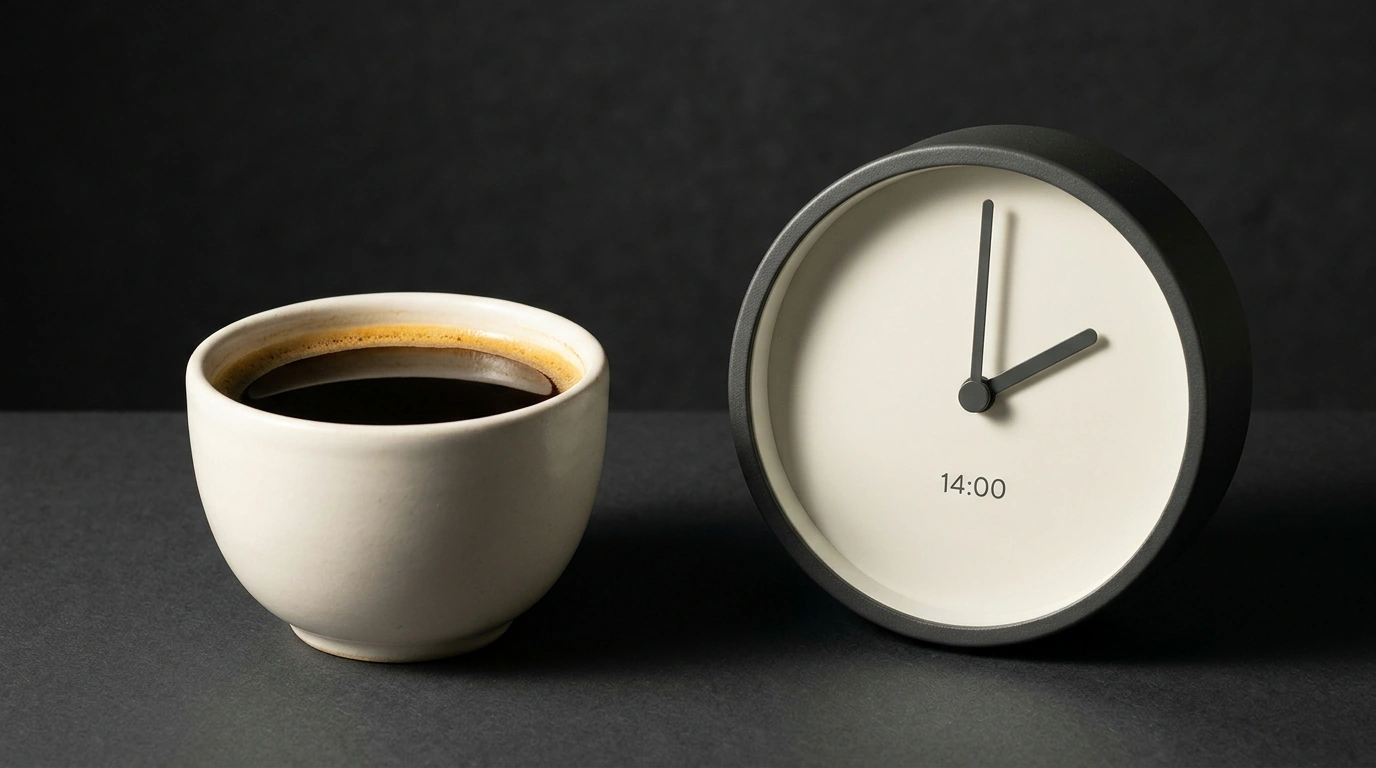
- Cut off caffeine 9 hours before bed (the 14:00 rule): If you plan to fall asleep at 23:00, the last drop of any caffeinated drink should enter your body no later than two in the afternoon.
- Watch hidden sources: After lunch, skip not only espresso, but also green tea, matcha, cola, dark chocolate, and energy drinks. Switch to herbal infusions (chamomile, mint, rooibos) or chicory.
- Don't buy the calcium-leaching myth: Caffeine flushes only 4–5 mg of calcium per cup through urine, which is more than offset by a couple of spoons of milk. Sedentary living weakens bones—not moderate coffee.
Timing discipline brings back morning alertness without forcing you to drown fatigue in yet more liters of espresso.