A colossal industry of fear has been built around insulin. Bloggers scare people into thinking that "as long as blood insulin is high, burning fat is physically impossible," demand expensive HOMA-IR tests, ban cottage cheese because of its high insulin index, force people to fast for days, and prescribe handfuls of dubious supplements—from berberine to chromium.
Endocrinologist Maksim Kuznetsov dismantles this popular pseudoscientific mythology in a detailed breakdown. High insulin is not the sinister culprit behind obesity—it is its logical consequence. The body raises insulin secretion not out of spite, but to somehow force energy into overflowing fat warehouses. Let's break down the physiology of resistance in plain terms and see how to genuinely normalize carbohydrate metabolism.
The Logic Trap: Why Cause and Effect Get Mixed Up
To see the absurdity of the claim "I'm not losing weight because my insulin is high," you only need to recall basic physics. The first law of thermodynamics—conservation of energy—is not overridden by any hormone.
In strictly controlled metabolic wards where volunteers receive an exact calorie deficit, every single person loses weight, regardless of their baseline fasting insulin. When food supplies less energy than the body spends on breathing, heartbeats, and walking, the body is forced to break down endogenous fat stores. We explained in detail why a lab number does not block weight loss in the article on why high fasting insulin is not to blame for obesity.
Insulin works like a warehouse manager. If the warehouse is empty, the manager is calm. If the warehouse is bursting with crates, the manager shouts louder and hires extra hands. High blood insulin is a marker that the body's fat cells are full and can no longer accept incoming energy.
What Happens Inside an Overflowing Cell
Normally, subcutaneous fat tissue can safely store energy reserves. Yet the capacity of this depot is genetically limited for each person (the so-called personal fat threshold).
When adipocytes swell to their limit, ectopic fat deposition begins: lipids start leaking where they do not belong—into the liver and pancreas (Professor Roy Taylor's twin-cycle hypothesis). Liver and muscle cells activate a defense against energy overload: they literally hide and block their insulin receptors (IRS-1/2) so that no new glucose can enter.
The pancreas sees that blood sugar stays elevated and begins producing more and more insulin, trying to force its way past that resistance. Compensatory hyperinsulinemia develops. Trying to treat it with pills without reducing fat volume is like trying to silence a fire alarm instead of putting out the burning curtain.
Skeletal Muscle and the GLUT-4 Bypass
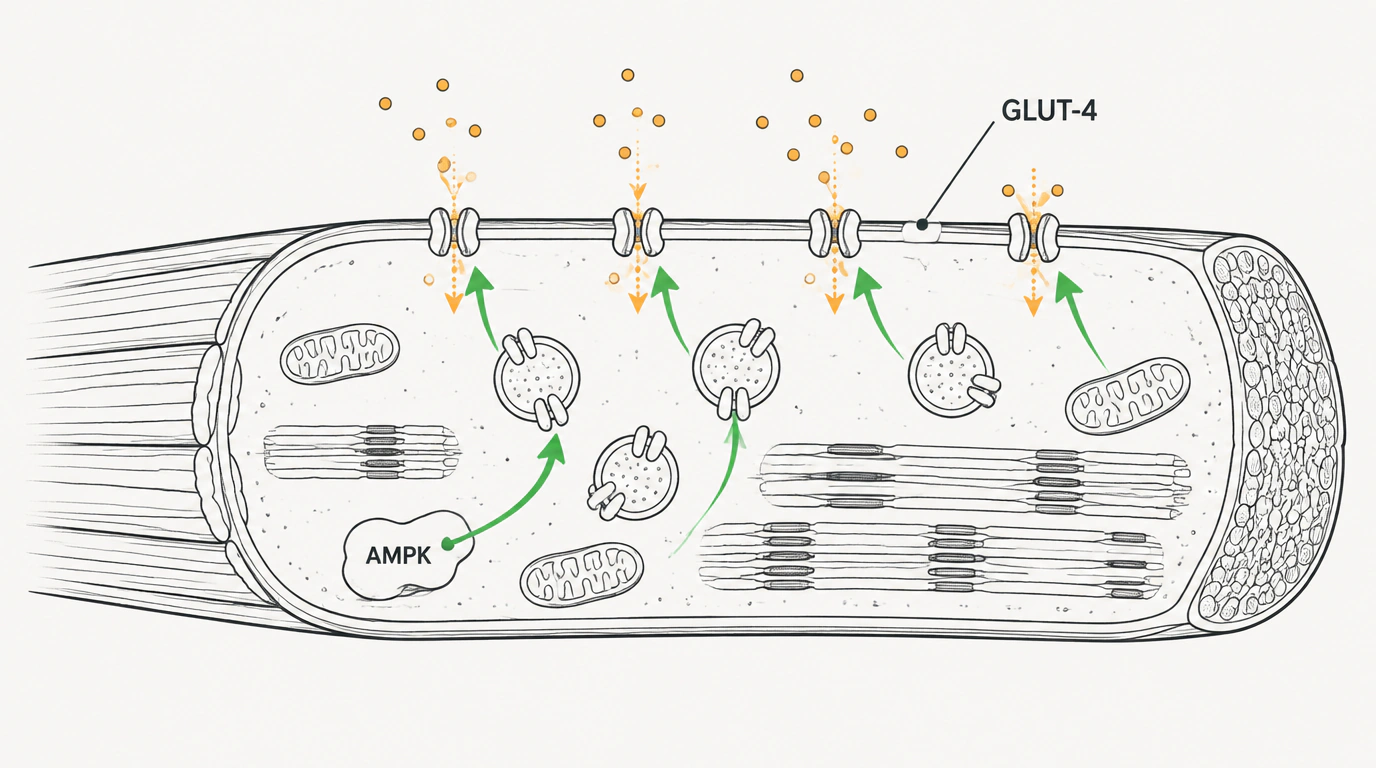
About 70–80% of all glucose arriving after a meal is cleared by skeletal muscle. At complete rest, a muscle indeed needs insulin: it binds to the membrane and orders special GLUT-4 transport proteins to rise from the depths of the cell to the surface and pull in sugar.
Yet nature built an astonishing alternative mechanism that people often forget: insulin-independent transport.
When you start moving—doing squats, climbing stairs, or simply walking briskly—muscle fibers contract. The breakdown of ATP molecules instantly activates the cellular energy enzyme AMPK and Rac1 proteins. In response, vesicles carrying GLUT-4 proteins rush to the cell membrane on their own, without any insulin at all!
Muscles begin greedily soaking up sugar straight from the blood, offloading the bloodstream. The pancreas immediately lowers insulin output because blood sugar drops naturally. Just one short 10–15 minute walk right after a meal cuts postprandial blood sugar by 20–30%, as clearly shown in the study on walking against blood sugar spikes.
The Scientific Triumph of the DiRECT Trial
The most compelling proof that insulin resistance is reversible came from the landmark DiRECT clinical trial, published in The Lancet in 2018. Researchers proved that losing 10–15 kg leads to sustained remission of type 2 diabetes and complete disappearance of pathological resistance in 86% of participants.
Within the very first weeks of creating a calorie deficit, liver fat dropped from a dangerous 16% to normal (under 5%). As soon as the liver was cleared of fat overload, its insulin sensitivity bounced back, and basal blood insulin normalized automatically. We examined this process closely in the piece on type 2 diabetes remission through weight loss.
How to Act in Practice
To forget insulin fears for good, stick to the clear rules of evidence-based medicine:
- Create a steady 10–20% calorie deficit: It makes no difference which diet you pick—Mediterranean, balanced, or low-carb. What matters is reducing total visceral and liver fat.
- Add strength training 2–3 times a week: The more functional muscle mass you have, the roomier your "warehouse" for clearing carbohydrates. Every additional 10% of skeletal muscle cuts the risk of metabolic disorders by nearly a quarter.
- Move after carb-heavy meals: Don't collapse onto the couch after a hearty lunch. Walk for 10–15 minutes: contracting leg muscles will pull in glucose without insulin.
- Don't fear cottage cheese and fermented dairy: Yes, dairy protein triggers a brief insulin bump due to amino acids, yet large meta-analyses prove that eating cottage cheese lowers diabetes risk and protects the cardiovascular system.
- Skip unnecessary lab tests: International diabetes associations (ADA, WHO) do not use fasting insulin or the HOMA-IR index to make a diagnosis. To monitor carbohydrate metabolism, you only need glycated hemoglobin (HbA1c, normal up to 5.7%) and fasting plasma glucose.
Lowering insulin is not the magic of rare supplements—it is the simple physics of emptying fat depots and working large muscles regularly.