When someone resolves to firmly step onto the path of healthy living and shed extra kilograms, the morning plate is usually the first thing put under the knife of reform. Sausage sandwiches and sugary cereal are decisively tossed in the trash, replaced by the "gold standard": crunchy granola, glazed curd bars, smoothie bowls, and avocado-salmon toast.
Everything looks aesthetic and wholesome. Yet a month passes, and the scale needle stalls or creeps upward. Endocrinologist Maksim Kuznetsov regularly unpacks this trap: people confuse a food's healthfulness with its calorie count. A wholesome eco-breakfast easily climbs to 800–1,000 kcal—half an adult's daily allowance.
The Physiology of Satiety: Why Volume Matters
To understand why ravenous hunger strikes just an hour after a bowl of granola, you have to look at how the brain registers fullness. Two main mechanisms are at work here:
- Mechanical loop (stomach stretch): Sensitive mechanoreceptors line the muscular wall of the stomach. When food physically fills its volume, a signal travels along the vagus nerve straight to the hypothalamus, switching off production of the hunger hormone ghrelin.
- Chemical loop (protein and satiety hormones): As protein amino acids break down in the gut, satiety peptides (PYY, cholecystokinin, and GLP-1) are released, providing calm, lasting fullness for 3–4 hours.
Now look at typical store-bought granola. It consists of rolled oats generously baked in vegetable oil with honey, Jerusalem artichoke syrup, dates, and nuts. Per 100 grams, that product packs 500–600 kilocalories and up to 35 grams of sugar! You pour a small bowl (80 g of granola), add a cup of yogurt—and get 650 kcal. The physical volume of food in your stomach is tiny, while calorie density is off the charts: the stomach never stretches, satiety never switches on, and half your daily calorie budget is already spent.
The same thing happens with smoothies: when you blend a banana, mango, a handful of nuts, and a spoonful of honey, you drink concentrated calories in three gulps, robbing your jaws of chewing and your stomach of the work of digesting solid food.
Anatomy of the "Healthy" Toast and Glazed Curd Bars
The second popular trap is the famous avocado and red-fish toast. Avocado and salmon are wonderful foods, rich in omega-3s and monounsaturated fats. Still, let's do the math:
- Half a large ripe avocado (100 g) — 160 kcal (15 g of fat).
- 50 g of lightly salted salmon — about 100 kcal (6 g of fat).
- 30 g of cream cheese or quark spread — 80 kcal (7 g of fat).
- Two slices of whole-grain bread — 160 kcal.
Total: a pair of neat, pretty open-faced sandwiches brings in over 500 kcal, including 28 grams of pure fat. Add a milk coffee and a small chocolate-covered curd bar (which is actually a 220 kcal calorie bomb of sugar and butter), and breakfast crosses 900 kcal.
In Holt's satiety index study, oatmeal cooked in water scored 209%, eggs scored 150%, while muesli and pastries scored under 100%. We broke down the principles of fullness in the article on the ideal breakfast for weight loss.
How to Build an Ideal Breakfast Without Excess Calories
You don't need to give up healthy foods—just shift the proportions:
- A protein base: Cook two whole eggs with two extra egg whites (or an omelet with 5% low-fat cottage cheese or slices of turkey). Protein lays a reliable foundation for fullness.
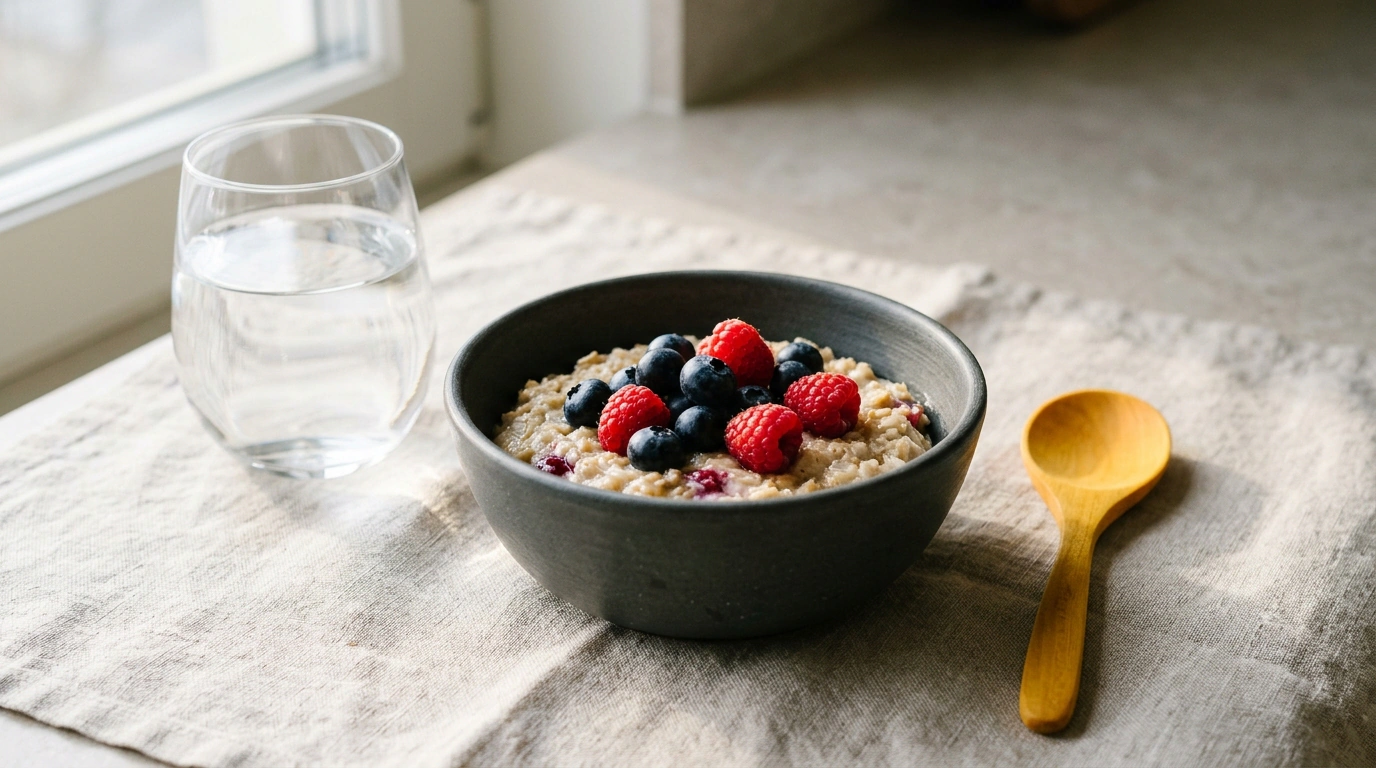
- Volume from complex carbs: Instead of granola, cook traditional slow-cooking rolled oats (15–20 minutes) in water and toss in a handful of fresh or frozen berries (blueberries, raspberries, cherries). At just 40 kcal per 100 g, berries add huge volume, fiber, and bright flavor.
- Healthy fats under strict control: Cut a thin slice of avocado (30 g instead of half a fruit) or add a teaspoon of seeds. Fats are needed for the gallbladder, but they shouldn't dominate the plate.
Such a breakfast fills the exact same plate, keeps you full for 4–5 hours, and fits into just 380–420 kcal, leaving plenty of room for a tasty lunch and dinner.