Right now, as you walk to the store or climb the stairs, two teams of cells are hard at work inside your bones. One team, osteoclasts, acts like a demolition crew and dissolves old bone tissue. The other team, osteoblasts, immediately patches the gaps with a fresh framework of protein and minerals.
As long as your body stays in balance, demolition and construction match each other. After age 50, however, estrogen levels drop during menopause, and the brakes on the demolition crew come off. Bone turns porous like dry chalk inside a thin shell, while from the outside you feel nothing at all.
Why Thinning Bones Don't Hurt and What a Fall Risks
Bone tissue contains no pain receptors. Osteoporosis steals strength quietly for years until a low-energy fracture happens.
A healthy skeleton easily survives a fall from standing height, whereas osteoporotic bone breaks from a standing fall or even less. Vertebrae can collapse simply from stepping off a curb, bending for a bag, or sneezing hard. The most common break sites are the wrist, thoracic and lumbar spine, upper arm, and femoral neck at the hip.
A hip fracture is the most dangerous injury in older age. As endocrinologist Maxim Kuznetsov reminds us, bed rest, congestive pneumonia, pulmonary embolism, and pressure sores claim 20 to 30% of older patients within the first year after a hip fracture, and more than half of survivors lose their independence.
False Alarms: Clicking Knees and Lower Back Ache
Doctors hear the same story in clinics again and again. A woman in her fifties notices an aching lower back or clicking knees, blames osteoporosis, starts taking vitamin D, and stops worrying. Then one icy day she slips outside her door and breaks her hip.
Let me warn you upfront: the mistake here is aiming at the wrong target. Joint clicking comes from gas bubbles in joint fluid or shifting ligaments, not bone density. Back pain usually stems from muscles, degenerative disc wear, or worn spinal joints, or else signals that a vertebra has already collapsed. Waiting for pain before getting checked makes no sense.
Losing Centimeters and Getting a DEXA Scan
You need to rely on objective clues, and the main one is literally shrinking. Losing more than 4 cm of height compared to age 25, or 2 cm or more over the past year, often points to silent compression fractures in the spine.
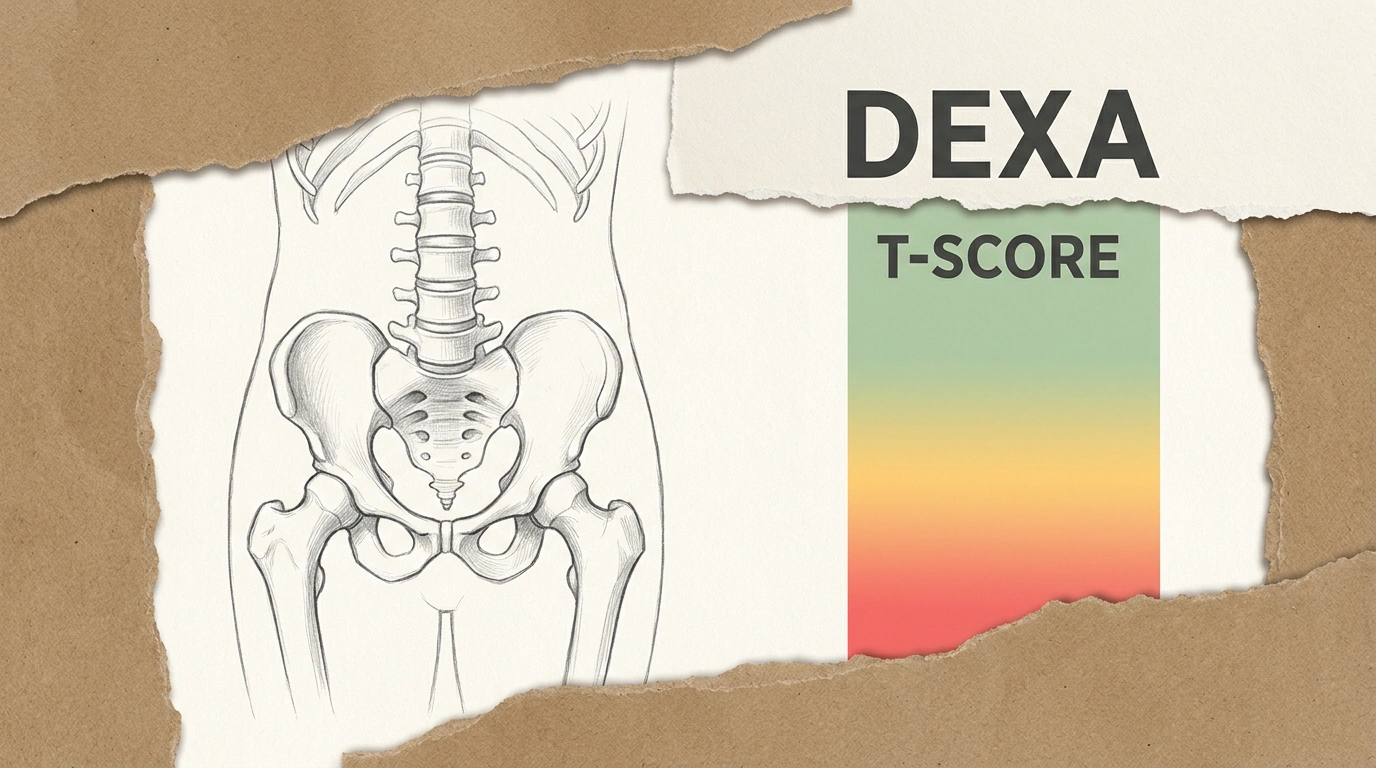
A standard X-ray spots osteoporosis far too late, only after 30 to 40% of bone mass is gone. Early detection requires dual-energy X-ray absorptiometry, or DEXA. This low-radiation scanner checks your lower spine and upper hip and calculates a T-score.
That number compares your bones to the density of a healthy young adult. A score from +1.0 to -1.0 standard deviations is normal, while -1.0 to -2.5 means borderline osteopenia. A score of -2.5 or lower confirms osteoporosis, and paired with a fragility fracture it signals severe disease. Under AACE/ACE clinical guidelines, a hip or spine fracture from a standing fall establishes the diagnosis right away, even if the scan still reads as osteopenia.
Osteoporosis Risk Factors
- Age over 50 and postmenopause in women with declining estrogen
- Height loss of more than 4 cm since age 25 or more than 2 cm in the past year
- A fracture after a fall from standing height, stepping off a curb, bending, or coughing
- A DEXA scan result in the osteopenia range with a T-score between -1.0 and -2.5
Why Vitamin D Can't Replace Osteoporosis Treatment
Once a diagnosis is on paper, it's tempting to buy high-dose vitamin D and calcium and wait for your bones to harden again. At this stage, supplements alone are powerless.
Let's be clear about what vitamin D actually does. It helps your gut absorb calcium and builds bone reserve starting in youth, remaining a helpful baseline in later life. Yet it cannot stop overactive demolition cells that are already tearing down your bone framework.
Real skeletal protection comes from prescription therapy chosen by an endocrinologist or rheumatologist. First-line options include antiresorptive drugs—bisphosphonates like alendronate, ibandronate, and zoledronic acid, or denosumab—that slow down bone breakdown. For very high fracture risk, doctors add bone-building agents like teriparatide or romosozumab to grow new bone tissue, while vitamin D and calcium serve as reliable backup.