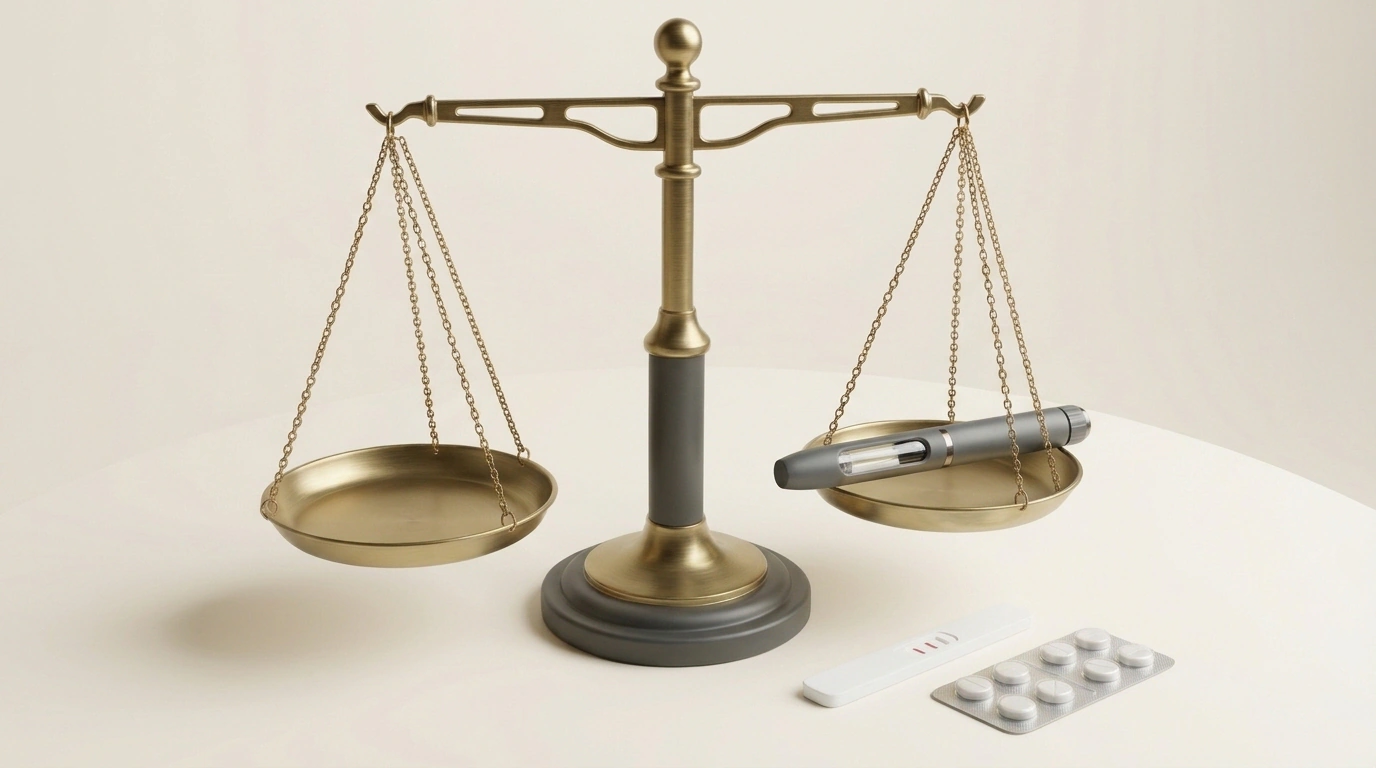
Endocrinologists are seeing the same paradox more and more often. Women with years of infertility or strict birth control routines start weight-loss injections, and within one to three months they see two lines on a pregnancy test instead of a lower number on the scale.
Online, people dubbed this trend 'Ozempic babies,' sparking rumors that semaglutide cures infertility. Endocrinologist Stanislav Khan breaks down the phenomenon without the hype: the shots open a path to conception through two side mechanisms, and using them during pregnancy is strictly off-limits.
How a Weight-Loss Shot Wakes Up 'Sleeping' Ovulation
Take a common clinic story: a woman carrying extra weight with polycystic ovary syndrome (PCOS) starts semaglutide or tirzepatide to lose around ten kilograms. Here is where the surprise test result comes from.
Excess weight packs visceral fat around organs and keeps blood insulin high. Too much insulin nudges the ovaries to produce extra male hormones. When those levels climb too high, eggs fail to mature and ovulation stops.
Then a direct chain reaction kicks in. Losing just the first five kilograms—around 5 to 10% of body weight—helps tissues sense insulin normally again and lowers male hormones. The ovaries receive a healthy signal, and ovulation suddenly returns. If a woman assumed she was infertile and skipped protection, the very first cycle can bring two pink lines.
Why Birth Control Pills Fail
With combined oral contraceptives, the mechanics are trickier. GLP-1 receptor agonists mimic a fullness hormone and slow down the stomach so food leaves more gradually. Logic suggests that such a traffic jam might keep pills from entering the bloodstream.
Here pharmacology splits into two scenarios. In a 2015 study by Kapitza on 43 women, semaglutide itself did not lower contraceptive hormone levels; ethinylestradiol and levonorgestrel actually rose by 11% and 20%.
Tirzepatide behaves differently. After a single 5 mg dose, overall contraceptive exposure fell by 20 to 23%, and peak blood levels crashed by 55 to 66%. On top of that, starting or increasing the dose of any shot in this class often triggers nausea, vomiting, or diarrhea. If you vomit within two to three hours of taking a pill, the hormones never absorb in your gut and your protection fails.
How Risky Are These Drugs for a Fetus?
In rat and rabbit studies, doses of semaglutide toxic to the mother caused fetal death, stunted growth, and skeletal or organ abnormalities. Even though animals received massive doses, those warning signs make doctors cautious.
Let's look at human data. In February 2024, JAMA Internal Medicine published a study by Cesta and coauthors across the U.S., Northern Europe, and Israel. Researchers tracked 938 pregnancies in women with type 2 diabetes taking GLP-1 agonists and compared them against an insulin group. The risk of major birth defects did not rise and stayed at the baseline risk seen with diabetes.
Still, reassuring statistics don't make the shots safe. No clinical trials are run on pregnant women, and long-term effects on children remain poorly studied. The drug lingers in fat tissue and blood for weeks, reaching the embryo between weeks three and eight when the neural tube and heart form. That's why using semaglutide or tirzepatide for fertility or during pregnancy is prohibited.
Safety Limits: Stopping Rules and Protection
Semaglutide has a half-life of roughly seven days, meaning blood levels drop by half each week. Clearing the medication completely takes five cycles, or five to seven weeks.
Because of that timeline, regulators including the FDA, EMA, and Russia's Ministry of Health require stopping treatment at least two months before trying to conceive. For women with PCOS looking to lose weight before pregnancy, doctors prescribe approved options like metformin or myo-inositol alongside diet adjustments. While pregnancy isn't planned, add condoms to oral pills, especially when raising your dose or dealing with stomach upset.
- If you see two lines on a pregnancy test, stop semaglutide or tirzepatide immediately without waiting for your next scheduled shot.
- Contact your gynecologist and endocrinologist right away to confirm dates and set up monitoring.
- If you have type 2 diabetes, your doctor must switch you promptly to safe insulin therapy with close blood sugar checks.