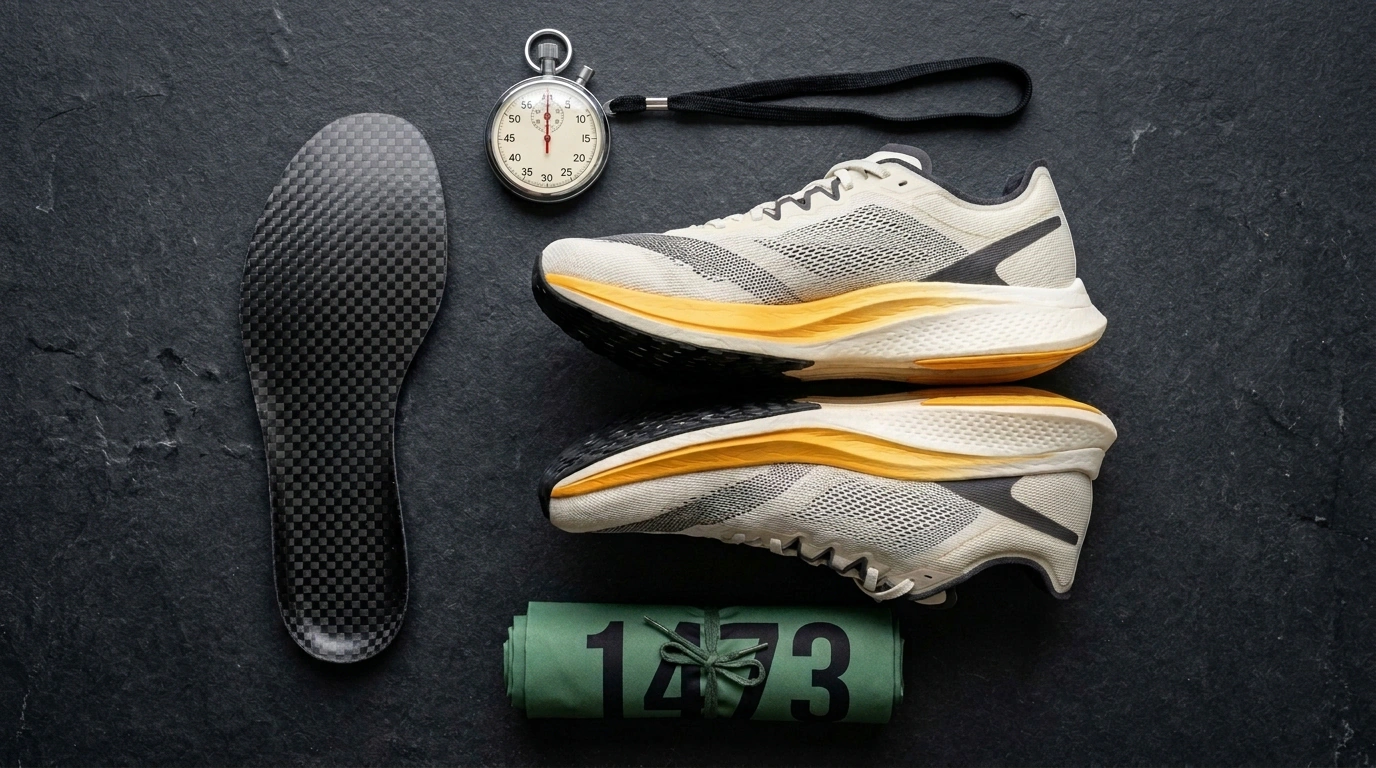
Sweden's Andreas Almgren lined up for his debut marathon and won New York in 2:06:01, becoming the first European man to take the race in 30 years. He ran in a pre-release $360 Nike Apex prototype featuring a zero heel-to-toe drop, stacked dual Air Zoom pods under the forefoot, and a January 2027 retail launch.
Four more brands crowded the top five right behind him. Italy's Yemaneberhan Crippa finished second in 2:06:14 wearing the On LightSpray Cloudboom Strike 2 with its robot-sprayed seamless upper, while Kamohelo Mofolo took bronze in 2:06:26 in China's Xtep 160X 8.0 Pro. Benson Kipruto placed fourth in the $500 adidas Adizero Adios Pro Evo 3, and Haftu Strintzos fifth in the featherweight ASICS Metaspeed Ray. Rounding out the top eight were Ahmed Muhumed in a Hoka DEV-1187090 prototype, Geoffrey Kamworor in the discontinued Nike Alphafly 3, and Ryota Kondo in the ASICS Metaspeed Sky Tokyo. This raises a direct question: does it make sense for an amateur runner to spend $300 to $500 on a pair like this?
Anatomy of Super-Foams: Why Soft Doesn't Equal Fast
Let's look inside the midsole. Traditional EVA foam returns only 60 to 65% of impact energy, packs down quickly, and turns stiff in the cold. By contrast, PEBA polymer foamed with nitrogen or carbon dioxide returns 85 to 87% of energy according to a Sports Medicine - Open review. You press into the asphalt, and the material rebounds with almost no loss.
The downside of softness shows up in two ASICS models. The Metaspeed Ray uses an aliphatic thermoplastic polyurethane (A-TPU) sole under a paper-thin mesh upper. It delivers marshmallow cushioning and flies on straightaways, yet the soft block wobbles sideways around sharp turns. The Metaspeed Sky Tokyo stacks two layers underfoot—springy PEBA on top and softer A-TPU below under a sturdier mesh. That shoe absorbs shock while keeping your foot locked in as fatigue sets in.
Why Carbon Is Inside and Why It Isn't a Trampoline
Seeing a curved carbon plate makes it easy to assume it acts like a spring. In truth, the stiff insert works as a lever: it limits excess bending at the base of your toes, saves foot muscle energy, and spreads load evenly across the foam. Meanwhile, the curved sole profile—called a rocker—speeds up the roll from midfoot to toe-off.
World Athletics caps road-shoe stack height at 40 millimeters and allows only one lengthwise rigid plate. As a result, brands squeeze extra seconds out of foam chemistry, seamless uppers, and air pods. In the zero-drop Nike Apex, stacked Air Zoom pods create a sharp, aggressive push-off. Nike is keeping the Apex for elites while positioning the Alphafly 4 as its marathon shoe for everyday runners.
The Cost of Savings: What Amateurs Pay at 6:00 min/km
That same Sports Medicine - Open review credits super-shoes with 2 to 4% energy savings, roughly two to four minutes over a marathon. However, those gains only unlock at speed. Runner's World tester Josh Davis, cited in a review by the 'Begat prosto' channel, called the Xtep 160X 8.0 Pro a rocket during fast intervals, yet found them downright awkward at easy paces. These race machines are built for a cadence of 180 to 190 steps per minute, forefoot or midfoot striking, and speeds faster than 3:30 to 4:30 min/km, while real carbon benefits start at race paces quicker than 5:00 to 5:30 min/km.
At 5:30 to 6:30 min/km with a heel strike, everything backfires. Your heel sinks deep into narrow 40-millimeter foam, making your ankle roll inward. Without a powerful push-off, the carbon plate turns into a rigid speed bump that overloads your Achilles tendon, plantar fascia, and ankle ligaments. On top of that, $360 to $500 buys you a PEBA lifespan of roughly 250 to 350 kilometers—just enough for a couple of tune-up workouts and one or two races.
- Match your pace: carbon and PEBA pay off in races faster than 5:00 to 5:30 min/km.
- At 5:30 to 6:30 min/km or if you heel-strike, skip extreme zero-drop models with narrow heels.
- Choose stable geometry: a wide sole base, a 6 to 8 mm drop, supportive sidewalls, and dual-layer foam.
- Save super-shoes for race day and log your training mileage in a regular daily trainer.
- If your Achilles or arch aches after running in carbon, switch back to regular shoes and see a doctor if pain lingers.