You open your browser in the morning, paste your project description into a chat window for the third time this week, and ask the AI for five cold email subject lines. The model spits out options, and then it's right back to manual grunt work: copying rows into a spreadsheet, hunting down email addresses on websites, and sending messages one by one. Open a fresh tab, and the algorithm stares at you like a total stranger—having already forgotten your product and your audience.
How do you move from basic Q&A to a system that actually runs multi-day workflows on its own? I looked into Nous Research's Hermes Agent release and a walkthrough by Julian Goldie: the leap comes down to persistent shared memory and clear role separation. Let's trace how a single prompt—finding 20 UK fintech marketing directors—turns into a verified contact list with personalized email drafts.
Six Levels of Agentic Maturity: Why 90% of Users Get Stuck on Simple Chat
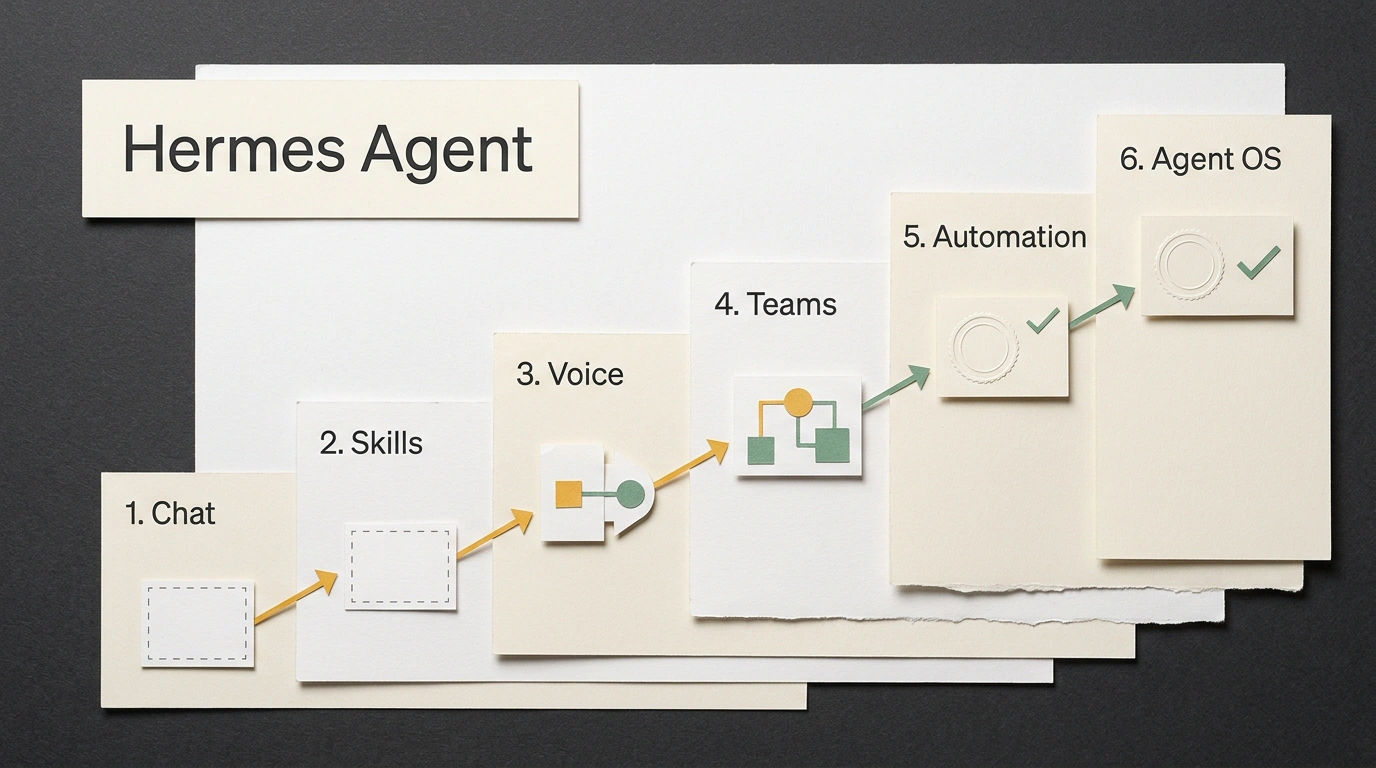
Roughly 90% of users never get past basic chat because without shared memory, every new window has to be briefed from scratch. Inside the Hermes ecosystem, the path to autonomy breaks down into six stages:
- Level 1 (Chat): a browser conversation where context resets every session and you assemble the final output by hand.
- Level 2 (Skills): step-by-step playbooks for recurring tasks that Hermes saves to memory and sorts every 7 days by how often you call them.
- Level 3 (Voice): the Apollo module and WhatsApp audio for reading back notes, morning briefings, and voice-assigned tasks.
- Level 4 (Agent Teams): a Kanban board (
To Do,Doing,Done) where a manager agent breaks an idea into a subagent plan in 20 seconds, leaving you withApproveandRejectbuttons. - Level 5 (24/7 Automation): scheduled routines firing at 7:00 AM, where Tuesday's run builds directly on Monday's results.
- Level 6 (Agent OS): the Mission Control dashboard, tying skills, voice, the task board, and pipelines together through shared memory.
When stepping up to Level 5, there's a strict seven-day burn-in rule: for the first 7 days, the overnight bot drops every email into Drafts without sending anything until you review each line in the morning.
True autonomy grows out of inspectable drafts, not blind trust.
Inside the Hearth Release: Unified Gateway, Shared Memory, and Context Rewind
The Hermes Agent Hearth v0.23.0 release landed more than 1,650 changes in a project that has grown from 15,700 to 100,000 GitHub stars. Its centerpiece is the Unified Gateway, keeping your terminal, desktop app, and messaging apps in sync.
To bridge local sessions and manage agents from a browser, you spin up the background gateway:
# Start the Hermes Agent background gateway
hermes gateway start --port 8443 --bind 0.0.0.0
This launches the coordinator on --port 8443, while --bind 0.0.0.0 opens the unified task queue to your desktop, a web tab, or your phone via Telegram and Discord.
I also checked the safety rails in the changelog: /rewind rolls a conversation back to any earlier step and branches the context, session compaction flags unverified guesses under unverified, and spending caps on paid MCP tools stop runaway loops from draining your balance.
Shared memory only works when the system keeps verified facts separate from guesses.
A 6-Module Pipeline: How Hermes + Hunter API Finds and Verifies Leads
At Level 6, pairing Hermes Agent with Hunter API and Agent OS turns lead generation into a six-module pipeline:
- Describe: you type a single sentence ("Build a list of 20 marketing directors at UK fintech companies") or upload a spreadsheet to enrich.
- Find & Enrich: the agent pulls domains and email addresses via Hunter API, sorting cards across
New,Enriched,Valid,Contacted, andReplied. - Verify: a filter drops addresses with deliverability below 90% (
deliverability < 90%). Out of 20 directors, 4 contacts get weeded out for bounce risk, protecting your domain from DNSBL spam blacklists. - Score: every lead gets a 0–100 fit score against your criteria.
- Write: for the remaining 16 contacts, Hermes drafts emails with a personalized icebreaker referencing the company's recent posts.
- Send: drafts wait in
Ready for Reviewand go out through a dedicated sending inbox.
For setup details, check out our breakdowns of Hermes architecture across 371 scenarios and running Hermes v0.22 locally.
Before you manually hunt down another batch of contacts, ask yourself how many times this week you've pasted the exact same project rules into a chat box—and whether it's time to move them into shared memory with a seven-day draft review.