Conventional wisdom says SEO is an endless race for Google's number-one spot—buying backlinks and packing keywords into every paragraph. It seems obvious that if a site pulls tens of millions of visits, its pages must be tuned to perfection, leaving smaller projects without massive budgets no chance. Yet when I looked at a fresh search audit that separated brand-name recognition from non-branded discovery queries, that neat picture fell apart.
SEO specialist Julian Goldie ran three major platforms—design tool Canva, real estate portal Zillow, and workspace app Notion—through a pairing of the Claude Code terminal agent and the open-source OpenSEO platform. One number in that report jumped right out at me: nearly 9 out of 10 Google clicks for these giants happen simply because people type "Canva," "Zillow," or "Notion" into the search bar. Branded queries drive 88% of Canva's top-100 keyword traffic (out of roughly 22.7 million monthly US visits), and around 87% of Zillow's 63 million visits. You can't copy someone else's brand fame. In the remaining 10–12% of non-branded search, however—where users want answers and read summaries in Google AI Overviews, ChatGPT Search, and Perplexity—the rules change completely, and the giants have surprising blind spots.
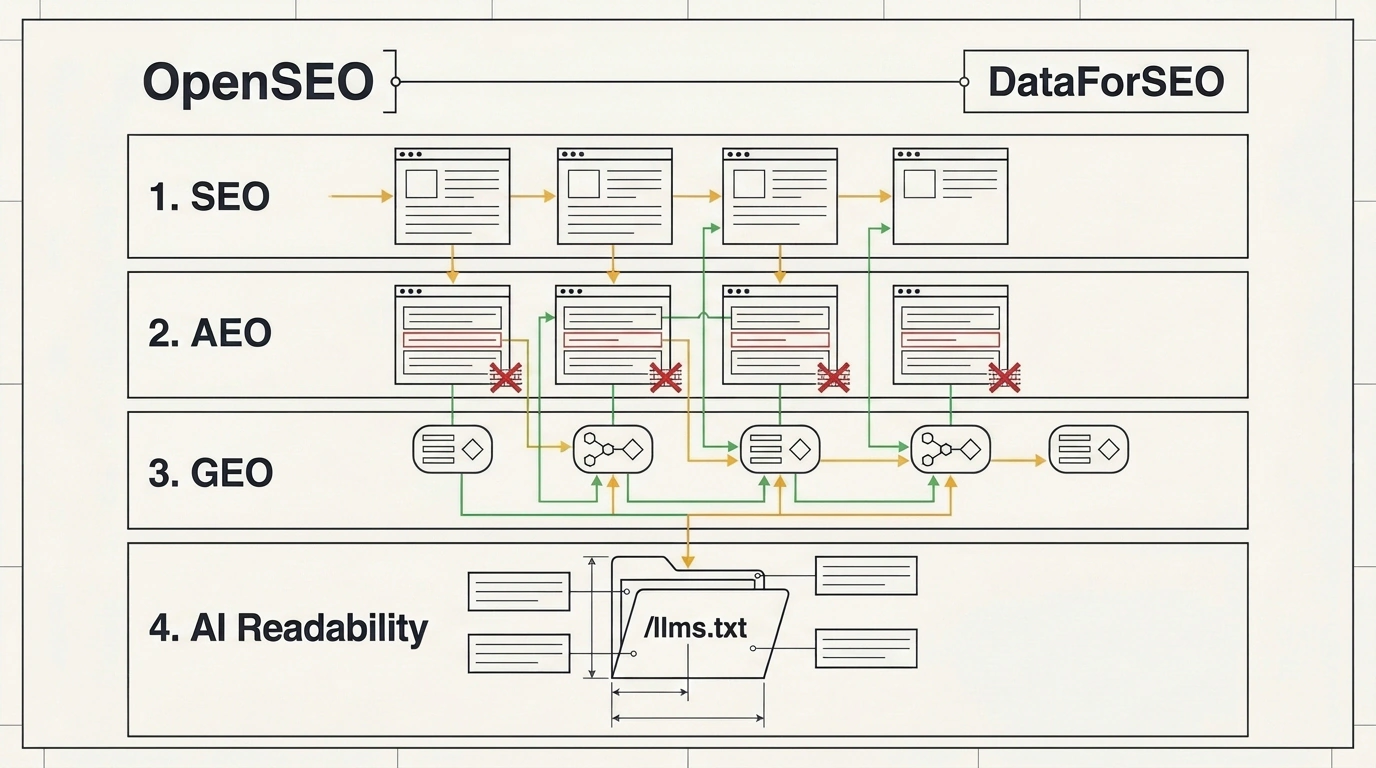
Four Layers of Visibility: Classic SEO, Answer Boxes (AEO), AI Citations (GEO), and Machine Readability
Most site owners still watch only the first layer—classic SEO (Search Engine Optimization), where pages fight for blue links. Today, the path to being found splits into four floors, and failing on any one of them makes your site invisible to AI models:
- Classic Search (SEO): traditional keyword rankings and domain backlink authority.
- Answer Engine Optimization (AEO): top-of-page answer boxes (Google Featured Snippets) where search pulls a single paragraph, list, or table.
- Generative Engine Optimization (GEO): getting cited as a source inside Google AI Overviews, ChatGPT, Claude, and Perplexity answers.
- AI Readability: letting LLM crawlers actually reach your pages without
robots.txtblocks, firewall walls, or heavy client-side scripts.
Legacy SEO tools don't tell you which exact lines an AI model lifted into its answer. That's where OpenSEO steps in—a free, MIT-licensed platform you run in Docker. It pulls live metrics from the DataForSEO API (search volume, keyword difficulty from 0 to 100, backlinks, and AI visibility), adds a 3D Rank Orbit view, and exposes an MCP server.
Through that MCP connector, Claude Code plugs straight into OpenSEO. Instead of exporting CSVs from five different tools, a task-planning SaaS founder types one sentence in the terminal asking the agent to audit a competitor against their own product. In three minutes, the agent pulls traffic stats, verbatim AI citations, and bot access rules—separating myths from reality.
Inside the Giants: Why Google AI Quotes Canva's Spec Tables and Zillow's Cards Word for Word
A common assumption is that because Canva ranks for 716,000 keywords, its flashy landing pages win hundreds of featured answers. In reality, the domain holds just 27 AEO answer boxes, while Google AI cites it across 177,922 queries. AI ignores marketing slogans: all 27 of Canva's snippets come from dry help-center pages. Ask for Facebook cover dimensions, and the model grabs the line starting with the number (820 × 312 pixels) followed by one clean sentence; ask for teal's color code, and it pulls the HEX value; ask for flyer sizes, and it lifts a three-row table. In generative answers, it copies FAQ blocks and short how-to steps ("1. Open your design. 2. Go to Elements...") the same way. Yet on queries like the best digital planner for iPad, the giant loses out to small independent blogs.
Zillow tells a similar story with 574,992 AI citations. You'd assume half a million mentions come from its massive listings database, but look at what models actually extract. From the mortgage calculator, they take the monthly payment formula; from market reports, the dated summary ("As of..."); from agent profiles, the structured block with name, license, address, and phone; from rental pages, the filter list. Clean structure beats long prose, and city-specific pages with hard numbers outrank generic portals.
The biggest surprise, though, showed up on layer four—machine readability:
- Canva's filter:
robots.txtblocks ChatGPT and Claude bots across most of the site, allowing them only into tools, help, and learning sections (while Perplexity gets full access). A giant can afford to gate content; for a smaller site, locking bots out just cuts your reach. - Zillow's firewall: Zillow's
robots.txtsays AI bots are welcome everywhere, yet when an agent tried to fetch a page, the WAF blocked the request. There's an "Open" sign on the door, and a bouncer turning everyone away. - Notion's empty templates: Notion has an ideal technical setup—open access for ChatGPT, Claude, and Perplexity, clean text versions, and an
/llms.txtmap. Yet it has fewer than 9,000 Google AI mentions (mostly branded). Why? 94% of Notion's non-branded traffic lands on its template gallery, and inside the top template cards, the "About this template" section is empty—no definition, no steps, no FAQ.
The llms.txt Standard in Practice: Giving Models Clean Context Without Markup Clutter
Why maintain a separate map for bots? Browsers chew through scripts and layout CSS effortlessly, but an LLM crawler needs to grab the core meaning of a page fast and fit it into its context window (the model's working memory). If a bot gets bogged down in nav menus and scripts, it moves on to a cleaner source. For more on how generative engines pick sources, read our guide on GEO and AEO vs. classic SEO.
To serve bots clean text without HTML noise, Jeremy Howard (Answer.AI) proposed the llms.txt standard in September 2024: a curated Markdown sitemap at /llms.txt in your domain root, paired with /llms-full.txt that bundles all documentation into a single text file for a one-shot HTTP fetch.
In our running example, the task-planning SaaS founder audits Notion with Claude Code and OpenSEO and sees that on freelancer software queries, Notion misses AI recommendations (only surfacing via a Reddit thread), while on reference queries search quotes third-party shortcut tables. The team checks bot access and drops an /llms.txt file into their site root:
# PlanFlow
> Task planning and client onboarding workspace.

## Core Documentation
- [Quick Start](https://example.com/docs/start): Installation and setup.
- [Pricing](https://example.com/pricing): Plans and usage limits.
- [Templates](https://example.com/docs/templates): Keyboard shortcuts and workflows.

## Optional
- [Blog Archive](https://example.com/blog): Company news and updates.
Look at how a crawler reads that structure. The # heading sets the project name, and the > blockquote right below sums up the product in one line. ## sections group links to core reference pages with short descriptions after the colon. Secondary pages go under ## Optional—if an agent hits a tight context limit, it skips that tail and saves tokens for your core docs. Just remember to keep links in /llms.txt up to date so models don't ingest stale context.
Three Page Formats AI Models Prioritize: Definitions, Comparisons, and Step-by-Step Workflows
Once bots can reach your pages, it comes down to how the text is packaged. Comparing citations across all three giants shows AI models prioritize three formats:
- Entity Definitions: a tight opening paragraph (under 250 characters) answering "What is it?" directly, with a number or formula in the first line followed by a bulleted list of specs.
- Comparison Matrices: side-by-side tables ("X vs. Y") with clear criteria, a freshness date ("As of..."), and at least one unique data point from your own practice.
- How-To Workflows and FAQ: numbered 4–5 step instructions where every item starts with an action verb and zero fluff, plus an FAQ block marked up with
FAQschema (Schema.org).
In our example, the SaaS founder uses OpenSEO to spot "client onboarding software" (480 monthly US searches, difficulty 14 out of 100) and "best client onboarding software" with difficulty 4. Instead of fighting over crowded keywords, the team builds template pages that fill Notion's exact gap: a crisp definition on line one, 4–5 setup steps, a shortcut table, a comparison matrix with their own metrics, and an FAQ at the bottom. On the next Perplexity query, the startup lands straight in the top source cards with a direct link.
Of course, /llms.txt and a few tables won't solve traffic overnight. Generative search carries a real downside—zero-click searches, where users read your numbers right inside the AI box without visiting your site, while providers keep ranking formulas under wraps. There's no magic bullet here, but now you can see all four layers of search clearly—and spot the exact doors even the biggest players leave wide open.