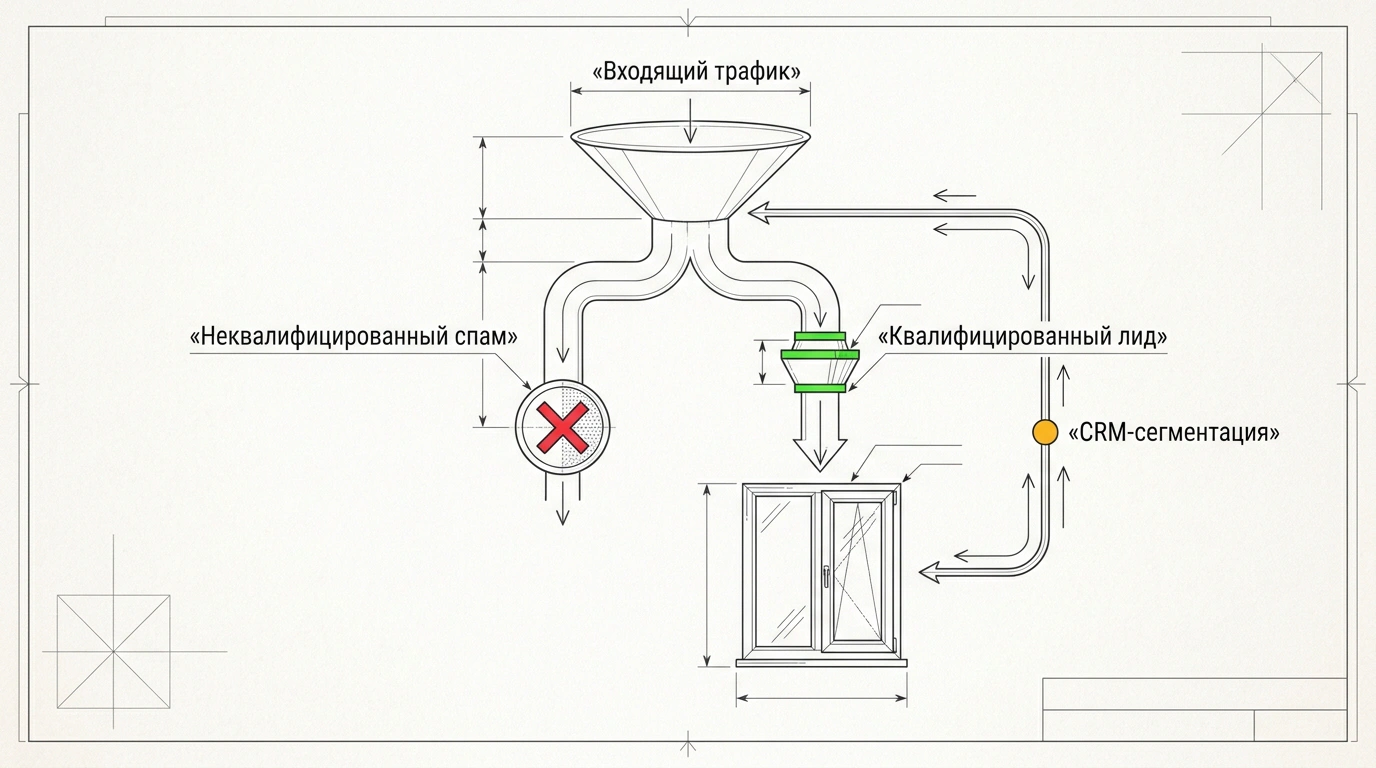
You've probably seen this play out before: you enter a red-hot niche, launch search ads, and watch your budget evaporate while the sales team shrugs. Clicks cost 460–500 RUB, leads cost a fortune, and the phone either stays silent or rings with spam. Most business owners blame their PPC specialist or decide that "search ads are dead." Let's pull apart a real case where a team didn't just rescue a failing campaign—they squeezed record sales out of it in a shrinking market.
This is about a PVC window manufacturer and installer with branches in Saratov and Voronezh, serving apartments, cottages, and loggias. The project was run by the agency MAKO. The market backdrop was brutal: according to OknaMedia, window sales had dropped 20–25%, and fell another 20% in the first half of 2026. Demand was dragged down by expensive mortgages and loans, while PVC profile costs jumped 10–15%. On top of that, over 50% of demand comes from home renovations where buyers count every ruble. On Yandex Direct Search, clicks climbed to 800 RUB, and peak-season lead costs easily broke past 10,000–12,000 RUB.
The April Nightmare and a Phone Detective Story
At the start of the spring season, the search campaign delivered grim numbers: clicks cost 467 RUB, site conversion sat at 6%, and the final cost per lead hit 11,230 RUB. At the average ticket for a window replacement, that's a guaranteed loss. Worse still, exactly half of all calls and form submissions turned out to be fraud and irrelevant junk.
The marketers sat down to listen to call-tracking recordings and uncovered something wild. Roughly a third of the spam calls came from pensioners and young mothers demanding child benefits or government subsidies. It turned out the call-tracking proxy number differed by just one digit from the regional social protection office's hotline (or had previously belonged to a government agency). Swapping out that single phone number on the site immediately cut irrelevant junk from 35% down to 23%.
Still, 23% spam remained. And that's where the biggest trap of modern Yandex automated bidding strategies showed its teeth.
Why Automated Bidding Kills Unit Economics on Dirty Data
When you optimize for a raw "Form Submitted" or "Call" goal and tell the algorithm to find similar people, the system optimizes for the conversion event itself. The machine can't hear that the caller asked about child benefits or hung up after two seconds. So the algorithm works overtime to bring you even more of those same spammers and bots. The more junk flows in, the harder the system scales it.
To break that feedback loop, the team linked the client's CRM to Yandex Metrica via ClientID. Deals in the pipeline were split into two buckets:
- Qualified leads: need identified, measurement visit scheduled, or deposit paid.
- Junk and fraud: wrong number, immediate drop-off, spam, or out-of-region inquiry.
Never optimize campaigns on raw website submissions. Set up offline conversion tracking from your CRM to Metrica and switch automated bidding to the qualified-lead stage. Apply a -100% bid adjustment to the rejected-lead segment, and make sure sales reps update CRM statuses daily.
As soon as training shifted to target pipeline stages and junk got a -100% bid adjustment, the share of qualified inquiries rose by 20% and fraud dropped from 23% to 12%. Similar tight-qualification setups work wonders in other service niches too—check out our breakdown: Cutting Cost Per Lead 4x: A Quiz, Chatbot, and Yandex Direct Funnel in Tourism.
Product Gallery and Quiz: Slashing Search CPL 6x
Cleaning the traffic was half the battle; they still had to bring down those sky-high click costs. Classic Search was generating leads at 10,498 RUB apiece.
So the team built a product feed from the website and launched dynamic ads across three placements at once: standard search results, the product gallery above organic listings, and the services gallery. They covered two intents simultaneously: buying the product ("buy PVC windows") and ordering installation ("turnkey window installation"). The result: search CPL plummeted from 10,498 to 1,524 RUB—an exact 6x drop.
In parallel, they rebuilt the landing page. Analytics showed that 74% of visitors came from smartphones, and 94% were seeing the site for the first time. Nobody was reading long walls of text about German profiles. Instead, the team launched an interactive 5-step quiz to configure window specs with a 5,000 RUB discount.
The first version of the quiz asked for contact details at the end without showing an estimated price—and visitors bailed. The moment they added an instant automated price estimate right before the phone prompt, contact submission conversion jumped 5x. Adding low-frequency feed items (balconies, cottages, loggias with "starting from" prices) brought another +26% lift in leads.
The Bottom Line in Numbers
Here is what the rebuilt funnel delivered:
- Qualified lead volume grew 4x at peak season and held a 3x increase in September.
- Spam and fraud dropped 4x—from 50% down to 12%.
- Search cost per lead fell 6x—from 10,498 to 1,524 RUB.
In an overheated auction, the winner isn't the one who throws the most money at the platform. It's the one who filters out junk with end-to-end data and removes friction for the mobile buyer.