Ask almost any PPC specialist, "Which Yandex Direct strategy should I pick if I need sales?" Nine out of ten won't even blink: "Maximize Conversions, obviously! Click strategies are outdated—they'll flood you with bots and junk." That dogma is baked so deep into the industry that businesses blindly turn on conversion-based bidding and then wonder why impressions grind to a halt and traffic collapses overnight.
Ekaterina Shashlova, Senior Performance Specialist at Molinos, broke down real client accounts to show how "Maximize Clicks" actually works under the hood. Set up properly, it can deliver qualified leads more steadily—and cheaper—than hyped conversion strategies. Let's look at why.
Under the Hood: How Clicks Turn Into Conversions
The biggest misconception is assuming "Maximize Clicks" flies blind and only hunts for the cheapest possible traffic. That was true five years ago. In modern Yandex Direct, the algorithm is far smarter.
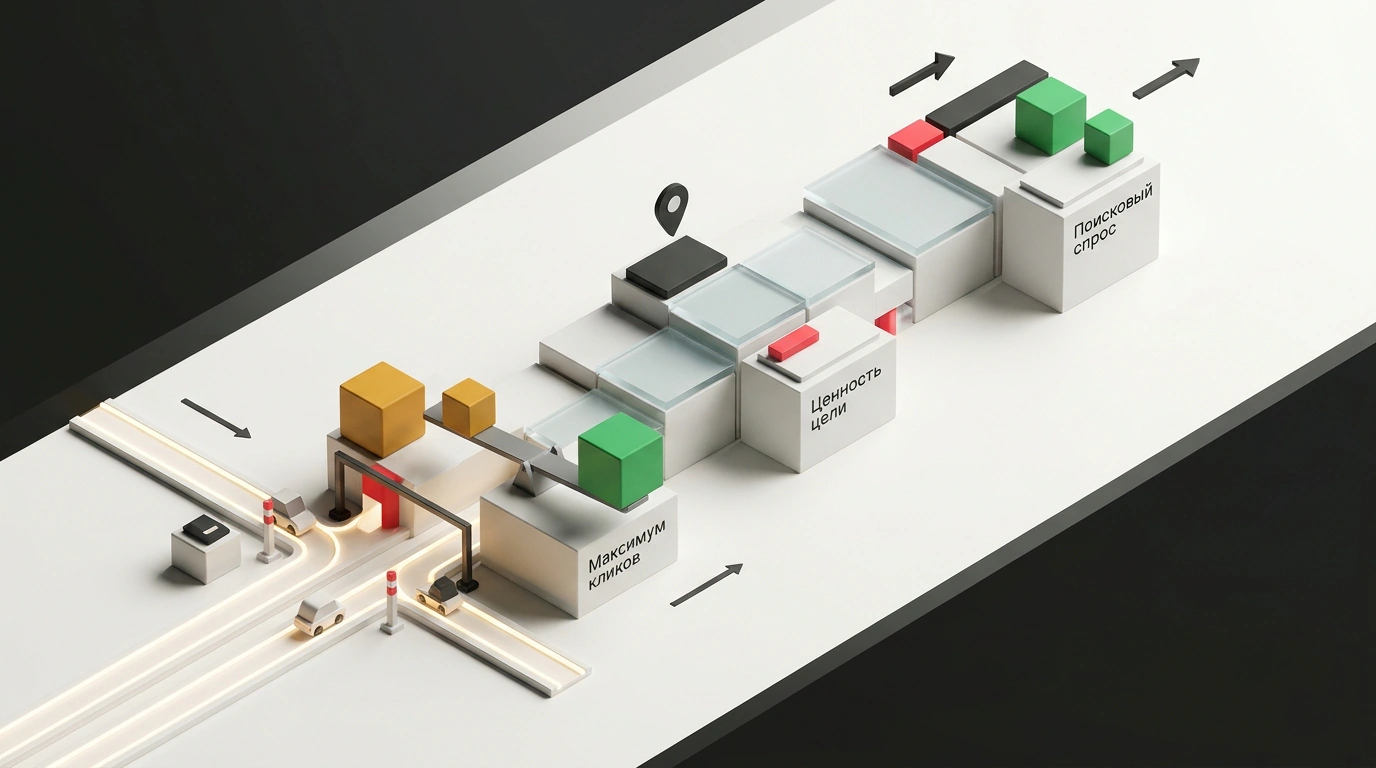
When you add key target actions (macro-conversions: calls, bookings, form submissions) to your campaign settings and assign them values, the system uses those goals as a compass. Every time a user enters a search query, the algorithm scores the likelihood that this specific person will complete a target action. If that probability is high, the click strategy automatically bids higher in the auction for that user.
The real dividing line is how much training data each strategy needs:
- Maximize Conversions needs a steady stream of 10–20 target actions per week per campaign. Fall short of that, and the strategy stalls in "Learning incomplete," panics, slashes bids, and strangles impressions.
- Maximize Clicks trains on clicks and runs reliably on just 100+ clicks per week, even if those clicks only produce 3–5 actual leads in that window.
Better yet, goal values don't have to reflect exact profit in rubles. The algorithm reads them as relative weights. If a phone call is set to 100 units and a paid order is set to 300, the system understands that a purchase is three times more valuable than a call.
Four Scenarios Where 'Maximize Clicks' Wins Hands Down
- Branded search campaigns. This is your cleanest, highest-intent traffic—buyers searching specifically for your company. If you turn on Maximize Conversions here, the algorithm tries to force leads into a tight CPL or DRR target and ends up handing your branded clicks to competitors. Ekaterina cites a real Molinos case for a five-star hotel's branded campaign: the conversion strategy was choking traffic, while switching to Maximize Clicks captured 100% of branded demand and restored a steady flow of bookings.
- Narrow B2B niches and complex products. If your entire market only generates 200–300 relevant searches a month, Yandex's conversion algorithms simply have nothing to train on. Waiting for 20 conversions a week means zero impressions. Your job is to capture everyone who types that query, and a click strategy handles that cleanly.
- Mature campaigns with tight negative-keyword lists. If you've been running an account for six months, scrubbed search query reports clean, and blocked irrelevant intent, Maximize Clicks runs like clockwork without wasting spend.
- Capping max CPC in overheated auctions. Using a max or average CPC cap smooths click costs over a calendar week, absorbing daily auction spikes and protecting your balance from sudden overbids.
To understand how buyer intent shapes auction behavior even further, check out our breakdown: From Demographics to Motives: 3 Buyer Roles Inside One Customer.
Never run 'Maximize Clicks' in the Yandex Advertising Network (YAN). On display placements, the algorithm's hunt for cheap clicks will send you straight to bot-ridden mobile apps, clickbait widgets, and junk sites. It's also a bad fit for broad keywords without thorough negative-keyword filtering.
There's no magic "make it profitable" button in performance marketing. When a campaign can't hit critical conversion volume, stop fighting the algorithm—switch to a guided Maximize Clicks setup with weighted goals and claim your high-intent traffic.