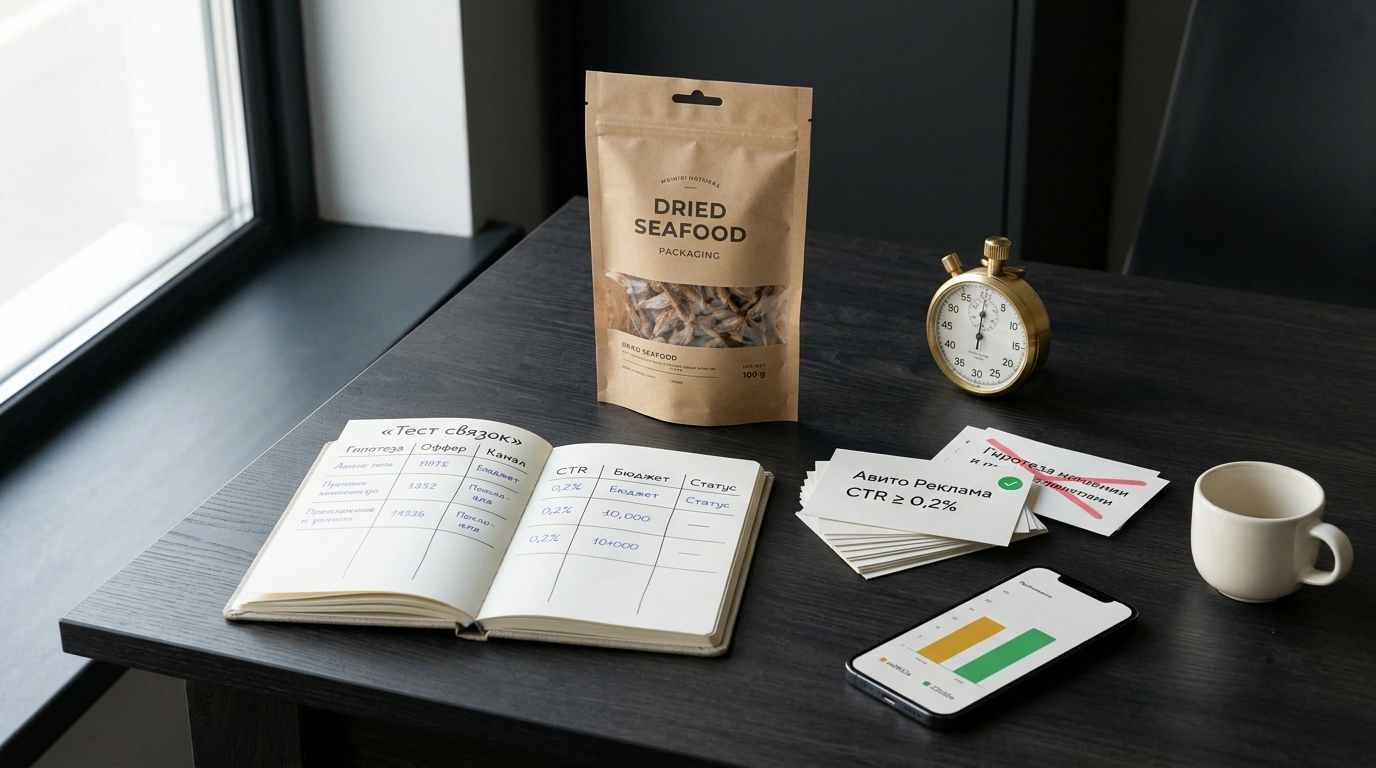
When classifieds advertising comes up, plenty of marketers still picture one-off listings for used furniture or local plumbers. Mainstream e-commerce brands selling mass-market goods tend to steer clear. That's a mistake. Today I'm breaking down a massive case from a dried seafood producer that turned Avito Ads into a core lead-gen engine and built an assembly line of 900 ad combinations.
The numbers from seven months of spend (January through July 2026) speak for themselves: on an 8.5 million RUB budget, the manufacturer generated 108,300 inquiries at an average CPL of just 78 RUB. Their original target KPI was 200 RUB per contact, meaning they beat it by 61%. Over the final two months alone, that flow converted into 2,555 paid orders totaling 13,351,594 RUB, with an average order value around 5,200 RUB. Let's look at the mechanics that kept the unit economics solid at that kind of scale.
Broad Reach vs. the Micro-Segmentation Illusion
The first fatal mistake specialists make when bringing social-media habits to classifieds is slicing the audience razor-thin. People stack dozens of narrow interests, behavioral segments, and hyper-local geo filters. For fast-moving consumer goods (FMCG), that's campaign suicide: the auction chokes, reach dries up, and CPC skyrockets.
This team did the exact opposite:
- They set broad demographic boundaries—gender, basic age brackets, and major delivery regions.
- They gave the platform's algorithms room to hunt inside a wide pool, choosing a cost-per-click (CPC) model driving traffic to their own website.
- They ditched glossy 3D renders and overly polished studio layouts. Banners featured real, appetizing photos of actual seafood packs with clear promo badges ("table-ready set," "first-order discount").
The 0.2% Filter: Testing Hundreds of Hypotheses Without Burning Cash
Over the course of the campaign, they tested more than 900 combinations. How do you avoid drowning in that many ads and blowing millions on dud creatives? An ironclad cutoff rule:
Every new hypothesis launches with a minimum daily budget of 1,000 RUB. If a creative posts a CTR below 0.2% in its very first days, pause it immediately. No 'let's give it a few more days' and no hoping for a miracle—just ruthless pruning.
Combinations that cleared the 0.2% bar got scaled: daily budgets went up, and winning setups were cloned into neighboring regions. If you're interested in testing product demand before committing inventory, take a look at our piece: Testing Demand on Competitor Listings: How to Validate Product Conversion Before Production.
End-to-End UTMs and the Duplicate-Lead Trap
With 900 campaigns running, manual tracking is out of the question. The team enforced a strict UTM naming convention:
utm_source=avito(traffic source);utm_medium=cpc(buying model);utm_campaign— the hypothesis formula (for example,m25-45_msk_nabor, encoding gender, age, geo, and offer);utm_content— the exact photo asset ID.
Then came a critical analytics catch that 9 out of 10 marketers miss: deduplicating repeat inquiries in the CRM.
Snack and fish buyers reach out multiple times—checking delivery status, tweaking an order, or reordering a week later. If your CRM logs every incoming call as a brand-new lead, your report looks gorgeous with dirt-cheap CPLs, while your actual lead-to-sale conversion rate turns into a mirage. In this case, all repeat contacts were automatically merged into a single customer record so the team could see real conversion to paid orders.
Unit Economics: Calculating Your Max Allowable CPL
Never chase cheap leads in isolation from margin. Your ceiling for allowable cost per lead follows a straightforward formula:
Max CPL = (Average Order Value × Gross Margin − Operating Costs) × Lead-to-Sale Conversion Rate.
Here, with a 5,200 RUB average order, roughly 1,500 RUB in net margin contribution, and a 10% lead-to-order conversion rate, the business could afford up to 150 RUB per inquiry. Hitting an actual CPL of 78 RUB created a huge safety margin and kept scaling profitable.