Picture a familiar Monday morning meeting: a private clinic's marketer proudly reports that cost per lead is down. Inquiries are flowing, search ads are humming, and the dashboard is glowing green. Then the CEO checks the cash register and asks one uncomfortable question: "So why are the hallways empty and the doctors twiddling their thumbs?"
Darya Dzhepparova, Lead Marketing Analyst at Kokoc Group, audited the mobile websites of 50 top-ranking private medical centers in Moscow, cross-referencing them with Yandex Metrica, Callibri analytics, and Roistat industry benchmarks. The findings exposed a massive gap between pretty lead-gen numbers and actual patients walking through the door.
Mobile Traffic Calls the Shots
Start with the baseline facts shaping healthcare marketing right now:
- According to Callibri, the average cost of a qualified inquiry in private medicine rose from 2,472 to 2,717 RUB.
- 75% of all visits to clinic websites happen on smartphones (Kokoc Group data).
- 75% of initial calls and inquiries also come from mobile devices.
Desktop traffic is now a niche slice; the smartphone is the front door. Yet the way clinics greet mobile patients quietly bleeds their ad budgets dry.
The Show-Up Paradox: Callback Form vs. Online Schedule
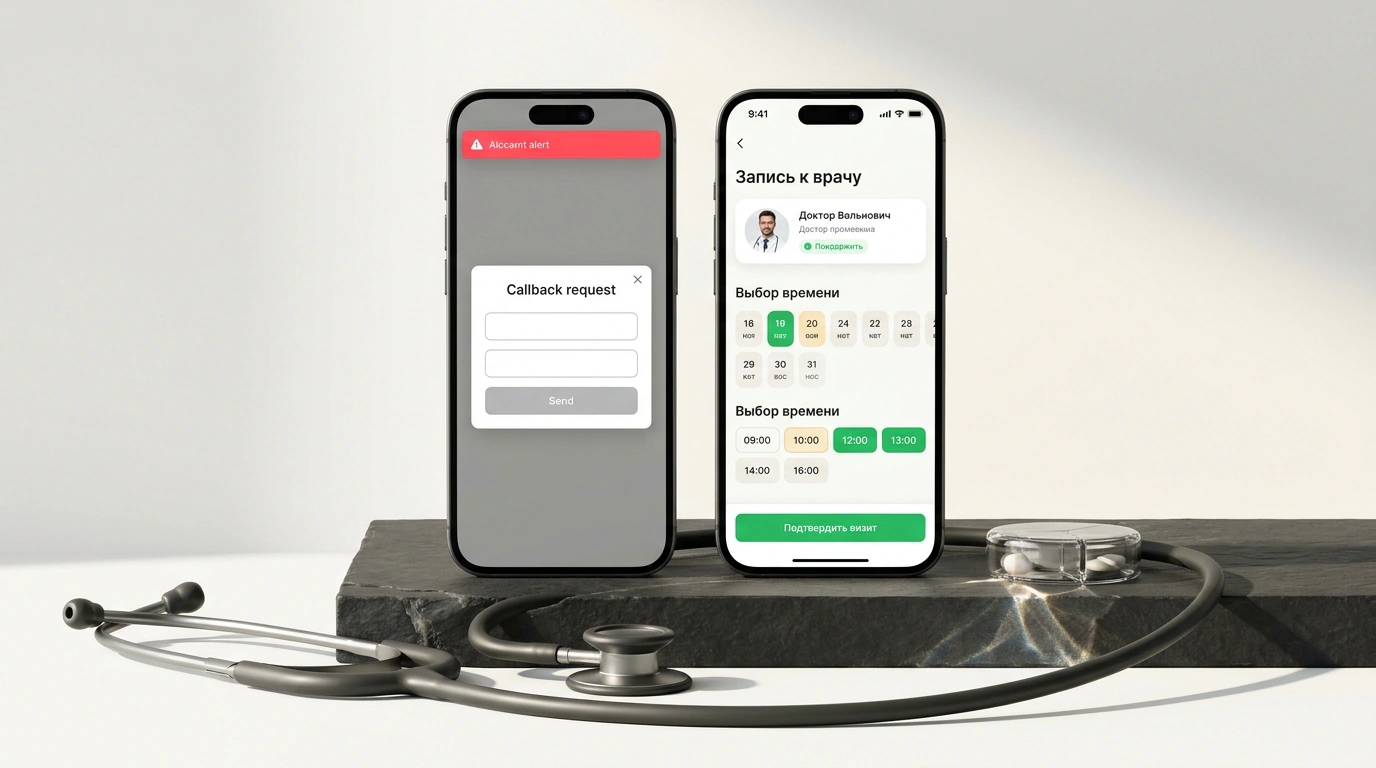
On 80% of the audited clinic sites, the "Book an Appointment" button does just one thing: opens a bare-bones two-field form asking for "Name" and "Phone."
On paper, it makes sense—fewer fields mean less friction and higher website conversion. A visitor fills it out in five seconds, and the clinic gets a flood of cheap leads. Here is what happens next:
- The person typed their number in a rush on the subway or at work. They didn't pick a doctor, didn't lock in a time, and made zero mental commitment.
- When a call-center rep rings back 20–30 minutes later, the patient either ignores the call, already booked elsewhere, or balks at the price quoted over the phone.
- The result: according to Roistat, actual show-up rates from callback forms sit at a dismal 20–30% (25% on average).
Now compare that to interactive online booking with live doctor schedules, used by fewer than 20% of clinics:
- The patient sees the doctor's photo, years of experience, specialty, exact initial consultation price, and open time slots.
- Booking takes longer—you have to choose a specialist, date, and time—so raw website submissions drop roughly in half.
- Yet the show-up rate for actual visits skyrockets to 70–90% (80% on average)!
In psychology, this is Robert Cialdini's commitment and consistency principle: once someone deliberately spends time picking Thursday at 2:30 PM with Dr. Ivanov, their brain treats it as a personal promise.
Compare the math on a 270,000 RUB budget at Callibri's average 2,700 RUB CPL:
- Callback form: 100 leads → at a 25% show-up rate, 25 patients walk in (10,800 RUB per actual patient).
- Online booking: just 50 leads → at an 80% show-up rate, 40 patients walk in (6,750 RUB per actual patient). An interactive schedule puts 60% more paying patients in the chair on the exact same ad spend.
We saw the exact same dynamic in premium dentistry: Case Study: Yandex Direct for High-Ticket Dentistry in Moscow — 622 Leads and 74 Patients in the Chair in Six Months.
Four Technical Traps on Mobile Clinic Sites
Beyond the booking widget, the audit uncovered glaring UX flaws costing clinics mobile visitors every day:
- Sluggish load times. Homepages on 55% of sites take longer than 3 seconds to load, averaging 5.2 seconds. Google data shows that delays past 3 seconds raise bounce probability by 32%, and up to 5 seconds by 90%.
- Hide-and-seek phone numbers. On 13% of sites, the mobile header lacks a clickable number or quick-call button. On 6%, multiple phone numbers are crammed so tightly together you can't tap one with a thumb.
- Unpinned headers. On a quarter of sites, the menu and phone number scroll out of sight. A patient reads a long article about joint pain, reaches the bottom, and sees nowhere to tap to book.
- Scenario blindness. 70% of smartphone users land on symptom articles during a moment of worry, whereas 53% of desktop users open service and pricing pages. If an informational article doesn't offer a clear next step and an on-duty doctor's schedule right inside the text, the reader simply closes the tab.
Stop optimizing ads for the cost of a virtual callback. Put live schedules front and center and measure the patients who actually make it to the exam room.