You've probably heard the anxious chatter in team Slack channels and coffee breaks: "AI writes code in seconds—in a couple of years developers won't be needed, and it's already taken the fun parts, leaving us with nothing but dull debugging."
I've watched this panic around Copilot, Cursor, and Claude Code for a while now, and I couldn't shake the feeling that people are mixing up two completely different things. We keep mistaking mechanical keystrokes for the actual core of engineering thought.
Software architect and HowProgrammingWorks founder Timur Shemsedinov put it into a sharp thesis that sets the record straight: artificial intelligence isn't destroying the developer profession—it's stripping away the chaff and exposing the real intellectual core underneath.
Syntactic Grunt Work vs. System Invariants
Let's split what we actually do at work into two fundamentally different buckets: language mechanics and essential system properties.
Mechanics are the routine syntactic building blocks: for loops, if-else branches, promises, closures, classes, and decorators. That's mechanical mortar. Generative models trained on trillions of tokens from public repositories mix and match those bricks at astonishing speed.
But a program's value has never been measured by how many loops you typed out. Value comes from essential architectural properties:
- Immutability: guaranteeing data can't be mutated in place, which eliminates race conditions in concurrent execution at the root;
- Idempotency: a service's ability to repeat an operation multiple times without corrupting the result during network retries;
- Loose coupling: designing modules so swapping out one service doesn't trigger a chain reaction of failures across the system;
- Composability: building complex abstractions out of simple, mathematically sound functions.
An AI model doesn't "feel" these properties. It just predicts likely token chains based on similar code snippets in its training set.
Four Levels of Engineering Mastery
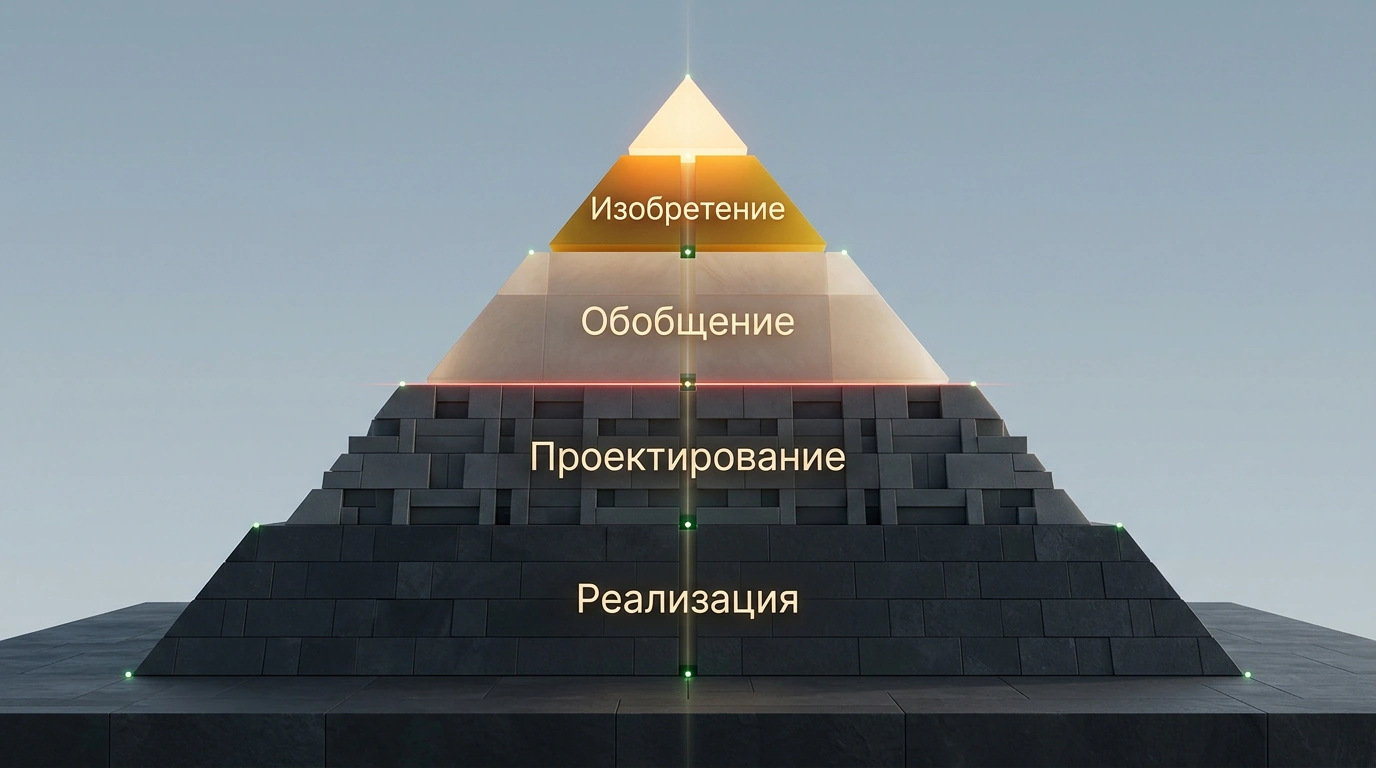
To pinpoint where modern LLMs actually sit, Shemsedinov maps programming onto a four-level pyramid:
- Level 1. Implementation: writing code straight from a finished spec. "Build an endpoint, accept JSON, validate fields, write to PostgreSQL." Generative models crush this level, freeing humans from tedious boilerplate.
- Level 2. Design: picking established architectural patterns and frameworks. Here the engineer decides whether to use clean architecture, the Repository pattern, or an event bus. AI feels comfortable here as long as the problem fits standard boundaries.
- Level 3. Generalization: spotting a deep, shared pattern across hundreds of disparate systems and distilling it into a clean new abstraction. At this level, AI becomes a timid assistant that needs constant human supervision.
- Level 4. Invention: formulating a fundamentally new way of organizing computation that spawns a new paradigm. Think about how object-oriented programming, functional programming, Erlang's actor model, or differentiable programming were born.
And here is the headline fact worth sitting with: throughout the entire boom of generative AI, neural networks haven't created a single new computing paradigm or invented one genuinely new architectural pattern.
Where Engineers Go From Here
By their mathematical nature, modern LLMs perform interpolation—searching for plausible solutions inside the multidimensional space of human experience already recorded. They compile the past brilliantly, but they can't make a conceptual leap into the unknown.
That's why the era of basic prompts like "write a CRUD app in FastAPI" is fading fast. Real engineering work in the AI era is moving upstream into framing fundamental problems: managing coupling, formalizing mathematical invariants, and designing fault-tolerant distributed protocols. The boilerplate is automated—now it's time to do real architecture.