You've probably noticed your own search habits shifting: instead of typing a short keyword into a search box and clicking through ten ad-heavy links, you increasingly go straight to ChatGPT Search, Perplexity, or Google's AI Overviews. You ask a detailed question in plain language and expect a synthesized answer with concrete recommendations.
But what's actually happening under the hood? Why does an AI recommend certain projects in the very first lines while completely ignoring others that bought thousands of backlinks? Let's take apart the inner gears of generative search.
The Death of Classic SERPs and the Rise of Query Fan-Out
In traditional search, the pipeline was linear: a crawler grabbed a keyword, matched it against an index, weighed domain authority, and spat out a list of links. Your entire job was fighting your way into the top three.
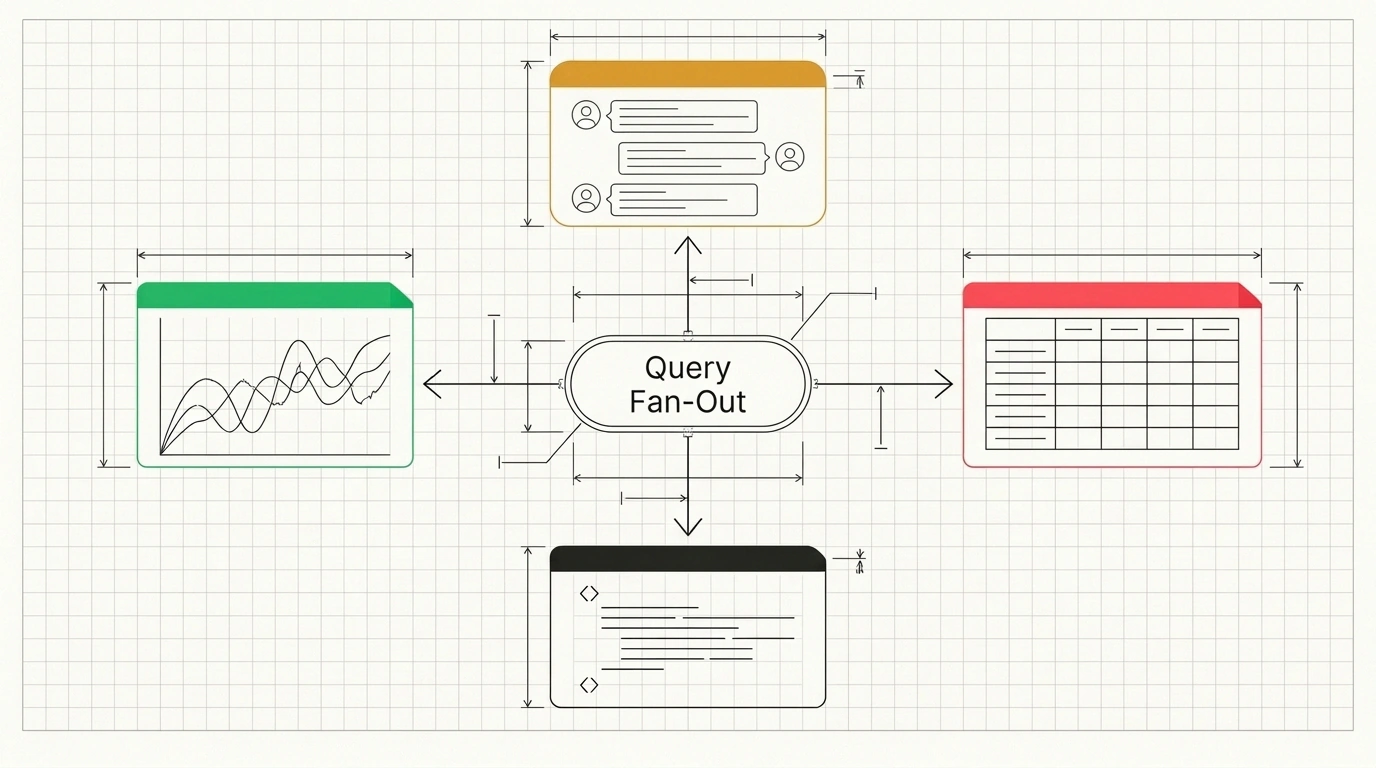
In the era of large language models, search engines operate differently. When you ask a complex question (say, "which lightweight agent harness should I pick for Python on Linux"), the model triggers Query Fan-Out.
The engine decomposes your prompt into 3–7 parallel sub-queries:
- Performance benchmarks for agent libraries;
- Recent Reddit and GitHub discussion threads from the past quarter;
- Documentation from specific open-source repositories;
- Compatibility comparison tables.
After pulling dozens of raw pages, the model acts like a research analyst: it reads through the text, strips out promotional fluff, cross-checks facts, and synthesizes a coherent answer. Links become supporting Entity Citations rather than the main product.
The Two-Stage Model: GEO vs. AEO
The industry has settled on two distinct disciplines: GEO (Generative Engine Optimization) and AEO (Answer Engine Optimization). They aren't synonyms—they're two stages of the same funnel:
- Retrieval Pass (GEO). The search agent decides whether your pages even make it into the model's context window. Technical crawlability for bots (GPTBot, PerplexityBot) and semantic clarity are what matter here.
- Generation Pass (AEO). The pages are already in working memory, and the algorithm decides whom to cite in the final answer and whom to discard as noise.
A landmark study from Princeton University, Georgia Tech, and the Allen Institute for AI (preprint arXiv:2311.09735, GEO-bench) proved that standard SEO copywriting falls flat in generative engines.
Three factors, however, make a decisive difference:
- Hard facts and statistics: including latency measurements, benchmarks, and system requirements boosts citation odds by up to 40%.
- Direct expert quotes: models treat verbatim statements from creators as strong signals of credibility.
- Structured comparison matrices: "feature / option A / option B" tables are tailor-made for transformer attention mechanisms.
We previously covered the new rules of search optimization and why algorithms favor firsthand practitioner experience, while in e-commerce structured catalog feeds are critical so models can read prices and stock levels instantly.
Three Rules for Writing for AI Search
- Give a clear answer in the very first paragraph. Don't force the model to wade through throat-clearing intros. Put the core takeaway right under the heading.
- Publish configs and exact numbers. Terminal commands, JSON configs, and benchmark logs are concrete evidence that algorithms cite first.
- Show up in niche communities. Search agents actively crawl forums and technical threads. If practitioners are talking about your product, AI engines will cite it right alongside the incumbents.