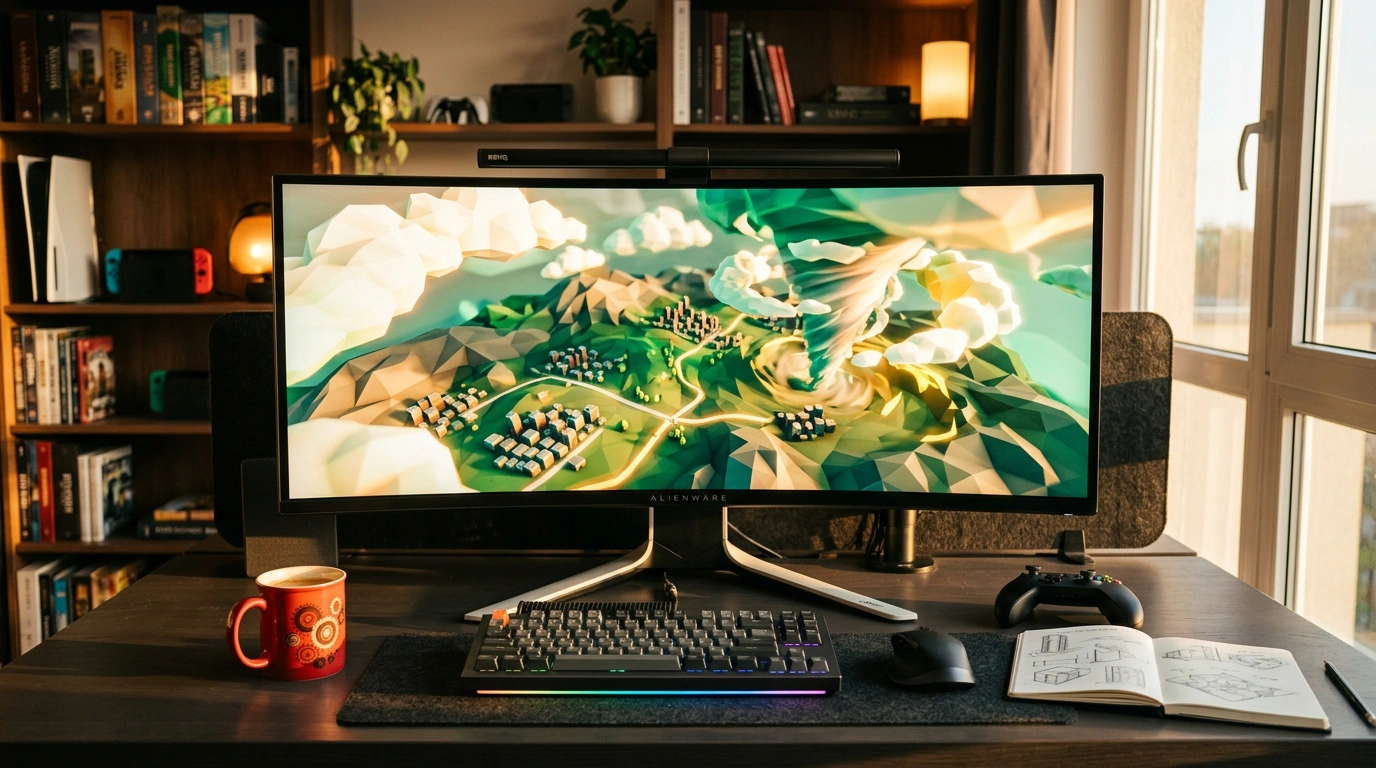
Just a couple of years ago, building an open-world 3D video game meant assembling a full studio: a C++ engine programmer, a shader specialist, a physics engineer, a level designer, and hundreds of hours hunting down segfaults. An outsider couldn't even get started without years of specialized study.
Today we're watching a tectonic shift that Andrej Karpathy aptly named Vibe Coding.
The idea is disarmingly simple: the creator doesn't write syntax by hand. Instead, you describe your creative vision and game physics in plain language, feed those instructions to AI models (Claude Code, OpenAI Codex, Claude Opus 5.5), and test the playable result on screen right away. Let's look at the real projects already emerging from this workflow.
Charlie Chapman's Earth Simulator: GTA Meets Apple Maps
One of the wildest examples comes from developer Charlie Chapman. He set out to build a 3D procedural sandbox of the entire planet Earth on a custom C++ engine with native graphics in Metal (for macOS) and Vulkan.
The game streams live OpenMapTiles cartography, procedurally generates 3D buildings and room interiors, simulates rocket-boosted car physics, handles snowboarding mechanics, and renders dynamic weather complete with destructive tornadoes and hurricanes.
The kicker: every single line of the codebase was written by Claude across three Macs. Chapman acted as architect and director—describing the mechanics he wanted, playtesting builds, flagging physics glitches, and approving commits.
Live-Streamed Game Dev and Deep ASCII Worlds
Vibe coding is also transforming how creators build alongside their audiences:
- Max Blade's live-streamed Fortnite clone: the streamer builds a Fortnite-style game using Claude Opus 5.5 live on air. Viewers suggest mechanics in chat ("add a gravity gun and bounce pads"), he prompts the model, and by the next day the community is playing the updated build.
- Dmitry's deep ASCII RPG: an indie developer from Russia built an intricate turn-based RPG featuring a procedural world, branching quests, magic systems, and generated audio using Claude Opus 5.5 and GPT-6 Astra.
- Riley Brown's multi-agent 3D pipeline: Brown demonstrated a workflow where an AI takes a single text prompt, builds a 3D scene in Blender, sets up lighting, and renders thousands of frames on cloud RunPod GPUs for just $1.
Earlier we looked at building a 3D browser game with Claude and Simon Willison's experiments with game prototypes. Projects like Chapman's and Max Blade's prove that vibe coding has moved well past toy demos.
Real Limits and Catch-22s
Does this mean traditional programmers are obsolete? Not even close. Vibe coding has clear boundaries:
- Models excel at rapid prototyping, procedural mechanics, and indie sandboxes;
- When you scale up to high-concurrency multiplayer titles with millions of players online, you still need human engineers to tune netcode, sync server ticks, and lock down anti-cheat.
Still, for creative builders, the barrier to entry has collapsed for good. If you have a great game idea, you no longer need to wait for investors or spend years memorizing syntax—you just open a terminal and start building.
