Anyone who has ever shipped stock to mega-warehouses like Koledino or Elektrostal during peak season remembers those endless lines of trucks at the gate and hours spent waiting for a loading dock. With the biggest sales of the year just days away, logistics turns into your #1 risk factor. Miss an FBS drop-off window by a hair, and the platform slashes your rating while your commission rate shoots up.
To take the pressure off its central hubs, the merged Wildberries group is rapidly rolling out a network of specialized facilities: Goods Drop-Off Points (PPT). The interactive warehouse map in your seller dashboard already has a new filter splitting the network into four tiers: standard customer pickup points (PVZ), the new PPTs, sorting centers (SC), and partner fulfillment centers (PFC). Let's break down how this chain works and what it actually saves you.
How a PPT Differs from a Regular Pickup Point and a Major Hub
The main bottleneck with a standard neighborhood pickup point is its strict intake cap. Try showing up at a residential PVZ with five bulky sacks or boxes: the clerk will just shrug because the backroom is packed with customer parcels and the receiving limit is often capped at one cubic meter. Worse, you end up standing in line behind shoppers picking up clothes to try on.
Driving to a sorting center solves the volume issue, but it means a dedicated trip out of town and half a workday gone. A PPT is built as an in-city or industrial-zone gateway within easy reach.
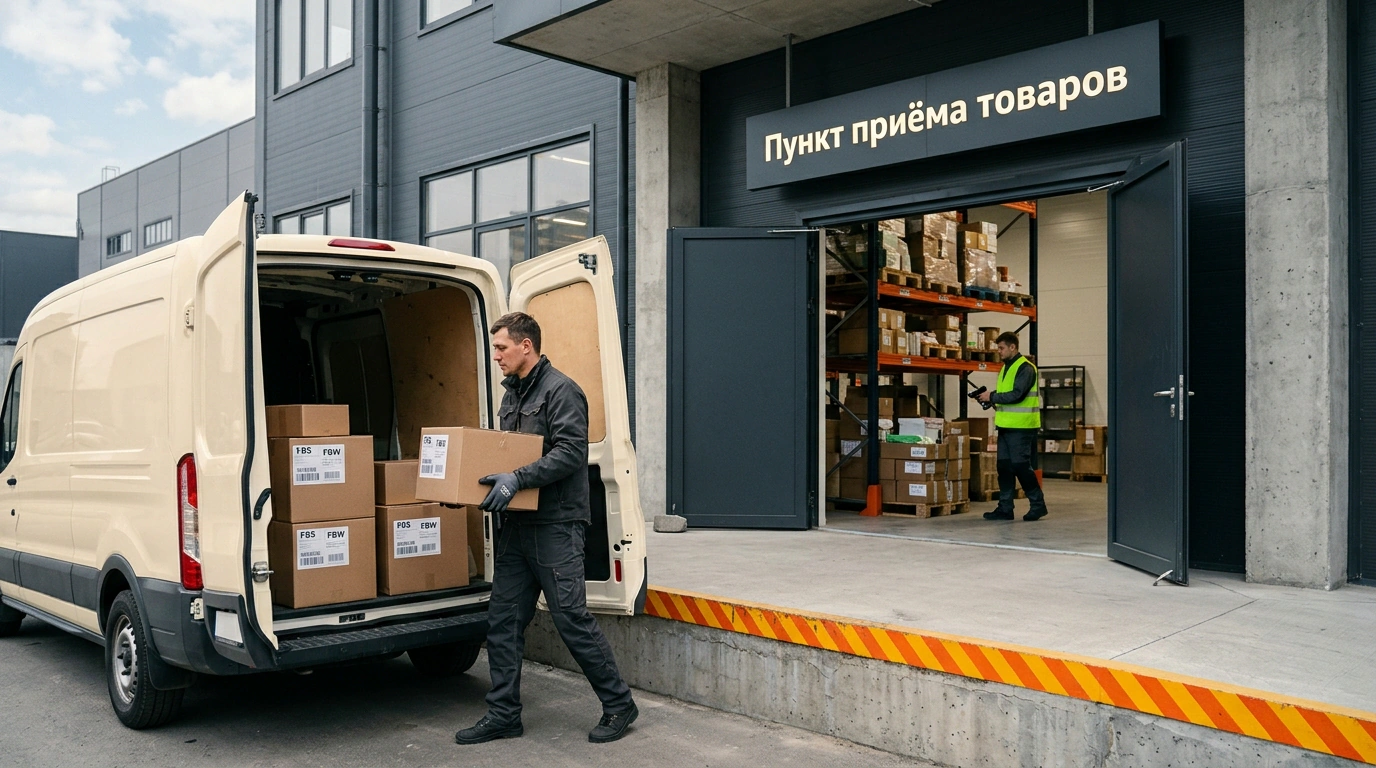
There is zero retail footprint here—no customer lines, no cash registers, no fitting rooms. Spaces starting at 100 square meters are laid out for commercial freight, with easy access for Gazelle vans and box trucks, wide racking, and mandatory 24/7 CCTV with at least five cameras. Staff scan and receive everything through the dedicated "WB PVZ" mobile app. It's pure B2B infrastructure built for fast cross-docking. As part of Wildberries' broader decentralization of logistics through partner hubs, this network relieves critical bottlenecks right before holiday spikes.
Rules for FBS Orders, FBW Boxes, and Returns
According to official guidance from PPT rollout lead Ferdaus Mamadzhanov and the pvz.wb.ru portal, these drop-off points handle three core seller workflows:
- FBS ("Marketplace") order handoffs. You bring in items that already have active customer picking tasks. Each unit gets its individual WB order barcode sticker, and the entire batch is handed over under a single shipment QR code. Where's the real money in this? If you drop off the shipment within 15–24 hours of order placement, Wildberries gives you a hefty cut on the base commission—up to 5 percentage points. In thin-margin categories, that's pure profit going straight into your pocket instead of the platform's. We covered how to combine these workflows in our guide on FBS rules and hybrid shipping setups.
- FBW "Box" deliveries. If you sell from Wildberries' own warehouses, you no longer have to haul every small restock out to a transit sorting center. You can drop off pre-packed FBW boxes at a PPT, and WB's linehaul fleet will move them to the distribution center. One strict catch: oversized goods (KGT) and monopallets are not accepted at PPTs—those still require full-scale sorting center docks.
- Fast customer return pickups. Returns no longer sit stranded for weeks at far-flung hubs. Items consolidate at your chosen PPT, and pickup takes a couple of minutes: show the operator your QR or numeric code from the "WB Partners" app, they scan it, and hand over the box.
Just keep one operational detail in mind: a PPT's floor capacity is still finite. If a point fills to the brim before the evening linehaul truck arrives, intake can be paused temporarily. Always check the location's live load status on your dashboard map before you hit the road.
