In sales decks, every 3PL operator looks flawless: "we pick orders in two hours," "same-day dispatch," "zero delays." Yet the moment November hits and order volume jumps three- or fourfold, that polished pitch falls apart. FBS orders stall in packing, sellers get slapped with Wildberries and Ozon fines for missed dispatch slots, and product listings tank in search rankings.
When you trust an outside warehouse with your working capital, you can't take a sales rep's word for it. You need hard metrics and a strict process audit before your very first pallet touches their dock.
Real Speed Benchmarks: Lessons from an Open Dashboard
Operator UPMARKET set a revealing market precedent by opening a public dashboard showing its actual FBS fulfillment speeds. It's a rare look under the hood of warehouse logistics without the marketing gloss.
Here is what real measurements from a well-run 3PL look like:
- Pure warehouse picking time: 3 to 4.5 hours from the moment an order drops via API from the marketplace dashboard to the final shipping label being applied on a handheld terminal (TSD).
- Full cycle from customer checkout to physical handoff at WB gates: 11 to 15 hours. That window includes sorting, batch consolidation, linehaul transfer, and waiting in the unloading queue at the distribution center.
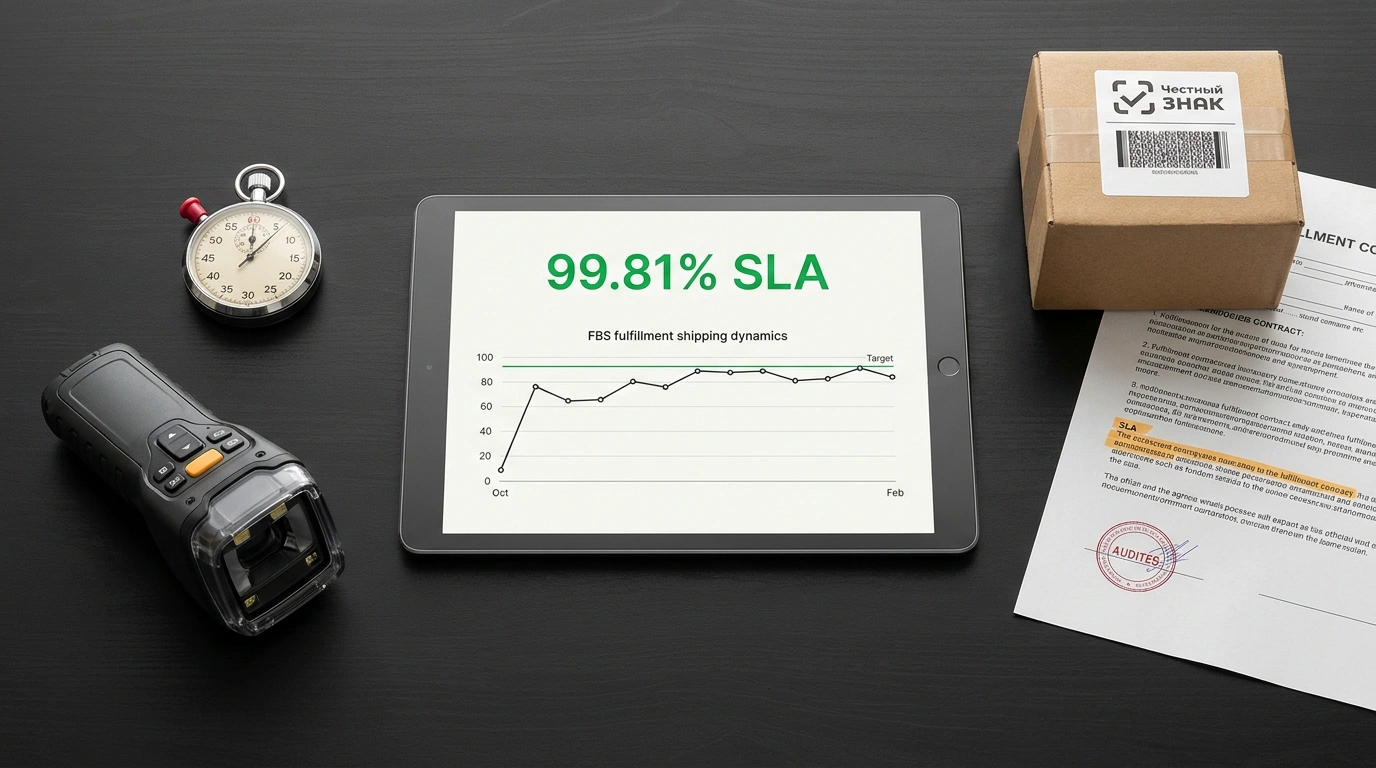
- Bottom-line impact for sellers: 99.81% of shipments beat the marketplace's fast-dispatch deadline. That earned the seller pool the maximum 5-percentage-point commission discount, keeping over 2,668,855 rubles in net savings inside their businesses. Meanwhile, delays past 48 hours stayed at just 0.07%, practically wiping out late-shipment fines.
Use those exact numbers as your yardstick when evaluating any prospective partner.
A Pre-Launch Audit Playbook for 3PL Warehouses
To avoid waking up to a suspended store in the middle of peak sales, put a contractor through this hands-on stress test:
- Send a complex test batch. Never move your entire bestseller stock on day one. Ship a pilot of 10–20 tricky SKUs: fragile items, apparel with size matrices, and products requiring mandatory Chestny ZNAK marking. This immediately exposes whether their scanners can validate marking codes (KIZ) and push them to the system without hanging.
- Time the Dock-to-Stock interval. Log the exact hour your truck pulls into the yard and when the received stock goes live in their WMS. A healthy benchmark for agile operations is 12 to 24 hours. If intake drags out to three days during a quiet month, that warehouse will grind to a halt in November.
- Check WMS and automation. There should be no emailing Excel spreadsheets back and forth. Demand direct API integration with Wildberries, Ozon, and Yandex Market. Pickers need Android terminals displaying product photos and exact packing specs (bubble wrap, polybag, or five-ply corrugated box).
- Verify daily dispatch runs. A single evening truck won't cut it for serious FBS—morning orders will miss their window. Check the exact schedule: reliable operators run up to three dispatches a day to WB and at least two to Ozon.
- Lock in mirror liability. Promises of reliability mean nothing without a legally binding SLA backed by financial penalties. The operator must reimburse marketplace fines for late dispatches or lost stock dollar-for-dollar whenever the warehouse is at fault. Insist on packing-table video recording for shortage disputes and full inventory insurance against fire and damage.