Anyone who has sold on Ozon via FBO (Fulfillment by Ozon) knows that deceptive sense of comfort inside the seller dashboard. You click a couple of buttons, pick the nearest sorting center outside Moscow, book a transit shipment via cross-docking, and breathe a sigh of relief: the marketplace itself will pick up your boxes and haul them all the way to the Urals or the banks of the Yenisei. On paper, it looks like the ideal service for a seller who doesn't want the headache of dealing with long-haul truckers or hiring dedicated freight.
Let's take off the rose-colored glasses and put this mechanic under the cold X-ray of unit economics. Over years of selling on marketplaces, I've learned one ironclad rule: in e-commerce, the winner isn't the seller who found the cheapest line item on an intake tariff sheet—it's the one who turns over invested capital the fastest. While your boxes crawl through transfer hubs inside Ozon's logistics machine, your business is bleeding out. Your product listing in the target region shows buyers a dismal "out of stock" badge, the ranking algorithm mercilessly pushes you down the search results, and the cash you borrowed to buy the batch sits as dead weight on wheels.
Let's break down how Ozon's line-haul logistics actually work, why official cross-docking timelines rob a seller of an entire month of net sales, and when hiring an independent trucking company (TC) rescues your seasonal revenue.
The Free-Leg Trap: Where Your Inventory Disappears for 27 Days
Ozon's logistics model is fundamentally different from Wildberries'. Historically, Wildberries operated on a "drop it at the nearest sorting center and the platform will distribute it across hubs" paradigm, where sellers often didn't even see the actual route their boxes took. On Ozon, the architecture is deliberate: you personally choose the specific distribution center (DC) or fulfillment hub where your stock should physically sit.
Three fundamental metrics depend directly on that choice:
- Delivery speed to the buyer. If a shopper in Novosibirsk searches for winter boots, Ozon's search results give top priority to listings with stock sitting in a local warehouse in the Siberian cluster. Delivery time: tomorrow morning. Your inventory sitting in Khorugvino or Sofyino (near Moscow) will travel halfway across the country for at least 4–5 days. As a result, your listing either drops to page two or three, or gets filtered out completely by the "Tomorrow Delivery" toggle.
- Line-haul leg cost. Cross-cluster shipping carries higher multipliers. The farther the physical warehouse is from the buyer's pickup point, the more expensive fulfillment becomes for every single unit.
- Localization index and average delivery time. Ozon has set a target benchmark of 29 hours for average delivery time. If all your stock is concentrated in Moscow, your average delivery leg across Russia spikes, and the system slaps a surcharge multiplier on logistics for every order nationwide.
To push sellers to spread inventory across regions, Ozon offers cross-docking: you drop your cargo at a local sorting center, and the platform promises to haul it to the target cluster. Often, the marketplace even advertises cross-docking as free or sets a nominal fee of 100–300 rubles per box to lure sellers into distant regions. Earlier, in FBO through a pickup point, we broke down how intra-network transit works for small batches. But once you start scaling with regular inventory waves, this setup turns into a ball and chain.
Open Ozon's official cross-docking SLA table, and you'll see the harsh reality:
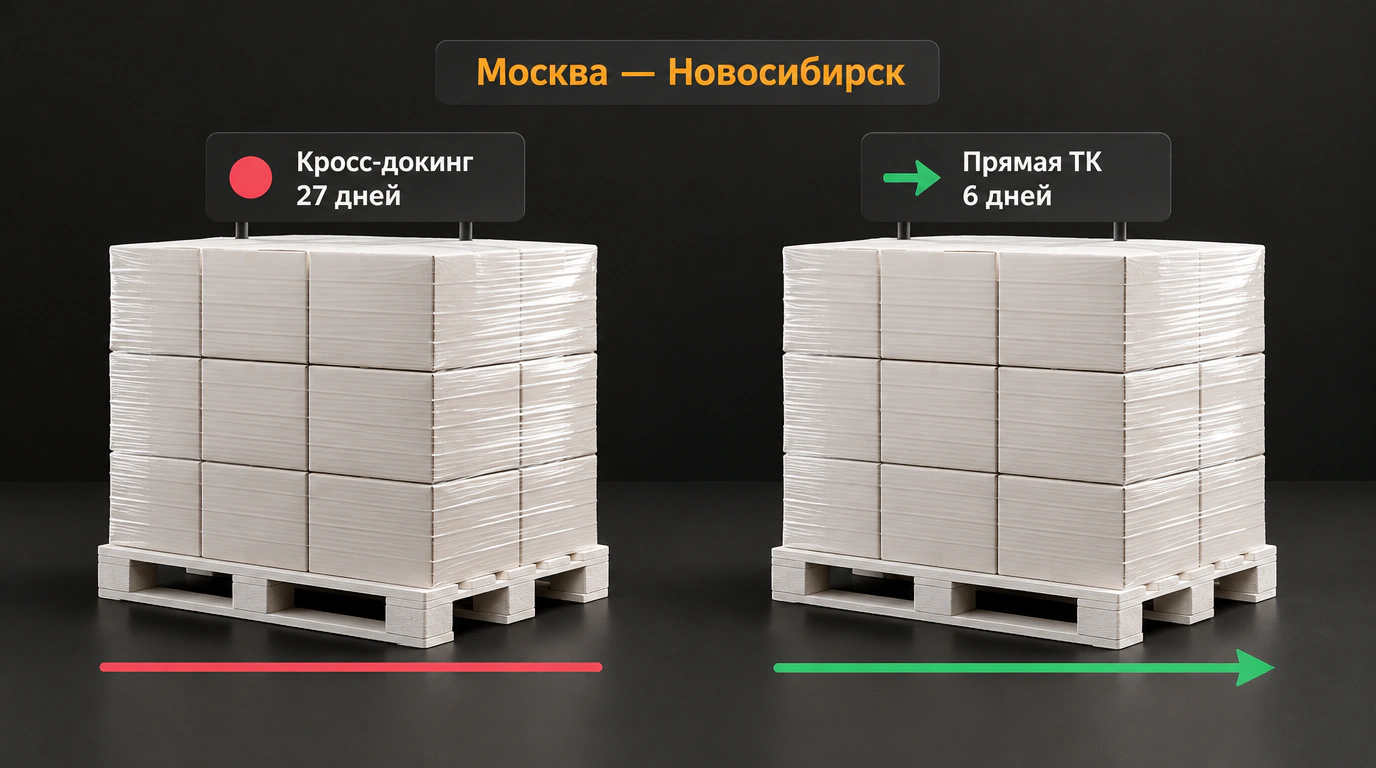
- Transit from Moscow to Novosibirsk takes 22 calendar days.
- The Moscow–Khabarovsk route takes up to 44 calendar days by regulation.
- Add the standard receiving window at the destination regional DC: 2 to 5 business days from the moment the truck arrives.
- And the maximum regulatory window during which a shipment can stay "in transit" in your dashboard before being declared lost is up to 90 calendar days under the platform agreement.
Add those numbers up: by shipping a batch to Novosibirsk via cross-docking, you voluntarily wipe your product off the shelf for 27–30 days—almost an entire calendar month. Picture this: it's October 1, and you ship a batch of winter knitwear or thermal mugs, counting on skimming the cream off early cold-weather demand. That inventory won't go live until October 30, when the peak frenzy is already underway and faster competitors have locked down the top search spots.
The Math of Frozen Capital: Counting Real Losses on a Single Pallet
When a newer seller compares logistics options, they usually stare exclusively at the direct freight line item. Cross-docking looks free or dirt-cheap, whereas a commercial trucking company (Delovye Linii, PEK, Baikal Service) quotes 7,500 to 11,000 rubles to haul a standard Euro-pallet (1200 × 800 mm, up to 1.8 m high) from Moscow to Novosibirsk.
Put a calculator on the table and count the real cost of lost opportunity. We've already touched on optimizing logistics and storage costs on Ozon, where hidden expenses flip the balance sheet upside down. Let's run a typical calculation for a fast-moving SKU:
- Batch on one pallet: 300 units with an average retail price of 2,500 rubles.
- Total retail value of the batch: 750,000 rubles.
- Purchase cost (COGS) of the batch: 250,000 rubles.
- Net margin per SKU: 20% (meaning 500 rubles of net profit stays in your pocket from each unit sold after all commissions, payment processing, and taxes).
- Planned sales velocity in the Siberian cluster with local stock: 10 units per day.
Now let's compare two scenarios:
Scenario A: Ozon Cross-Docking
You drop off the batch on October 1 at a Moscow-region hub. The marketplace truck hauls the boxes to Novosibirsk in 22 days. Another 6 calendar days go to unloading and receiving at the regional DC. Your product becomes available to order only on October 29.
Over 28 days of stockout vacuum, you missed 280 unit sales (28 days × 10 units/day).
Direct lost net profit: 280 × 500 rubles = 140,000 rubles.
Add the cost of frozen working capital: if you borrowed the 250,000 rubles for inventory via a credit line or factoring at 24% APR, you paid the bank roughly 5,000 rubles just to let your goods ride around in a trailer for a month.
Total hidden losses from cross-docking: 145,000 rubles on a single pallet.
Scenario B: Direct LTL Shipping via an Independent Trucking Company
On October 1, you hand the same palletized batch to a commercial carrier with a dedicated marketplace-delivery service. The truck runs from Moscow to Novosibirsk in 5–6 calendar days. On October 7, the freight backs up to the Ozon DC gate under a booked timeslot. Direct palletized deliveries get priority intake via electric forklifts in 2–3 business days. By October 10, your listing turns green with "In Stock" and starts collecting orders.
Your product sells for 19 days longer than under cross-docking. Over those 19 days, you move 190 units and earn 95,000 rubles in net profit.
For door-to-gate pallet delivery, the trucking company charged you 10,500 rubles.
Net financial outcome: +95,000 rubles profit − 10,500 rubles freight = +84,500 rubles net advantage in your bank account compared to "free" cross-docking.
The gap is massive. You didn't save 10,000 rubles on shipping—you threw nearly a hundred thousand rubles of net profit out the window.
Three-Way Showdown: Direct Freight vs. Cross-Docking vs. Internal Transfers
In an Ozon seller's practical toolkit today, there are three main ways to replenish regional stock. Each has clear boundaries for when it makes sense:
| Comparison Metric | Direct LTL via Trucking Company | Ozon Cross-Docking | Ozon Internal Stock Transfer |
|---|---|---|---|
| Transit time to Siberia | 5–7 days | 22 days | 14–28 days |
| Receiving speed at DC | 2–3 business days (pallet) | 2–5 business days (boxes) | Up to 5 days after unloading |
| Cost per pallet | 7,500 – 11,000 RUB | 0 to 3,000 RUB | 30,000 – 50,000 RUB |
| Minimum volume | From 1 pallet (1–1.5 m³) | From 1 box | From 1 unit |
| Mis-sort & loss risk | Minimal (sealed pallet) | Medium (manual sorting) | Medium (internal re-handling) |
Direct LTL trucking via Delovye Linii or PEK wins hands down on speed and reliability, though it requires volume: sending two small boxes on a commercial freight line makes no economic sense.
Marketplace cross-docking is ideal for testing new launches and slow-moving SKUs: you can pack a single box of 20 units of a new item, drop it at your local sorting center, and test demand in the Urals or Siberia without risking getting stuck with an illiquid pallet.
The third option—intra-network transfers of already-received stock between Ozon warehouses (for example, from Sofyino to Kazan or Rostov)—hides gigantic expenses. Ozon bills this per unit: 50 to 150 rubles for every single item moved. If you decide to relocate a pallet of 400 knitwear units from the Moscow region to the Siberian hub, the marketplace will deduct 40,000 to 60,000 rubles from your balance! That's 4–5 times more expensive than pulling the pallet back to your own warehouse and shipping it via a commercial carrier. Use internal transfers only as an emergency measure to rescue stuck stock from disposal—never for routine replenishment.
If you don't have enough volume on one SKU to fill a whole 1.5-cubic-meter mono-pallet, build a mixed pallet of 3–5 fast-moving items heading to the same regional warehouse. Trucking companies bill by physical floor space in the trailer, while Ozon's DC receives mixed palletized freight under a single timeslot with no surcharge.
Gate Rules: Timeslots, Electronic Yard Management, and Unforgiving Docks
Once you decide to work with direct carriers, your main risk shifts to the handoff at the Ozon distribution center gate. The marketplace's warehouse perimeter runs on strict industrial standards, and one slip by the driver or loader gets the truck turned away.
Architectural isometric drawing of an Ozon unloading ramp showing a truck docked to a bay, a 30-minute timeslot, and a compliant Euro-pallet.
Here are the baseline rules you need to keep locked down:
- Timeslot booking and electronic yard management. In the FBO section of your seller account, you create a shipment request and select a strict 30-minute arrival window. You must enter the driver's exact passport details, tractor and trailer license plates, and the forwarding receipt. Ozon's largest hubs (Sofyino, Khorugvino, Chapaevsk) run an automated Yard Management System: the driver checks in at a self-service kiosk or via SMS at the security gate, and the assigned dock number lights up on the yard display board.
- Truck specifications. The rear bed height of a standard semi-trailer must be 1.10–1.20 meters off the pavement to align cleanly with the dock leveler. If a shipment arrives in a light commercial van (like a Gazelle with a 0.8–0.9 m bed height), unloading is only possible at specialized low docks. If the selected warehouse doesn't have low bays—or they're all occupied—the vehicle simply won't be allowed onto the ramp.
- Palletizing and labeling. Use only standard certified Euro-pallets (1200 × 800 mm) free of chips, cracks, or protruding nails. Maximum stack height is 1.80 meters (including the pallet). Boxes may not overhang the pallet perimeter by more than 2 centimeters. Wrap the pallet in clear stretch film at least 3–4 layers thick, making sure to anchor the film around the wooden base. Attach an A4 pallet sheet to the short side of each pallet showing the shipment barcode, seller name, and request number.
If a truck arrives more than 30 minutes past its booked timeslot, the warehouse logs it as a no-show. The gate pass is automatically canceled, the driver is dropped from the queue, and the seller gets hit with a missed-slot penalty or a multi-day freeze on booking new deliveries. Work only with carriers that guarantee arrival inside the assigned window.
Cluster Breakdown: How to Position Stock for 29-Hour Delivery
A major tectonic shift has hit Ozon logistics: the marketplace shifted its focus from the old localization index to a composite average order delivery time metric. The platform's target benchmark is 29 hours.
Here is how the search algorithm reacts in real time: When a Siberian shopper types "cordless vacuum" into search, the ranking engine instantly filters thousands of offers. A listing whose inventory sits in the Novosibirsk warehouse gets the highest ranking multiplier: the system knows a courier can hand over the box tomorrow. That exact same vacuum sitting in Moscow takes 4–5 days to arrive: at best it drops 40–50 spots lower, and at worst it vanishes from view entirely when the shopper toggles the fast-delivery filter.
To hold top organic search positions without freezing working capital in regional warehouses, experienced sellers rely on a proven cluster allocation matrix:
- Center Cluster (Khorugvino, Sofyino): 45–50% of total warehouse stock. This is your core inventory, covering the highest-spending capital region and acting as a buffer for rapid replenishment elsewhere.
- Northwest Cluster (Shushary, Saint Petersburg): 15–20% of stock. Easily reachable either by direct truck in 1–2 days or via fast cross-docking.
- Volga Cluster (Kazan): 10–15% of stock. A strategic crossroads covering the eastern half of European Russia.
- South Cluster (Rostov-on-Don, Nevinnomyssk): 10% of stock. Captures strong local conversion across southern regions.
- Ural Cluster (Yekaterinburg): 10% of stock. Direct carrier transit from Moscow takes just 3–4 days.
- Siberia Cluster (Novosibirsk): 5–10% of stock. Send exclusively direct pallets via vetted carriers here—completely cut out cross-docking and its 22-day wait.
There is one dangerous trap in regional distribution, though: storage fees on slow-moving stock. If you misread demand and ship six months' worth of inventory to Novosibirsk, Ozon switches on daily per-liter storage charges once turnover exceeds the 60–90 day threshold. Pulling stranded goods back from Siberia to Moscow through the marketplace costs astronomical money. That's why the iron rule of regional expansion is simple: ship only 30–45 days of active sales to distant clusters, and only for proven flagship SKUs. For a step-by-step look at building the numbers before your first run, read our guide on planning your first regional shipment.
Decision Map: When to Book Direct Freight vs. Tolerate Cross-Docking
Let's wrap up with a pragmatic checklist. There is no single universal route for every seller—your logistics choice should be dictated by cold math on each product's profile:
- Sales velocity (turnover):
- If your SKU sells faster than 10–15 units per day, Ozon cross-docking is off limits. Lost profit from 28 days of stockout vacuum will dwarf the cost of commercial freight. Hire a trucking company, palletize the load, and ship direct.
- If the item moves slowly (1–3 units a week) or you're just testing a new hypothesis—send 1–2 boxes via Ozon cross-docking. You'll pay a nominal fee, wait out receiving calmly, and protect your cash flow.
- Dimensions and unit margin:
- Small, high-margin items (cosmetics, gadgets, watches, boutique accessories) are built for direct pallet shipments to distant regions. Freight cost per unit on a consolidated pallet runs just 15–30 rubles, while appearing instantly in local search triples order conversion.
- Bulky, low-ticket goods (plastic bins, budget furniture, construction insulation) can lose up to half their margin on long-haul freight. For those categories, it's smarter to use regional FBS (fulfilling from a local partner warehouse) or catch Ozon's subsidized cross-docking promos.
- Carrier discipline:
- Pick only trucking companies with a dedicated "Marketplace Delivery" product and a fixed turnkey handoff SLA by power of attorney.
- Always demand that the driver return a stamped forwarding receipt showing the Ozon warehouse's actual check-in time.
Marketplace logistics isn't an unavoidable cost center—it's a competitive weapon. Manage your delivery legs with a calculator in hand, stop letting "free" cross-docking freeze your capital, and capture regional sales while sluggish rivals wait months at receiving.