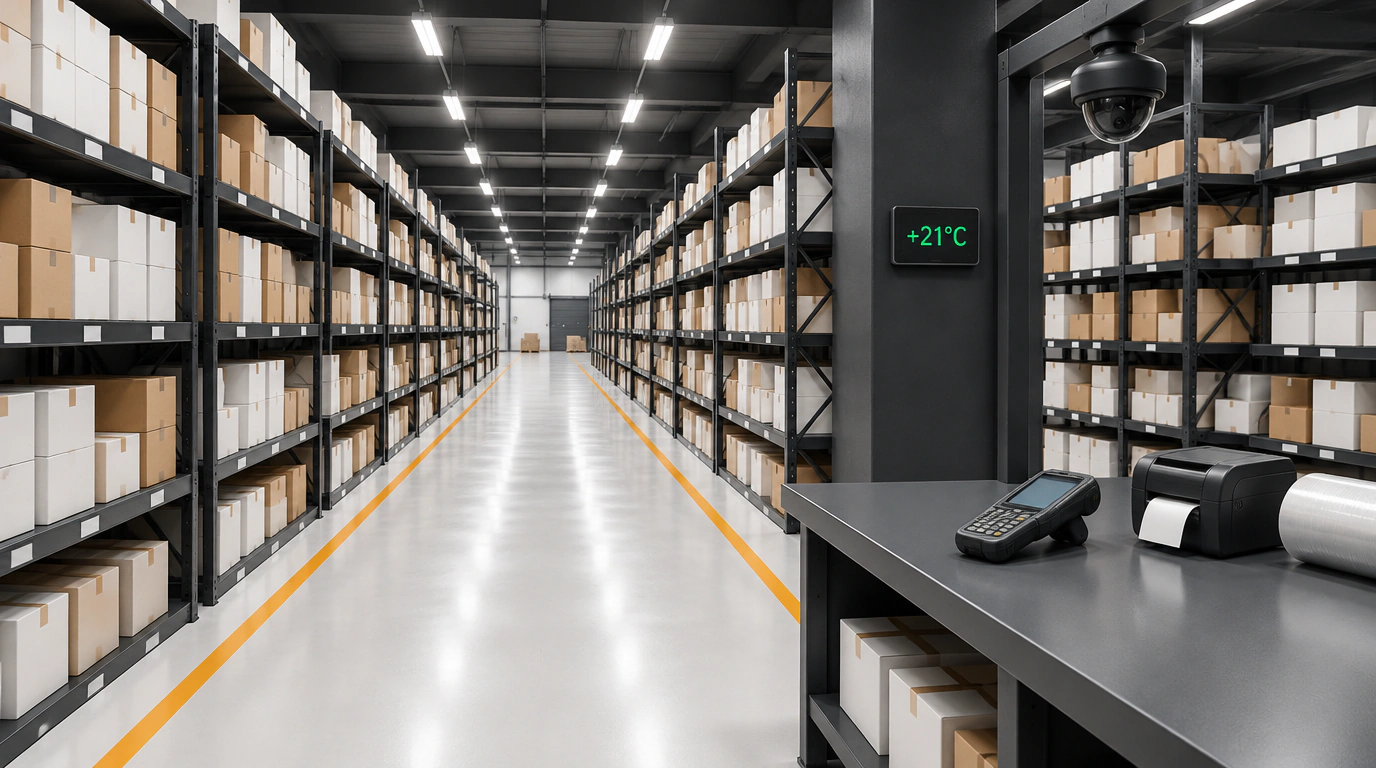
Every entrepreneur who has worked with Wildberries remembers the gold rush of opening partner pickup points (PVZs). Those who got into the PVZ program early locked down prime locations, collected generous platform subsidies, and paid back renovations in a matter of months. Today, the retail pickup market is tightly saturated, so the marketplace has opened an even bigger niche for outside operators: partner warehouse infrastructure.
Explosive GMV growth and chronic gridlock at central mega-hubs (Koledino, Elektrostal, Tula, Kazan) forced Wildberries down the road of total logistics decentralization. The platform invited independent entrepreneurs to take over the physical handling of seller shipments.
On the surface, the model looks phenomenal: you open a warehouse, scan other people's inventory with an industrial terminal, and the marketplace reliably pays you for every "beep." Speaking as an active seller who has seen the back room of dozens of fulfillment centers, I'll tell you straight: warehouse B2B leaves zero room for illusions. There's none of the laid-back rhythm of a retail pickup point here, and a single picker's mistake can wipe out an entire month's profit overnight. Let's take this mechanic apart piece by piece.
From Pickup Point to Full Warehouse: Why WB Opened Logistics to Partners
Inside Wildberries' official partner ecosystem today, two fundamentally different warehouse formats coexist:
- PPT (Goods Acceptance Point). This is a transit cross-docking terminal starting at 100 square meters. A PPT does not do piece-level picking or long-term storage. Its job is to quickly unload local sellers' Gazelle vans working on FBW (Fulfillment by Wildberries) or FBS (Fulfillment by Seller), scan the barcodes on incoming cargo units (boxes and pallets), sort them by destination, and reload them onto WB line-haul semi-trucks. On top of that, a PPT acts as the handoff point returning uncollected customer returns back to sellers. We covered how the network of partner goods acceptance points (PPT) evolved back during its pilot rollout.
- PFC (Partner Fulfillment Center). This is a full-cycle distribution and fulfillment hub. Sellers bring raw inventory here straight from wholesale markets, factories, or cargo forwarders. The partner executes the entire workflow:
- Piece-by-piece receiving with barcode verification and photo documentation of defects;
- Applying WB barcodes and Chestny ZNAK (mandatory digital product marking) DataMatrix labels;
- Individual packaging in poly sleeves, zip-lock bags, or shrink wrap;
- Addressable bin/rack placement mapped to the warehouse topology;
- Picking customer orders from WMS pick lists and packing them into shipping cartons.
For existing owners of PVZ networks, launching a PFC became the logical next step in expansion: they already know how to manage hourly floor staff, negotiate with landlords, and navigate the marketplace's software logic. Our earlier breakdown of Wildberries partner fulfillment centers (PFC) at launch confirmed strong market appetite, but the real-world unit economics demand razor-sharp precision.
Piece-Level Economics: Pay-Per-Scan, Value-Added Services, and Payback on 500 Square Meters
A PFC's financial model rests on two revenue streams: direct payouts from Wildberries and paid services billed to sellers.
The platform pays a fixed fee for every confirmed warehouse workflow step:
- Primary scan and registration of a unit barcode at unloading;
- Picking a unit from an addressable storage bin into an assembly tote;
- Packing, stickering, and final build of a shipping carton or pallet;
- Temporary custodial storage of unclaimed returns when a seller leaves rejected goods past the allowed pickup window.
Experienced operators, however, make the lion's share of their net profit on ancillary B2B services for sellers:
- Full pre-sale prep and Chestny ZNAK DataMatrix labeling (4 to 8 rubles per unit);
- Replacing damaged packaging and adding branded inserts (flyers, thank-you cards);
- Scheduled freight pickup from Moscow wholesale markets (Yuzhnye Vorota, Sadovod, Lyublino) using the warehouse's own fleet.
Let's look at the baseline numbers for a typical 500-square-meter PFC:
Upfront Capital Expenditures (CAPEX):
- Basic facility prep and dust-proofing concrete floors: 350,000 – 500,000 RUB.
- 2- to 3-tier shelving and pallet racking with bin labeling: 600,000 – 900,000 RUB.
- High-definition CCTV system (16–24 IP cameras with zero blind spots, NVR, network storage with a 30-day archive): 250,000 – 350,000 RUB.
- Industrial data collection terminals (Zebra or Urovo Android handheld scanners, 4–6 units): 180,000 – 250,000 RUB.
- Thermal label printers, packing tables, pallet jacks, consumables: 250,000 RUB.
- Total launch investment: 1.6 to 2.3 million rubles.
Monthly Operating Expenses (OPEX):
- Heated Class B/B+ warehouse lease (500 m² at 700–900 RUB/m²): 350,000 – 450,000 RUB.
- Utilities and electricity: 40,000 – 60,000 RUB.
- Payroll (shift supervisor and 4 warehouse pickers/packers across two shifts), including payroll taxes: 350,000 – 450,000 RUB.
- Stretch film, tape, corrugated boxes, thermal ribbon: 80,000 – 120,000 RUB.
- Total monthly burn: 820,000 – 1,080,000 rubles.
Break-even for a facility like this sits at 4,000 – 6,000 processed units per day. Once the warehouse reaches steady traffic of 8,000 – 10,000 operations a day backed by a pool of regular sellers, the owner's net profit runs 250,000 to 400,000 rubles per month.
Agreement Specs: Ceiling Height, Climate Control, and Zero-Blind-Spot Cameras
Wildberries' authorization rules for partner warehouses (published in the agreement appendix on pfc.wb.ru) set rigid technical requirements:
- Floor area and clearance. For a PFC, the hard floor is 500 square meters (PPT starts at 100 m²). Ceiling height must be at least 3.5–4 meters, with level, dust-free floors rated for a load capacity of at least 3–5 tons per square meter.
- Trucking access. The site must have convenient approach roads for 20-ton Euro-semis. A loading dock, dock leveler, or grade-level roll-up gate is mandatory for unobstructed mechanized unloading.
- Software and WMS. Zero paper trails. All operations run through Wildberries' proprietary mobile WMS app, downloaded directly from the partner portal at
pfc.wb.ru. Every worker logs in under an individual account, letting the marketplace track productivity and tie every single scan to a specific person down to the minute. - Video surveillance. This is sacred ground in a warehouse. Cameras must cover 100% of the floor: unloading bays, packing tables (angled straight down onto the packer's hands), every racking aisle, and the palletizing zone. Footage must be archived for at least 30 calendar days.
Under Clause 1.4 of Appendix No. 3 to the Wildberries partner agreement, a PFC warehouse must maintain a strict year-round temperature corridor: no lower than +17°C in winter and no higher than +25°C in summer. Unheated hangars are out of the question—heating and supply-exhaust ventilation must protect cosmetics, household chemicals, and electronics.
Hidden Traps: Shortages, Seasonal Floods, and Drone Insurance
If you think opening a PFC means sitting back at home watching payout charts climb, reality will bring you down to earth fast. Here are the main risks nobody mentions on promo webinars:
- Full financial liability for shortages and mis-sorts. A seller hands over inventory against a manifest. If a picker mixes up shoe sizes, forgets to pack a unit, or double-scans a phantom SKU, the marketplace deducts the lost item's value from the partner's balance at retail price minus platform commission. Ten lost pricey jackets or smartphones can erase a week's warehouse earnings.
- Seasonal tsunamis and SLA breaches. During November's 11.11 and Black Friday sales, incoming seller volume jumps 5–7x. If your warehouse falls behind on clearing boxes within the regulated intake hours, the marketplace fines the operator for missed receiving SLAs.
- Shrinkage and internal security. Small electronics and fragrances always tempt sticky-fingered floor staff. Strict access control with metal detectors and a ban on personal phones inside the work zone are non-negotiable.
- Physical destruction of stock. In today's climate, safeguarding hundreds of millions of rubles in third-party inventory is enormous stress. Fortunately, Wildberries launched a voluntary insurance program for sellers covering goods inside PFCs against fire, flooding, and drone attacks at roughly 0.01% per day of stock value, which dramatically cuts the warehouse owner's legal exposure in force majeure events.
Wildberries partner fulfillment is a full-blooded operational business where staff discipline, process automation, and down-to-the-kopeck unit economics per square meter decide everything.