Every November in e-commerce follows the exact same script: feeds flood with celebratory seller screenshots showing millions in GMV, and by December those same entrepreneurs are holding their heads in their hands tallying net cash losses. Singles' Day (11.11), Black Friday, and the New Year rush can generate a full year's revenue in a few weeks—or wipe out your balance in an instant if you sell on gut feel.
In October 2026, Yandex Market officially kicked off peak-season prep. The platform opened promo campaign applications, rolled out generous discount co-investment, and simultaneously ran a sweeping overhaul of its core fee schedule. On one hand, sellers got free FBY (Fulfillment by Yandex) storage through year-end. On the other, the marketplace rewrote logistics rate cards and sharply tightened return rules on FBS (Fulfillment by Seller).
Let's cut through the marketing noise, break down the platform's key changes, re-run the unit economics on a fast-moving SKU, and set up guardrails so you walk out of peak season with real profit instead of just churning working capital for free.
Peak Season Calendar: From Singles' Day to the New Year Marathon
For 2026, Yandex Market built a dense promo schedule that stitches autumn and winter campaigns into one continuous sales cascade:
- Main 11.11 Sale:
- Early application intake for the "Bestsellers" promo section opens on November 2;
- The active sale window runs for nearly two weeks—from November 5 to November 18 (the platform widened the usual window so sellers can squeeze maximum traffic out of the event).
- Black Friday:
- The main discount surge is set for November 29–30, with audience warm-up starting a week ahead of launch.
- New Year Marathon:
- A nonstop sequence of themed promos ("Gifts for Loved Ones," "New Year's Table," "Cozy Home") kicks off in early December and runs straight through New Year's Eve.
Past seasons show that during peak sale days, daily turnover in popular categories (electronics, home appliances, kids' goods, beauty, apparel) jumps 3–4x compared to a quiet September. Traffic pours in and add-to-cart rates soar, which is precisely where the biggest trap lies: selling a lot is not the same as selling profitably. We've already covered cascading discount strategies for sale season without sliding into margin-killing dumping, and on Yandex Market the new October rulebook adds extra twists.
October Tariff Shuffle: Zero FBY Storage vs. Paid FBS Returns
To take pressure off its own courier network and fill regional fulfillment centers before the rush hits, Yandex Market rolled out an aggressive incentive package:
- Free FBY storage through December 31, 2026. For all standard categories, storage fees at Market's central and regional warehouses (Sofyino, Tomilino, Saint Petersburg, Samara, Yekaterinburg, Rostov) are completely zeroed out. You can load deep stock on proven sellers without worrying that daily storage charges will eat your margin. Bulky/oversized goods (KGT) are excluded from the waiver. We covered the earlier Yandex Market tariff and storage reform, and those terms are now locked in for the entire peak season.
- FBY/FBS commission parity and removal of the fast-dispatch discount. Previously, FBS sellers (shipping from their own warehouse) received a 4–7 percentage point commission discount for handing parcels over within 28–36 hours. In October, Market completely abolished that discount and equalized base commissions:
- Beauty and personal care: 9% (with a base subscription);
- Kids' goods: 9%;
- Home improvement and construction: 12%;
- Apparel and footwear: 14%. As a result, FBY became the clear winner: the commission rate is identical, storage is free, and faster delivery from Market's warehouse gives listings a strong search boost.
- 42% all-in bundled rate for low-ticket items. For small goods priced up to 300 rubles and under 5 liters in volume, Yandex Market introduced a single flat rate of roughly 42% that bundles the entire chain—commission, handling, delivery, and returns.
- Tougher FBS return rules. Market sharply cut the free holding period for unclaimed parcels at transit sorting centers and pickup points. If a seller fails to retrieve a refused item starting on day two, progressive daily storage fees kick in—and once the limit expires, the item goes to paid disposal.
The "Bestsellers" Program: How Co-Investment Works and Where the Trap Hides
The main sales engine for 11.11 is the Bestsellers program:
You go into your seller dashboard and agree to offer a 7–10% discount off the item's 30-day median price. Yandex Market stacks its own co-investment (subsidy) from its marketing budget on top of that. Shoppers see an eye-catching 20–25% discount tag, while your settlement account receives the full amount: the buyer's payment plus a direct cash top-up from Market.
Listings carrying the "Bestseller" badge get massive visibility:
- A dedicated sale badge in catalog grids;
- An automatic organic search lift of 15–30 positions;
- Placement on the Market app's home storefront, holiday push notifications, and email blasts to millions of Yandex Plus subscribers.
Yandex Market's dashboard runs an aggressive auto-enrollment algorithm for promos. If you haven't set the 'Minimum Product Price' field on each SKU in advance, the platform can automatically stack a campaign discount on top of an active sales boost or store coupon. Combined discounts will drag your price below landed cost. Set your floor price on every listing right now.
Unit Economics Audit: Step-by-Step Margin Math and Floor-Price Protection
Let's walk through a real unit-economics calculation on a concrete SKU: wireless TWS earbuds.
Baseline inputs:
- Regular retail price before the sale: 2,000 RUB.
- Supplier purchase cost (COGS): 800 RUB.
- Entering the 11.11 promo: you cut the price by 10% (to 1,800 RUB), Market adds a 10% co-investment (the shopper pays 1,600 RUB, Market reimburses the 200 RUB difference). Your gross revenue: 1,800 RUB.
- Base commission for Electronics (10%): 180 RUB.
- FBY logistics (warehouse handling + delivery, storage 0 RUB): 140 RUB.
- Sales-boost ad spend (5%): 90 RUB.
- Simplified Tax System (USN) at 6% on 1,800 RUB revenue: 108 RUB.
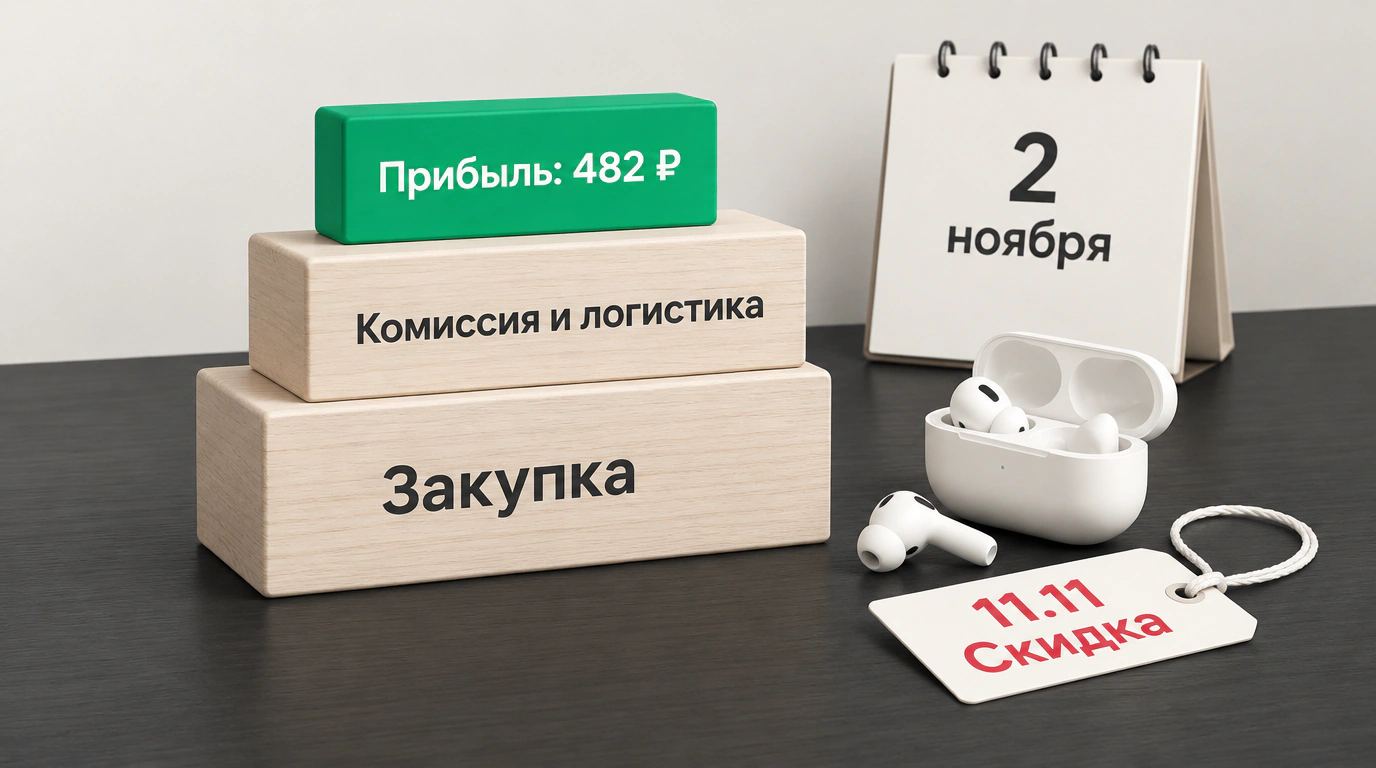
Net profit per unit:1,800 RUB (revenue) − 800 RUB (COGS) − 180 RUB (commission) − 140 RUB (logistics) − 90 RUB (ad boost) − 108 RUB (tax) = 482 RUB net profit.
That's a healthy 26.7% net margin.
Now imagine leaving that exact same SKU on FBS. With the fast-dispatch discount gone, out-of-pocket packing costs, and an average 8% non-pickup rate, net profit on the same earbuds drops to 340–360 rubles. Across a 1,000-unit batch, the gap between fulfillment models exceeds 120,000 rubles in net profit in favor of FBY.
Pre-sale prep checklist before November 2:
- Split your assortment by velocity: ship flagship SKUs with proven demand into FBY before October ends to lock in zero storage fees.
- Lock in minimum prices: block the dashboard from dropping any SKU below break-even when promos trigger automatically.
- Set up an FBS return-pickup routine: if part of your catalog stays in your own warehouse, assign a dedicated courier to clear refused parcels from pickup points daily so penalty storage never catches you off guard.
Peak season generously rewards disciplined operators. Count your margin down to the kopeck, use free FBY storage while it lasts, and meet the November order surge knowing your bottom line is protected.